


play_arrow
Listeners:
Top listeners:
00:00
00:00
volume_up
chevron_left
-
 play_arrow
Paul Verschure on consciousness and distributed adaptive control CSN Podcasts
-
 play_arrow
Edvard Moser on grid cells and entorhinal cortex CSN Podcasts
-
 play_arrow
Giacomo Rizzolatti on mirror neurons and action understanding CSN Podcasts
-
 play_arrow
Robert Axelrod on game theory and prisoner's dilemma CSN Podcasts
-
 play_arrow
Adrian Owen on disorders of consciousness and vegetative state CSN Podcasts
-
 play_arrow
Jonathan Whitlock on markerless motion capture and posterior parietal cortex CSN Podcasts
-
 play_arrow
Luis Puelles on neuroanatomy and prosomeric model CSN Podcasts
-
 play_arrow
Zoltan Molnar on subplate neurons and cortical development CSN Podcasts

- arrow_back Home
- keyboard_arrow_right Podcast
- keyboard_arrow_right Season 2021
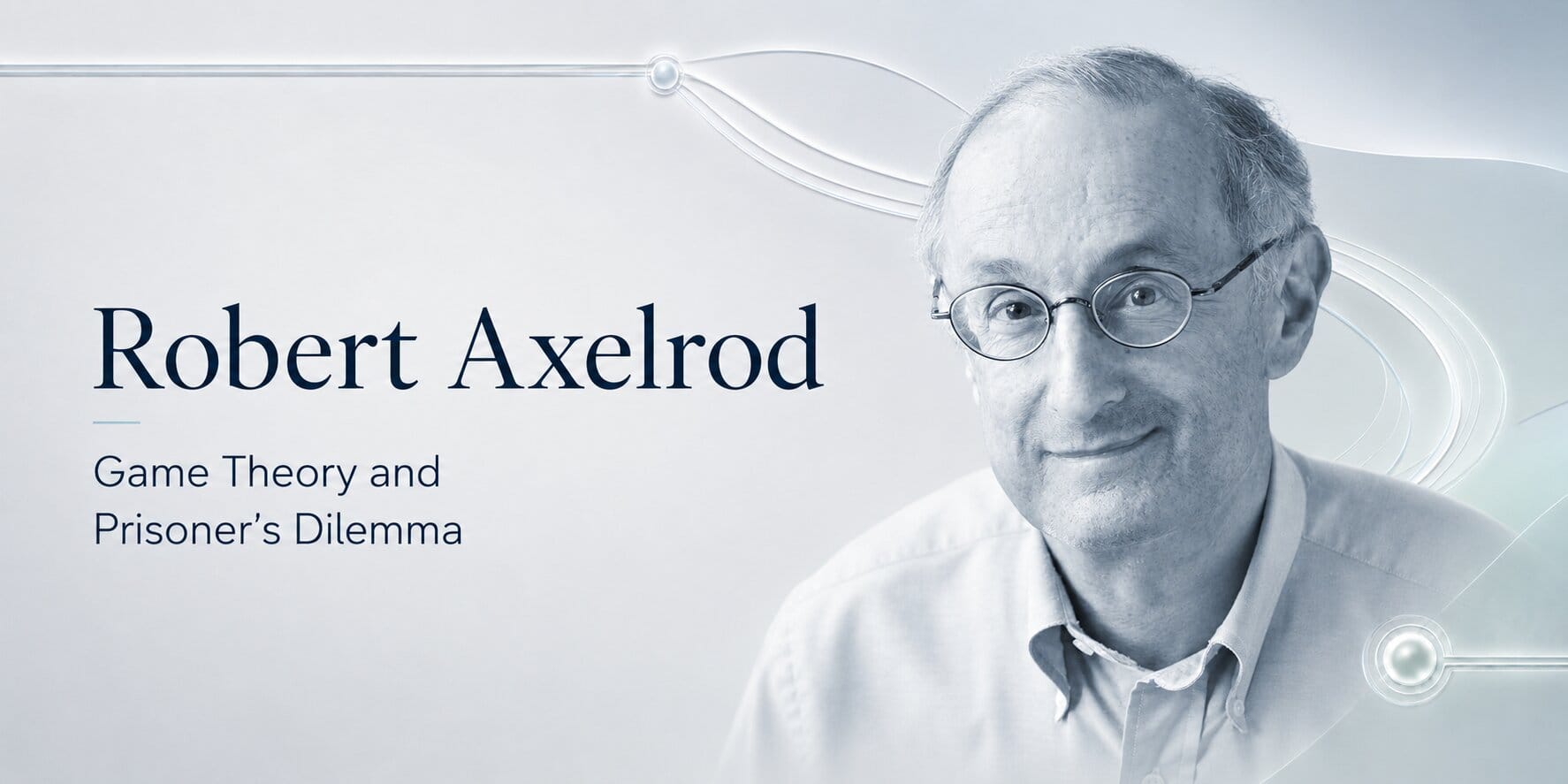
Robert Axelrod on game theory and prisoner’s dilemma
Episode 9 30.03.2021
-
play_arrow
PLAY EPISODE
Description arrow_drop_down

Description
What do cancer cells, cyber warfare, and the prisoner’s dilemma have in common? They all reveal how collaboration really works , and why it breaks down. Listen to political scientist Robert Axelrod explain the hidden architecture of cooperation, from tumor biology to international security. Subscribe and follow for more from this series on real-world collaboration. Robert Axelrod, one of the most influential thinkers on cooperation and game theory, joins Paul Verschure, Jenna Bednar, and Andreas Roepstorff for a wide-ranging conversation that moves from evolutionary biology to geopolitics with remarkable coherence. Axelrod draws on decades of interdisciplinary work to unpack what collaboration actually requires , and where our instincts betray us. The conversation opens with a deceptively simple distinction: cooperation is broad, but collaboration demands specialization, a common product, and mutual dependence. Axelrod illustrates this through his own research on cancer, where genetically distinct cell lines cooperate within a tumor , one disabling the immune system, another promoting blood supply , without any rational intent. This biological collaboration mirrors human teamwork in structure, even without consciousness or goals. From there, the discussion moves into game theory territory. Axelrod explains how the prisoner’s dilemma operates inside collaborations: each participant is tempted to shirk, but mutual effort produces the best outcome. The key insight is that collaboration does not require shared goals, complete information, or even rationality , it requires an appreciation that your choices affect the other side and theirs affect you. The most striking segment addresses the psychology of vengeance and its role in derailing cooperation at scale. Using Pearl Harbor and 9/11 as case studies, Axelrod shows how emotional responses can override rational calculation at both individual and national levels , and why understanding this dynamic is critical for avoiding escalation in domains like cyber conflict. Trust emerges as the essential infrastructure. Axelrod introduces his concept of “the shadow of the future”: collaboration sustains itself when both parties believe the relationship will continue and the future is worth investing in. Without that temporal horizon, trust collapses and so does cooperation. On the architecture of collaboration, Axelrod identifies key variables: whether goals are externally imposed or internally negotiated, the degree of specialization between participants, and the communication structures that allow mutual understanding across disciplinary boundaries. His collaboration with evolutionary biologist William Hamilton exemplifies this , one knew about beetles, the other about war, and neither could have produced the work alone. The conversation closes with Axelrod’s surprising answer to what he would change about humans to improve collaboration: nothing. The side effects of any modification are too unpredictable. Instead, he points to sustainable collaboration already functioning at global scale, the U.S. dollar as a universal medium of exchange, while acknowledging that climate change represents the hardest test of cooperative capacity humanity has ever faced. Part of the Ernst Strüngmann Forum series on Collaboration, produced with the Convergent Science Network.
Tagged as:
collaboration game theory Prisoner Dilemma
About the author call_made
CSN Podcasts
Both the triumphs of humanity and its most evil deeds have resulted from collaboration. In a time where humanity is required to aspire to the former and minimize the latter, the question arises of how collaboration arises and why it fails. Surprisingly, this phenomenon, so central to who we are, is not well understood. Hence, a collaborative effort is required to understand collaboration in its full biological, psychological, sociological, cultural, and economic complexity and to translate this understanding into operational impact. This series of podcasts is one step toward achieving these complementary goals. The Collaboration Podcast presents interviews with people who are central orchestrators of collaboration in various domains including business, government, science, art, health, sustainability, and the military. The discussions were conducted by Prof. Dr. Paul F.M.J. Verschure and members of the Program Advisory Committee of the Ernst Strungmann Forum on Collaboration (https://www.esforum.de/forums/ESF32_Collaboration.html) during 2021 and had the goal to sketch a map of opportunities, challenges, and obstacles in human collaboration. The forum took place in May 2022, and now we would like to share this series of interviews with a broader audience. The full report of the Forum will be published in 2023 by MIT Press. The podcast was produced by the Convergent Science Network (https://www.convergentsciencenetwork.org/). Context: The stability of social systems depends critically on realizing sustainable methods of “collaboration,” yet how and by which means collaboration is achieved is not clearly understood; neither are the conditions or processes that lead to its breakdown or failure. Collaboration can be understood as cooperation between agents toward mutually constructed goals. Part of the reason for our lack of understanding is that the phenomenon of collaboration is, by nature, a highly multidisciplinary problem, and effective research into its complexities has been difficult to achieve across the broad range of scientific and technical disciplines involved. The need for a fundamental understanding of collaboration, however, has become increasingly important. Not only does humankind demand answers as it attempts to address critical challenges at multiple scales (e.g., climate change, migration, enhanced automation, social and economic inequality), but ever-increasing technological and economic means of interconnecting people and societies are disrupting long-established, familiar patterns of how we interact. Radical technological changes that are ongoing have the potential to reshape collaboration in ways that are currently hard to predict or influence (e.g., by altering configurations in interaction, information creation, and modes of communication). On one hand, such changes could disrupt hitherto stable forms of collaboration by affecting critical communication channels and traditional roles, as can be observed in the rapidly changing patterns in governance, commerce, and social interaction. Conversely, technology could lead to the emergence of novel, successful forms of collaboration that deviate from traditional “hierarchical” architectures. Evidence of this can be seen in areas as diverse as highly automated manufacturing plants, the open science movement, collaborative software repositories, user-centered services, and the sharing of economy-based modes of organization. Without a fundamental understanding of the mechanisms, processes, and boundary conditions of collaboration, it is not possible to evaluate or predict which of these possible scenarios are sustainable or even plausible. The Forum “How Collaboration Arises and Why it Fails” (May 8–13, 2022, Location: Frankfurt am Main, Germany) Chairs: Andreas Roepstorff and Paul Verschure Program Advisory Committee: Jenna Bednar, Julia R. Lupp, Bhavani R. Rao , Andreas Roepstorff, Ferdinand von Siemens, and Paul Verschure
Episodes

play_arrow

play_arrow

play_arrow

play_arrow
Timestamp
- fast_forward00:00:04 - Hi, I'm Paul Verschuren today with my colleagues Jenna Bednar and Andreas Rupstorf.
- fast_forward00:00:09 - We're speaking with Robert Axelrod about the foundations of collaboration.
- fast_forward00:00:15 - Professor Robert Axelrod is a political scientist and the William D.
- fast_forward00:00:18 - Hamilton Distinguished University Professor Emeritus at the University of Michigan.
- fast_forward00:00:23 - Robert has been the author of many scientific articles and especially the 1981
- fast_forward00:00:28 - paper The Evolution of Cooperation, co-authored with Bill Hamilton,
- fast_forward00:00:32 - is considered a classic in the field.
- fast_forward00:00:35 - This is the Convergent Science and Instrument Forum podcast on collaboration.
- fast_forward00:00:41 - And today, me, Paul Verzsior, with my colleagues Jenna Bettner and Andreas Rupstorf
- fast_forward00:00:47 - are talking with Robert Axelrod on the topic of collaboration.
- fast_forward00:00:51 - So welcome, Robert. Thank you. Welcome. Thanks for inviting me.
- fast_forward00:00:56 - So, Robert, just to start off.
- fast_forward00:01:00 - Could you give us a short description of your professional trajectory to give
- fast_forward00:01:06 - us a bit of a sense where you're coming from and where you are now and all the
- fast_forward00:01:10 - steps in between that matter to our conversation?
- fast_forward00:01:14 - Sure. Well, I'm a political scientist who has long been interested in international
- fast_forward00:01:20 - security affairs and often use agent-based modeling and game theory to study
- fast_forward00:01:30 - and analyze such situations.
- fast_forward00:01:34 - I've also been interested in evolutionary biology and I've used some evolutionary
- fast_forward00:01:39 - concepts in my political science work.
- fast_forward00:01:42 - Work um my i'm at the university of michigan uh i've recently retired but i'm
- fast_forward00:01:50 - still active um uh my two major i had many collaborations uh,
- fast_forward00:01:59 - one was an evolutionary biologist william hamilton and more recently was an
- fast_forward00:02:05 - oncologist at cancer expert Kenneth Fienta. We can talk about those or others.
- fast_forward00:02:11 - Would you like more elaboration on my career?
- fast_forward00:02:15 - No, look, whatever you feel is relevant as an introduction. So it's really up to you.
- fast_forward00:02:20 - I'm not going to sway you one way or the other. But if you think that's enough
- fast_forward00:02:24 - as a start, then we're ready to go.
- fast_forward00:02:26 - So the topic is collaboration.
- fast_forward00:02:32 - So what is it and what is it good for?
- fast_forward00:02:37 - Well, in an academic setting where I am,
- fast_forward00:02:41 - collaboration often takes the form of two or more scholars or students working
- fast_forward00:02:48 - on a single project with the hope that they can do something that none of them could have done alone.
- fast_forward00:02:56 - And in many cases in my career,
- fast_forward00:03:02 - there have been interdisciplinary collaborations, I mean political scientists
- fast_forward00:03:06 - who worked with somebody from outside political scientists or even outside of social sciences.
- fast_forward00:03:14 - But in some sense, you now give an example of where it occurs,
- fast_forward00:03:19 - but in some sense the question would now be what are really the defining features?
- fast_forward00:03:23 - What makes something a collaboration?
- fast_forward00:03:28 - I think the basic defining feature is two or more people working on the same
- fast_forward00:03:34 - problem with mutual support, as opposed to completely independently sewing it together at the end.
- fast_forward00:03:44 - But then you could argue that, okay, we have cooperative systems and collaborative
- fast_forward00:03:49 - systems, so why don't we just give them one label?
- fast_forward00:03:52 - Because there in all cases we have agents doing things together right so it
- fast_forward00:03:57 - seems that there are more nuances here at work so what would these be well I
- fast_forward00:04:02 - think collaborative efforts um.
- fast_forward00:04:08 - Tend to be cooperative so i think collaboration is a subset uh but it is um,
- fast_forward00:04:16 - exploiting the differences between the participants uh the different things
- fast_forward00:04:22 - they bring to it the diversity uh they of talents and background and perspectives and goals,
- fast_forward00:04:29 - uh whereas cooperation where it's cooperation could be for example it's just
- fast_forward00:04:33 - uh i trade something with you and you give me money.
- fast_forward00:04:36 - And so cooperation is a much broader term.
- fast_forward00:04:41 - And certainly, we usually think of collaboration as necessarily human,
- fast_forward00:04:48 - although you could say that ants collaborate as well.
- fast_forward00:04:53 - But now, would that difference be, let's say that there's in the collaboration
- fast_forward00:04:59 - case, an explicitly defined goal in a corporation case, there's some happenstance
- fast_forward00:05:05 - interaction of exchange.
- fast_forward00:05:07 - Is that what you're going to? Yeah, collaboration typically involves,
- fast_forward00:05:13 - as I've said, a common purpose and the development of a common product,
- fast_forward00:05:18 - something that they achieve together.
- fast_forward00:05:20 - And it also typically involves some specialization, people having different
- fast_forward00:05:26 - things that they bring to the team.
- fast_forward00:05:30 - With your background, also, as you said earlier, your interest in evolutionary
- fast_forward00:05:34 - biology and your identity as a political scientist,
- fast_forward00:05:39 - do you then also see continuity here in this process of collaboration across
- fast_forward00:05:46 - different kinds of biological systems?
- fast_forward00:05:48 - Systems from let's say in case
- fast_forward00:05:52 - your cancer example cells interacting together differentiating in specific ways
- fast_forward00:05:57 - to interacting conscious and intentional agents like humans do you see a continuum
- fast_forward00:06:03 - there is that also what you what you are pointing to here yes uh well i'll give you an example um.
- fast_forward00:06:13 - And cancer involves cells, lines, developing the ability to overcome about seven
- fast_forward00:06:24 - or eight defenses that the host has to keep the cells in line.
- fast_forward00:06:29 - And the convention of wisdom was that one cell line based on a lot of mutations
- fast_forward00:06:35 - would develop these abilities to overcome all those defenses.
- fast_forward00:06:40 - I came up with an analogy much later, which goes like this.
- fast_forward00:06:47 - Imagine two thieves trying to rob a house.
- fast_forward00:06:51 - If one of them can pick the lock and the other one could turn off their wire,
- fast_forward00:06:55 - but they don't both have to have all the capacity to overcome the defenses.
- fast_forward00:07:00 - So that's a case of collaboration. It's also an example of cooperation.
- fast_forward00:07:05 - So I worked with a geneticist and an oncologist to develop this concept,
- fast_forward00:07:13 - see if it was even feasible.
- fast_forward00:07:18 - Later, it's been found to be valid in lab experiments. It actually happened.
- fast_forward00:07:25 - So that's collaboration within a tumor.
- fast_forward00:07:29 - In addition, you might say the same example can be used to study collaboration.
- fast_forward00:07:44 - I seem to have lost my picture here for some reason. I didn't lose your picture.
- fast_forward00:07:50 - But would you then say that collaboration defined in this way,
- fast_forward00:07:57 - also with the cancer example would fit in
- fast_forward00:08:00 - this broader category of an emergent phenomenon of
- fast_forward00:08:03 - sort of interacting elements that create
- fast_forward00:08:07 - a higher level structure yes absolutely but i was also going to add that that
- fast_forward00:08:16 - same example of tumors is a collaboration between uh three scientists uh bringing
- fast_forward00:08:25 - different things to the table.
- fast_forward00:08:27 - And so there's collaboration within the tumor and there's collaboration within
- fast_forward00:08:31 - the academic study of studying that.
- fast_forward00:08:35 - But sure, no, I understand that Nosara discussion in that sense is collaborative.
- fast_forward00:08:42 - But in some sense, if you now bring it to this underlying issue of the commons,
- fast_forward00:08:47 - right, that is supposedly playing a structuring role in human collaboration,
- fast_forward00:08:53 - what will be the commons in the case of cancer?
- fast_forward00:08:57 - Well, the cancer case, the...
- fast_forward00:09:01 - You might say the common evolutionary path of the cells in the tumor are to
- fast_forward00:09:08 - multiply and increase as they are in every biological system.
- fast_forward00:09:14 - Some of these cells can be evoking something called VEGF, which encourages capillaries,
- fast_forward00:09:25 - which encourages blood supply, which encourages oxygen.
- fast_forward00:09:28 - So one of them might be promoting oxygen in the immediate area,
- fast_forward00:09:33 - and the other one might be promoting some other nutrient.
- fast_forward00:09:39 - And so the common purpose, I mean, there's no common purpose defined by the
- fast_forward00:09:45 - evolutionary process itself,
- fast_forward00:09:47 - but the result could be at the emergent property of a malignant tumor.
- fast_forward00:09:54 - In the case of typically human collaboration, there's often a specific goal
- fast_forward00:10:02 - that either has been handed to them as team members or they develop themselves.
- fast_forward00:10:08 - But notice that the goals of the humans could be quite different.
- fast_forward00:10:12 - One of them might be after fame and getting credit and promotion in the organization.
- fast_forward00:10:19 - The other one might be an attempt to try to solve a problem and care more about
- fast_forward00:10:25 - the problem than their personal credit.
- fast_forward00:10:27 - So collaboration doesn't necessarily require complete agreement on the goals.
- fast_forward00:10:38 - Yeah, we've been active in the chat, Bob, because this is raising a lot of super
- fast_forward00:10:44 - interesting questions for us.
- fast_forward00:10:46 - So there's a couple of C words for, I think, that we're throwing around here.
- fast_forward00:10:54 - We're talking about cooperation, collaboration, the commons, right?
- fast_forward00:11:03 - But we can also talk about collusion, right?
- fast_forward00:11:07 - And the existence, I guess, of club goods, excludable goods.
- fast_forward00:11:10 - So when we're talking about a common interest or common purpose,
- fast_forward00:11:14 - I'm wondering to what extent, and it's interesting that we're talking about two different systems.
- fast_forward00:11:19 - The human system where there's rational forethought and then this biological
- fast_forward00:11:26 - system where there isn't.
- fast_forward00:11:29 - And so we're talking about whether there needs to be completely overlapping
- fast_forward00:11:38 - common goals or whether there can be some differentiation in that.
- fast_forward00:11:43 - And then also at the level of when we're talking about cancer cells.
- fast_forward00:11:49 - If the cancer cells are successful, they're actually going to kill the host,
- fast_forward00:11:55 - which is going to lead to their own death.
- fast_forward00:11:58 - So that's an interesting thing to unpack.
- fast_forward00:12:02 - And at the human level, an interesting thing to unpack is to the extent that
- fast_forward00:12:07 - this interest is held in common across all members of the group and includes
- fast_forward00:12:16 - also benefits to those outside of the group.
- fast_forward00:12:19 - So that's a lot of threads that I've just thrown out to you,
- fast_forward00:12:22 - but just because this is already a quite rich conversation.
- fast_forward00:12:25 - So any of that that you want to pick up on, and I'm sure that my colleagues
- fast_forward00:12:30 - will follow up on any piece that we want to continue with.
- fast_forward00:12:35 - We've already talked a little bit about the first three. On collusion,
- fast_forward00:12:38 - I see collusion as cooperation in the service of exploiting others.
- fast_forward00:12:43 - An example would be two major companies work together to set high prices.
- fast_forward00:12:51 - And so it's what we call a restraint of trade.
- fast_forward00:12:55 - And so that kind of business collusion is done often in secret so that the outsiders
- fast_forward00:13:04 - who are being disadvantaged don't even necessarily know the collusion is happening.
- fast_forward00:13:10 - But is that what the cancer cells are doing then?
- fast_forward00:13:13 - It's exploitation of others. Yes.
- fast_forward00:13:25 - Okay and of course as you said I can't fortunately cancer,
- fast_forward00:13:31 - evolutionary process as you said is a dead end mm-hmm mm-hmm and that's the
- fast_forward00:13:37 - tragedy of the commons for the cancer cells right yeah exactly so they're destroying
- fast_forward00:13:41 - the host that nurtures them,
- fast_forward00:13:45 - the better they do the more likely they're going to kill everything,
- fast_forward00:13:50 - that's well kill their environment fortunately it's not infectious so they don't
- fast_forward00:13:53 - kill others humans But they kill themselves.
- fast_forward00:13:56 - That's right. Yes, that's right. So it reminds me a little bit of climate change. Yes.
- fast_forward00:14:04 - Andreas, you wanted to step in. Yes. So, Bob, I would like to return to your
- fast_forward00:14:10 - article, Achieving Cooperation Under Anarchy, Strategies and Institutions from, I think, 1985, right?
- fast_forward00:14:17 - Which really sets kind of the
- fast_forward00:14:19 - ground for a lot of current thinking about collaboration and cooperation.
- fast_forward00:14:23 - And in that one, you were really using the powers of game theory as a way to
- fast_forward00:14:29 - outline the kind of dilemmas that one might end up in.
- fast_forward00:14:33 - Could you maybe start by telling a little bit about what would be the difference
- fast_forward00:14:38 - between being in a stack hunt or being in a prisoner's dilemma or in another
- fast_forward00:14:43 - of these situations when you are mutually trying to collaborate with each other?
- fast_forward00:14:53 - Well collaboration itself could be a prisoner's dilemma it could be that two
- fast_forward00:14:57 - members of the team each have an incentive to shirk that is to say let the other guy do all the work,
- fast_forward00:15:04 - but if they both shirk of course then the collaboration doesn't accomplish anything,
- fast_forward00:15:09 - and whereas um if they're in a if the collaboration goes on for some time uh
- fast_forward00:15:17 - each Either party might say to the other,
- fast_forward00:15:20 - well, if you shirk, I'll shirk, but if you're willing to give your contribution,
- fast_forward00:15:25 - I'll make a contribution too.
- fast_forward00:15:28 - We can even play tit for tat, which is to say, I'll start by giving some effort to this collaboration.
- fast_forward00:15:37 - Then if you cooperate by giving effort as well, then I'll continue so.
- fast_forward00:15:42 - But if you start shirking and not giving any effort, then I'll stop too,
- fast_forward00:15:49 - and then you'll realize that that was a losing proposition for both of us.
- fast_forward00:15:55 - So even within a collaboration, you can have a prisoner's dilemma between the participants.
- fast_forward00:16:05 - But I guess what this suggests is that the understanding of the situation is
- fast_forward00:16:10 - a critical part of a collaboration, right?
- fast_forward00:16:13 - Or the mutual understanding of the situation is a critical part of the collaboration.
- fast_forward00:16:18 - Well, they can have quite different conceptions of what it's about and what their goals are.
- fast_forward00:16:27 - They do have to appreciate, however, that the process is interactive.
- fast_forward00:16:37 - What I do and what you do jointly determine the payoffs to both of us.
- fast_forward00:16:42 - They have to at least understand that, so that when the other side...
- fast_forward00:16:51 - If you stop making effort, you come to realize that the other side might stop
- fast_forward00:16:59 - too, and that's better than both of you working.
- fast_forward00:17:03 - But you could have quite different understandings of the situation.
- fast_forward00:17:06 - For example, as I said, you might have different goals and you might have different
- fast_forward00:17:10 - understandings of what resources are available to the collaborators.
- fast_forward00:17:13 - You might have different understandings
- fast_forward00:17:14 - of who your audience is and what you're trying to accomplish.
- fast_forward00:17:18 - For example, in many organizations, two members of the same team might report
- fast_forward00:17:23 - to different bosses, and each one of them has the goal of satisfying their own boss.
- fast_forward00:17:33 - And so they don't necessarily have
- fast_forward00:17:35 - to have the same goals or even the same understanding of the situation.
- fast_forward00:17:40 - They have this minimal need to appreciate that if they don't cooperate,
- fast_forward00:17:50 - the other side probably won't either.
- fast_forward00:17:54 - And of course, critical to the game's theoretical approaches is the identification
- fast_forward00:17:59 - of a payoff matrix, right?
- fast_forward00:18:01 - But in a lot of kind of, I guess, real life situations, the payoff matrix is
- fast_forward00:18:06 - not quite so clear cut. There is a lot of uncertainty with it.
- fast_forward00:18:10 - And can you say anything about from your kind of perspective,
- fast_forward00:18:14 - what do you do or what sustains collaboration then in situations where the payoff
- fast_forward00:18:20 - matrix might be unknown?
- fast_forward00:18:25 - Well, typically, it might have a certain amount of uncertainty and error and
- fast_forward00:18:30 - noise in judging it, but it's rarely completely unknown.
- fast_forward00:18:35 - If it's completely unknown, then you'd have no reason to collaborate because
- fast_forward00:18:39 - you don't know whether to do anything or not.
- fast_forward00:18:40 - Um so i
- fast_forward00:18:44 - i i accept that uh some uh
- fast_forward00:18:47 - uncertainty about exactly what it is is common and and some notion even of whether
- fast_forward00:18:52 - the other guy cooperated recently uh you're never sometimes you've never been
- fast_forward00:18:57 - sure of that um so there could be misperception and noise um but there has to be,
- fast_forward00:19:07 - some understanding that your choices affect the other side and their choices affect yours.
- fast_forward00:19:13 - And just for the example for the prisoner's dilemma, you just have to have an
- fast_forward00:19:17 - understanding that you're the right order of the payoffs.
- fast_forward00:19:22 - So you have to have, in a prisoner's dilemma, what defining feature is that.
- fast_forward00:19:28 - The best payoff for you is if you shirk and the other guy does all the work.
- fast_forward00:19:33 - The next best is if both of you work, and the next best is if neither of you
- fast_forward00:19:39 - work, and the worst is if you do all the work and the other guy shirks.
- fast_forward00:19:44 - And so that's all that you really need for the prisoner's dilemma is just an
- fast_forward00:19:49 - understanding of the order of those possibilities,
- fast_forward00:19:51 - which is pretty common, namely that you do better by shirking,
- fast_forward00:19:57 - but you both do better by cooperating.
- fast_forward00:20:01 - Now, Bob, do you feel that these kinds of models from game theory alike we now
- fast_forward00:20:06 - describe in the person's dilemma are still valid?
- fast_forward00:20:09 - I mean, they also have been criticized in caricatures, if you want,
- fast_forward00:20:13 - of human decision-making.
- fast_forward00:20:15 - Herb Simon already started with this, right, with this whole notion of bounded rationality.
- fast_forward00:20:19 - There's also more and more evidence that humans are not optimizers always.
- fast_forward00:20:23 - We don't optimize really for outcome.
- fast_forward00:20:25 - We might have surprising deviations from that. So do you feel that that's still
- fast_forward00:20:30 - an effective model to look at the kinds of collaboration that we would like
- fast_forward00:20:36 - to optimize in everyday life and in our world?
- fast_forward00:20:39 - Well, traditional game theory and how it began does assume rational actors who
- fast_forward00:20:44 - have the ability to do foresightful analysis, look ahead, if I do this,
- fast_forward00:20:49 - you do that sort of thing.
- fast_forward00:20:51 - So that's true but evolutionary game
- fast_forward00:20:55 - theory has been able to drop the assumption of rationality
- fast_forward00:20:58 - so for example these cancer cells are not rational they don't look ahead they
- fast_forward00:21:04 - don't do any calculation um but uh but they can still cooperate from an evolutionary
- fast_forward00:21:11 - perspective which is to say what because whatever works well means that they reproduce more.
- fast_forward00:21:17 - And so the prisoners of land, for example, and game theory in general,
- fast_forward00:21:23 - no longer require rationality. It's sometimes a useful assumption in order to make predictions.
- fast_forward00:21:33 - And sometimes the predictions are wrong if the players aren't rational.
- fast_forward00:21:41 - But there's a downside to that, right? Because then we sacrifice the goal-directedness,
- fast_forward00:21:46 - the coordination of human agents in collaborative contexts.
- fast_forward00:21:52 - And we are back into a more behaviorist perspective on how human behavior comes
- fast_forward00:21:57 - about, which also has not been a complete success story.
- fast_forward00:22:02 - So there is a price you then pay if you bring it into this pure evolutionary,
- fast_forward00:22:08 - non-rational perspective.
- fast_forward00:22:11 - Or do you feel that's just a necessary step? Well, for humans,
- fast_forward00:22:15 - another version of evolutionary, another aspect that's not rational is trial and error learning,
- fast_forward00:22:21 - where you don't necessarily look ahead, but you experience whether you're doing
- fast_forward00:22:25 - well or not, and you change behavior if you're not doing well.
- fast_forward00:22:28 - So trial and error learning is another form of adaptation that humans can do, and of course always do,
- fast_forward00:22:37 - that's different from rationality, but it's often a very effective thing.
- fast_forward00:22:46 - Go ahead, Jenna. Sorry. Oh, no, thank you.
- fast_forward00:23:18 - You know, we can have biases, we have fears, et cetera.
- fast_forward00:23:22 - And so, you know, what role does that play? To what extent could we incorporate
- fast_forward00:23:27 - that into our game theoretic analyses successfully, make it work for us,
- fast_forward00:23:33 - not against us, as we're trying to understand human collaboration?
- fast_forward00:23:39 - But let me give you a specific example.
- fast_forward00:23:46 - Last week, I was, no, three weeks ago, I was talking to Chinese and Russian
- fast_forward00:23:53 - academics and think tank type people,
- fast_forward00:23:59 - an ongoing discussion of cyber conflict and how to avoid instability.
- fast_forward00:24:04 - Stability and the uh
- fast_forward00:24:07 - point of what i said was beware of
- fast_forward00:24:11 - vengeance so this is one of the psychological features of humans that jenna
- fast_forward00:24:16 - was talking about which is uh when we feel insulted or exploited or disgraced
- fast_forward00:24:23 - or punished without reason uh we often have a very powerful psychological need for vengeance,
- fast_forward00:24:31 - which often then we act on without much regard to the costs and benefits.
- fast_forward00:24:37 - We sort of put all that future-oriented thinking ahead and say,
- fast_forward00:24:40 - well, vengeance really feels good. I need to do it.
- fast_forward00:24:44 - And that's very dangerous.
- fast_forward00:24:47 - And if you're in a realm like cyber conflict where cyber weapons are used at
- fast_forward00:24:51 - scale, there's a lot of possibilities that people will feel the need for vengeance if attacked.
- fast_forward00:24:59 - And the implication, of course, is that we should really be aware of that when
- fast_forward00:25:05 - we try to understand the consequences of our own actions.
- fast_forward00:25:10 - So is it enough to say beware of vengeance, or is there then some guidance about
- fast_forward00:25:16 - how to avoid it? Oh, yeah.
- fast_forward00:25:18 - I mean, the guidance is to take into account what the other side might regard
- fast_forward00:25:26 - as requiring vengeance.
- fast_forward00:25:31 - Well, here's a good example. Pearl Harbor. The Japanese attacked Pearl Harbor
- fast_forward00:25:37 - and then knew that the United States was stronger.
- fast_forward00:25:40 - Stronger, but they didn't have a clear understanding of what would happen next,
- fast_forward00:25:47 - except that for six months they would be able to conquer everything in sight,
- fast_forward00:25:51 - but after that they'd be short of resources.
- fast_forward00:25:54 - I think that the United States' reaction to Pearl Harbor, among other things,
- fast_forward00:26:02 - was a strong desire for vengeance.
- fast_forward00:26:06 - That kept us going. uh and in
- fast_forward00:26:09 - a way where the japanese thought well maybe americans will let
- fast_forward00:26:12 - bygones be bygones they'll take the philippines and indonesia and malaysia and
- fast_forward00:26:16 - indo-china but then we'll let it we'll just let it all um regardless of the
- fast_forward00:26:22 - fate of complete uh but in fact we didn't of course and i think part of the
- fast_forward00:26:27 - reason we didn't was vengefulness so i think the uh.
- fast_forward00:26:34 - One policy application is to be cognizant of what the other side,
- fast_forward00:26:40 - in this case, America for Japan, what the other side might regard as vengeful action.
- fast_forward00:26:46 - And if you do it, you better do it with your eyes open. Otherwise, you better avoid it.
- fast_forward00:26:51 - But Bob, there's something that I cannot fully understand. Maybe you can explain
- fast_forward00:26:56 - that, because vengefulness, the wish for revenge, is a very individually defined emotional state.
- fast_forward00:27:04 - And now we describe it at the level of a nation state. Well,
- fast_forward00:27:08 - because it's shared by lots of individuals, yeah.
- fast_forward00:27:12 - Yeah, no, I think it's perfectly reasonable to say the United States was in a vengeful mood.
- fast_forward00:27:18 - Or after 9-11, we were in a vengeful mood.
- fast_forward00:27:21 - And of course we invaded Afghanistan and eventually killed bin Laden part of
- fast_forward00:27:28 - the motivation of Afghanistan was certainly vengeance,
- fast_forward00:27:31 - fine I understand but the point is of course there are many layers now between
- fast_forward00:27:37 - that right so we have institutions we have larger groups of humans that all
- fast_forward00:27:42 - coalesce into something like a nation state so how would that percolate between
- fast_forward00:27:48 - these levels of course you can say well they respond to this
- fast_forward00:27:51 - to the sense of vengefulness in the individual citizen.
- fast_forward00:27:55 - But still, how is that then incorporated in all the institutional layers that you have to go through?
- fast_forward00:28:00 - Well, in this case, I mean, sometimes that can be very complicated.
- fast_forward00:28:03 - Like you're trying to pass a law to slow down pollution.
- fast_forward00:28:07 - You know, you have to take into account all those layers.
- fast_forward00:28:11 - But in some of the cases I've cited, it's very straightforward because in both
- fast_forward00:28:20 - of those examples, was American citizens shared the experience of being attacked.
- fast_forward00:28:26 - They shared the experience of feeling that it was not an appropriate response to anything they did.
- fast_forward00:28:39 - And the leaders felt the same way. And so there was strong support in both those
- fast_forward00:28:47 - cases at all levels. So it didn't get complicated.
- fast_forward00:28:51 - You didn't have to worry about the role of Congress.
- fast_forward00:28:55 - You didn't have to worry about interest groups and so on.
- fast_forward00:29:00 - And because there was such a widespread understanding of the situation,
- fast_forward00:29:04 - it's calling for vengeance. and there was already identification and loyalty to the nation.
- fast_forward00:29:13 - So when Pearl Harbor was attacked, it wasn't just Hawaiians that felt attacked.
- fast_forward00:29:18 - It was all Americans felt attacked.
- fast_forward00:29:19 - And likewise, 9-11, it wasn't just New Yorkers that felt attacked.
- fast_forward00:29:23 - There was already this strong common understanding that the whole of the United States was attacked.
- fast_forward00:29:30 - And so to summarize that, sometimes the situation is simple enough that you
- fast_forward00:29:37 - don't have to worry about all the intervening stages.
- fast_forward00:29:39 - They all operate smoothly.
- fast_forward00:29:42 - But Bob, there's another aspect to this, right?
- fast_forward00:29:45 - So Japan was in a systematic war of conquest already since the 1930s.
- fast_forward00:29:51 - Also, when they attacked Pearl Harbor, they were performing many military operations
- fast_forward00:29:56 - around the Pacific. And their goal was to knock out the U.S.
- fast_forward00:30:01 - Of the war in one blow because they hoped to find all the ships there.
- fast_forward00:30:05 - And in the meantime, in parallel, the United States was in a competition,
- fast_forward00:30:09 - if you want, also for resources in the Pacific.
- fast_forward00:30:11 - So I could also give an alternative interpretation where I say,
- fast_forward00:30:15 - well, at the nation-state level, it was also a competition for control and resource.
- fast_forward00:30:20 - But to mobilize the citizenry,
- fast_forward00:30:24 - we use the sense, we enhance the sense of vengeance to mobilize the individuals
- fast_forward00:30:30 - in our society to actually volunteer to go to the army and sacrifice things
- fast_forward00:30:34 - so that we can achieve the goals we have as a nation state, which are not the same as vengeance.
- fast_forward00:30:42 - Well, I agree that the goals involve resources and power politics, but I'm just saying that,
- fast_forward00:30:49 - the motivation to declare war on Japan on December 7th and not a month before or not a year before,
- fast_forward00:31:02 - the situation from the American point of view didn't change dramatically in
- fast_forward00:31:08 - in the weeks leading up to Pearl Harbor. So, um.
- fast_forward00:31:16 - And so the reaction was definitely triggered, you might say, by that event.
- fast_forward00:31:23 - Now, of course, what we did about it did require leadership,
- fast_forward00:31:30 - including decisions such as how much of American resources should be devoted
- fast_forward00:31:35 - to the European theater to fight the Nazis and how much should be devoted to Japan.
- fast_forward00:31:39 - Yeah, that does require leadership, and you might study the institutions in
- fast_forward00:31:46 - order to understand that choice.
- fast_forward00:31:50 - So as we're teasing this apart, it almost sounds like there might be two different
- fast_forward00:32:00 - kinds of psychological processes going on.
- fast_forward00:32:05 - Maybe at the elite level, we've got a rational calculus of the appropriate actions
- fast_forward00:32:12 - for the state to take, but because it's a democracy,
- fast_forward00:32:16 - we need the support of the public, and so the elites can use emotion to get the public on board.
- fast_forward00:32:24 - Would you say that might be? That often happens. The clearest case may be the Spanish-American War.
- fast_forward00:32:34 - Also, the Mexican-American War, where the leadership led the way for the public
- fast_forward00:32:46 - to support the goals of the war.
- fast_forward00:32:48 - And it wasn't sort of spontaneous from the bottom up the way it was in 9-11 or Pearl Harbor.
- fast_forward00:32:56 - And certainly, the leaders do try to mold public opinion.
- fast_forward00:33:02 - I remember Roosevelt had a famous line to one of the people urging him to take action.
- fast_forward00:33:09 - He said, well, you've convinced me, now go out and convince the public.
- fast_forward00:33:14 - So that they will force me to do it, or in a way, please support me doing it.
- fast_forward00:33:20 - Yeah, so there are certainly complex interactions between the public and the leadership.
- fast_forward00:33:25 - And once you get into that, then you might well need to get into the institutional
- fast_forward00:33:29 - structures that mediate that difference, such as elections or the legislature.
- fast_forward00:33:36 - Yeah, and the public, I mean, it may be that they're unable to see as clearly
- fast_forward00:33:42 - as the elites, um, are, are interested in acting or not acting.
- fast_forward00:33:47 - Um, but then it's also probably the case that an awful lot of information cannot
- fast_forward00:33:51 - be shared with the public.
- fast_forward00:33:52 - So there's, there's, um, uh, um, covert information that just can't be released.
- fast_forward00:34:00 - Um, do you think, you know, of course, in, uh, in our country,
- fast_forward00:34:04 - Bob, um, we're all sort of, um, thinking about the implications of the the United
- fast_forward00:34:10 - States pulling out of Afghanistan.
- fast_forward00:34:12 - Do you think that this dynamic that you've been describing with Japan is happening
- fast_forward00:34:19 - in reverse in Afghanistan in the sense that the public just can't see our common
- fast_forward00:34:25 - interest in being present in Afghanistan anymore,
- fast_forward00:34:29 - and the leadership isn't able
- fast_forward00:34:30 - to make a convincing, compelling argument to bring the public along? on?
- fast_forward00:34:36 - Well, in this case, I don't think the leadership of the Biden administration,
- fast_forward00:34:40 - sees value in continuing the war.
- fast_forward00:34:43 - I don't think that they feel compelled by a public.
- fast_forward00:34:50 - I think they felt that they had quite a lot of choice about whether to declare
- fast_forward00:34:54 - a date by which thing we withdraw.
- fast_forward00:34:59 - You made a comment about the fact that the elites are rational,
- fast_forward00:35:05 - and I would say not necessarily.
- fast_forward00:35:08 - They sometimes make choices that, after the fact, we think were made for bad reasons,
- fast_forward00:35:18 - and not just bad information, but just not very carefully thought out.
- fast_forward00:35:23 - I mean, I've already mentioned Japanese case. I thought that was an irrational decision.
- fast_forward00:35:32 - Well, so if I ask, another thing to make a comment about Jenna's statement that
- fast_forward00:35:41 - sometimes the leaders can't share information, that's true.
- fast_forward00:35:45 - And then one of the factors that come into play is trust.
- fast_forward00:35:50 - Does the public trust the leaders? If they say this is the thing where the United
- fast_forward00:35:54 - States should do, trust me, do they trust them?
- fast_forward00:35:57 - And I think a major loss in the
- fast_forward00:36:06 - last four years in the United States is a decline in trust of government,
- fast_forward00:36:10 - for good reason.
- fast_forward00:36:13 - Well, it would be great to develop this notion of trust a bit further,
- fast_forward00:36:18 - because it seems to be critical both when dealing with an uncertain situation or an uncertain payoff.
- fast_forward00:36:24 - Of, it also seems to be critical in, so to say, linking up the individual level
- fast_forward00:36:29 - and the institutional level.
- fast_forward00:36:32 - So could you say also theoretically a bit more about what are you thinking about
- fast_forward00:36:38 - trust in terms of importance for collaboration?
- fast_forward00:36:41 - And how has the importance of trust or the understanding of the role of trust
- fast_forward00:36:45 - changed over the last years in your thinking?
- fast_forward00:36:50 - Well, typically, collaboration does require trust. It requires trust that the
- fast_forward00:36:54 - other person will give an honest effort, show up and do their part before you
- fast_forward00:37:00 - actually find out if that's true.
- fast_forward00:37:02 - You can commit yourself to participating in this activity, trusting that it
- fast_forward00:37:08 - will be mutually valuable.
- fast_forward00:37:16 - In international affairs, in the cyber context,
- fast_forward00:37:22 - the Russians and Chinese have told the Americans that trust is perhaps the most
- fast_forward00:37:27 - important thing in order to make progress in avoiding war and escalation.
- fast_forward00:37:33 - And game theory has done some work on what is required to build trust,
- fast_forward00:37:39 - but I think it has a lot more to offer.
- fast_forward00:37:44 - And certainly collaboration, as I said, requires a certain amount of trust.
- fast_forward00:37:50 - And trust, I guess, is also related to another critical issue,
- fast_forward00:37:54 - which has to do with the temporal extension of the collaboration or the exchange, doesn't it?
- fast_forward00:38:00 - Because trust seems also to be about projecting into a future.
- fast_forward00:38:05 - So is that an area to develop further? further, also theoretically,
- fast_forward00:38:08 - the relation between, you can say, future thinking and trust?
- fast_forward00:38:14 - Absolutely. In fact, one of the major conclusions of my work on cooperation
- fast_forward00:38:20 - was the importance of what I call the shadow of the future,
- fast_forward00:38:27 - the idea that both sides know that there's going to be a continuing relationship in economic terms,
- fast_forward00:38:34 - that they don't discount the future or too much that they find the future is
- fast_forward00:38:38 - worth worrying about and worth sacrificing today by taking a chance on trust
- fast_forward00:38:43 - in order to see if you can get the long-term benefits.
- fast_forward00:38:48 - So trust definitely can be built up by an appreciation that you're in this for the long term.
- fast_forward00:39:04 - So, Bob, we looked at a number of key features now, right?
- fast_forward00:39:10 - So the last one being trust, and then also the shadow of the future.
- fast_forward00:39:15 - But if we want to put these all together in a comprehensive framework,
- fast_forward00:39:20 - we could argue that also that collaborative system, as we also just described,
- fast_forward00:39:26 - going from citizens through institutions to a president, in the end has some sort of architecture.
- fast_forward00:39:32 - Where we have a functional decomposition, we have protocols of communication,
- fast_forward00:39:36 - we have mechanisms in which incentives are distributed through the system and so on.
- fast_forward00:39:41 - So would you see it in those terms? Do you think we can look at collaborative
- fast_forward00:39:47 - processes from that perspective of an architecture?
- fast_forward00:39:51 - And if so, what would the main features of that architecture be?
- fast_forward00:39:56 - Well, one of the main features of the architecture is the extent to which the
- fast_forward00:40:01 - goals are set by an outside agent, such as the boss within an organization.
- fast_forward00:40:11 - To the extent that two members of a collaborative team are working for the same
- fast_forward00:40:17 - boss and have the goal of making the boss happy with their work,
- fast_forward00:40:23 - that's a pretty strong architecture and a pretty strong way of setting goals and monitoring them.
- fast_forward00:40:30 - But often, participants in the collaboration don't have a common boss that sets
- fast_forward00:40:36 - the terms of the collaboration, and they've got to work that out together.
- fast_forward00:40:41 - Sometimes explicitly, such as,
- fast_forward00:40:45 - for example, if there's a treaty between two countries or a contract between
- fast_forward00:40:53 - two companies. I'll provide this if you provide that.
- fast_forward00:40:57 - So sometimes it's formalized between the participants themselves,
- fast_forward00:41:02 - but often it's less structured by a good deal. There's a handshake.
- fast_forward00:41:07 - Let's work on this together. And there's no formal contract and there's not
- fast_forward00:41:12 - necessarily a detailed definition of what this is that we're working on or how
- fast_forward00:41:16 - much you'll do and how much I'll do.
- fast_forward00:41:19 - Sometimes there's a collaboration, there's an explicit statement that I'll provide
- fast_forward00:41:25 - this if you provide that, based often on specialization.
- fast_forward00:41:29 - So, for example, when I collaborated with evolutionary biologists,
- fast_forward00:41:32 - William Hamilton, to develop the biological implications of the prisoner's dilemma.
- fast_forward00:41:41 - We had an understanding of what his strong suit was, and he could provide lots
- fast_forward00:41:45 - of examples for biology for what I was talking about.
- fast_forward00:41:48 - And I could provide some of the results of my computer tournaments and analyze them.
- fast_forward00:41:54 - And so we shared a common interest and understanding of both evolutionary theory and game theory.
- fast_forward00:42:01 - And that helped us work together effectively, even though our backgrounds.
- fast_forward00:42:06 - I mean, he knew a lot about Beatles and I knew a lot about war.
- fast_forward00:42:10 - Those two knowledge bases didn't overlap. Right.
- fast_forward00:42:14 - But now if I understand you right, Bob, then you're saying there is a hierarchical
- fast_forward00:42:19 - structure of goals and sub-goals, if you want.
- fast_forward00:42:22 - But now for the agents in the system to pursue those goals, we have something
- fast_forward00:42:28 - like trust, which also means by implication, we assume that all these agents have a theory of mind.
- fast_forward00:42:34 - Because that's why you need trust because you have a model of the other agent
- fast_forward00:42:38 - that says, well, they can do bad things, they can do good things,
- fast_forward00:42:40 - and I just make the assumption they will do good things. That's trust, right?
- fast_forward00:42:44 - So now that already gives us elements of this architecture, but now you have
- fast_forward00:42:50 - protocols of communication, right?
- fast_forward00:42:52 - That both has to run within layers and between layers.
- fast_forward00:42:56 - So do you have a specific view on what the features of that kind of communication
- fast_forward00:43:00 - structure then should be key to maintain your goal structure.
- fast_forward00:43:06 - Well, it's often said that a major impediment to interdisciplinary collaboration
- fast_forward00:43:13 - is that the two sides don't speak the same language.
- fast_forward00:43:20 - So when I started working on cancer, I certainly didn't speak the language of
- fast_forward00:43:24 - the cancer specialists.
- fast_forward00:43:25 - And there was a huge variety of specialized terms.
- fast_forward00:43:31 - You don't have to master the 6,000 terms that are in the index of a major cancer textbook,
- fast_forward00:43:38 - but you do have to learn a lot about what p53 is, for example, and why it's important,
- fast_forward00:43:50 - and VEGF and a million, several hundred other things. and so developing mutual
- fast_forward00:43:58 - understanding is often part of the collaborative process.
- fast_forward00:44:04 - Andreas? Yeah, so I think this is very interesting that the moment we started
- fast_forward00:44:09 - out with architectures, but the moment we go to the scientific collaborations,
- fast_forward00:44:14 - we are, so to say, back again in this more anarchistic realm where there is
- fast_forward00:44:18 - not a clear hierarchy of a shared boss and a shared goal and yet people figure
- fast_forward00:44:23 - out ways of collaborating.
- fast_forward00:44:25 - So is it maybe time to think a little bit more about what does it take for these
- fast_forward00:44:30 - interdisciplinary collaborations to actually work?
- fast_forward00:44:33 - Is there still kind of a commitment to some overarching shared goal or shared
- fast_forward00:44:39 - cause, be it the advent of knowledge or the increase of knowledge that stabilizes it?
- fast_forward00:44:46 - Or what does it then take for these agents who are in very separate systems
- fast_forward00:44:50 - actually to create this space in the middle between them.
- fast_forward00:44:53 - And I think the interdisciplinary collaborations are really interesting instances of that.
- fast_forward00:45:01 - Well, in the cases of my collaborations, which I think are typical,
- fast_forward00:45:06 - although they're much more heavily interdisciplinary than most collaborations are,
- fast_forward00:45:11 - the project started with the shared goal of achieving a new understanding of
- fast_forward00:45:22 - some, a better understanding of some phenomena in the outside world,
- fast_forward00:45:25 - such as say an arms race or cancer,
- fast_forward00:45:31 - and that the intention usually among academics is that this would lead to at
- fast_forward00:45:42 - least one publication as a concrete output of this collaboration.
- fast_forward00:45:50 - Sometimes part of the goal is just having fun. I find it fun to work with people
- fast_forward00:45:55 - that know a lot of things that I don't know, and to understand their perspective.
- fast_forward00:46:01 - And a lot of science, of course, is driven by curiosity and the desire to kind
- fast_forward00:46:07 - of play with ideas and concepts,
- fast_forward00:46:10 - obviously with the purpose behind that of advancing understanding and knowledge,
- fast_forward00:46:16 - but not necessarily a material purpose such as getting a raise.
- fast_forward00:46:29 - So, in your background for us, you shared your presidential address to the American
- fast_forward00:46:35 - Political Science Association called Political Science and Beyond.
- fast_forward00:46:40 - And in that one, you also talk about, you know, the four ops that you need to
- fast_forward00:46:44 - cultivate as a researcher.
- fast_forward00:46:46 - It's reading up on a variety of fields. It's teaming up with others.
- fast_forward00:46:50 - It's about loading up on research related to your problem.
- fast_forward00:46:53 - And it's about lighting up when you need to escape from the problem for a while.
- fast_forward00:46:57 - So, with four principles, in a sense, also count as general principles that
- fast_forward00:47:03 - are useful to initiate collaborations because each of them,
- fast_forward00:47:07 - in a sense, seems to assume that you need to bring yourself into a particular
- fast_forward00:47:11 - state to allow these kind of collaborations to happen.
- fast_forward00:47:17 - Well, yes, and you certainly, I call those things the four ups and they're on
- fast_forward00:47:22 - my website and people want to check out what they mean.
- fast_forward00:47:31 - I think the most interesting way is the last one
- fast_forward00:47:34 - the lighten up and what are the points i make which i
- fast_forward00:47:38 - have to found in myself is that uh when
- fast_forward00:47:41 - either in a collaboration or working on your own you get to a dead end uh uh
- fast_forward00:47:47 - you beat your head against the wall uh it pays to lighten up it face to back
- fast_forward00:47:51 - off and sleep on and turn to some other project for a while in order to get
- fast_forward00:47:58 - out of the current mode of thinking that you're stuck with.
- fast_forward00:48:02 - So, Bob, that makes me think a little bit more about what would cause a collaboration
- fast_forward00:48:07 - that ought to continue to fail.
- fast_forward00:48:11 - And so, you know, or another way of thinking about that is what makes a collaboration robust?
- fast_forward00:48:19 - So what is it...
- fast_forward00:48:23 - So in your sense, what do you think about what causes something to fail or what
- fast_forward00:48:28 - would, alternatively, how could you structure it so that it would be able to
- fast_forward00:48:33 - continue despite being hit by, you know, in this sense,
- fast_forward00:48:38 - you know, maybe people's distraction from other projects that are pulling them away?
- fast_forward00:48:47 - Well, I'll give you one example of a failure that I was involved with,
- fast_forward00:48:52 - which is this story about cooperation among cancer cells done with Dr.
- fast_forward00:49:02 - Kev Pienta. So when we sent that off to a major journal, we got two reviews.
- fast_forward00:49:08 - We got two reviews and of course what we were doing was somewhat speculative
- fast_forward00:49:13 - and one review says it's impossible what they're proposing this kind of cooperation and the other journal,
- fast_forward00:49:21 - the other reviewers say oh everybody knows this already,
- fast_forward00:49:26 - so honestly that was a failure it was a failure to get the thing published in
- fast_forward00:49:33 - that journal and it was also a failure of our um,
- fast_forward00:49:38 - ability to communicate what we were trying to do to show that it wasn't impossible
- fast_forward00:49:43 - and it was different from what people already knew.
- fast_forward00:49:46 - And the way we proceeded was to give up on that journal and take responsibility
- fast_forward00:49:53 - for explaining what's new here and why it was at least possible.
- fast_forward00:50:01 - And so it took a certain amount of perseverance. But when you got reviews that
- fast_forward00:50:06 - said it's impossible, but everybody knows it already, that was pretty discouraging.
- fast_forward00:50:14 - Yeah.
- fast_forward00:50:17 - Bobby, if I could just then follow up on this one, because this notion of lighten
- fast_forward00:50:22 - up, as you say, seems to be really important to actually keep collaborations going, right?
- fast_forward00:50:28 - Now, if we are to return to the payoff matrix, is there a payoff matrix of lightening
- fast_forward00:50:34 - up? How do we think of something like the lightening up in terms of an economic game?
- fast_forward00:50:40 - Because it seems to open for a very different dimension that precisely is about
- fast_forward00:50:45 - exploring trust, exploring kind of a long-term being in the game together,
- fast_forward00:50:49 - exploring ways of, in a sense, creating a shared understanding or exploring
- fast_forward00:50:54 - the shared understanding.
- fast_forward00:50:55 - Does that have a payoff matrix in a more traditional sense? Or how do we think of it?
- fast_forward00:51:03 - Well, I would think of it as not in the payoffs, but in the discount rate.
- fast_forward00:51:09 - That is to say, how patient or impatient are you?
- fast_forward00:51:12 - How much does the future count as opposed to getting immediate awards?
- fast_forward00:51:22 - And if the collaboration, for example, is set up in a business organization
- fast_forward00:51:26 - where you have one month in order to increase profits or else you're a failure,
- fast_forward00:51:30 - Well, then, obviously, you can't lighten up. You've got to work hard on that problem.
- fast_forward00:51:34 - But if you take a long-term perspective because your discount rate isn't too
- fast_forward00:51:38 - high because you value the future, then you might come to the conclusion with
- fast_forward00:51:42 - your colleagues in the collaboration that what you're doing now isn't working.
- fast_forward00:51:47 - You ought to step back and, for example, examine the premises,
- fast_forward00:51:51 - examine why you structured the the search for a solution in the way you did,
- fast_forward00:51:59 - or whether there's other ideas that are completely different from the ones that
- fast_forward00:52:04 - you've been trying to build on.
- fast_forward00:52:06 - And so I see it not so much as a change in the payoff matrix as a change in
- fast_forward00:52:10 - the discount rate and awareness and a realization that to make progress, you might have to give up,
- fast_forward00:52:21 - making progress in the short run, which wasn't working anyway,
- fast_forward00:52:25 - in order to do some more exploration of distant possibilities that might pay off later.
- fast_forward00:52:33 - Thank you.
- fast_forward00:53:03 - Don't typically think about when we're doing game theoretic analyses generally
- fast_forward00:53:07 - in game theory. We think in terms of extrinsic rewards.
- fast_forward00:53:12 - But there's also an intrinsic reward.
- fast_forward00:53:16 - And here I'm thinking in particular about the Bach group,
- fast_forward00:53:20 - which is for everyone else, this is a group that Bob was a part for a long time,
- fast_forward00:53:27 - a beautiful collaboration in a sense of meeting of fellow scientists that I
- fast_forward00:53:35 - don't think had a specific purpose other than being a place where you could
- fast_forward00:53:40 - share ideas in progress.
- fast_forward00:53:42 - And so you didn't have a sense of a definite goal beyond that in terms of a common publication.
- fast_forward00:53:50 - And yet it was incredibly important to all of you who were participating in it.
- fast_forward00:53:56 - And so a big part of that was the connection between fellow human beings.
- fast_forward00:54:02 - So what role do you think this connectedness between humans plays in fostering
- fast_forward00:54:09 - collaboration, successful collaboration,
- fast_forward00:54:11 - and getting you over some hurdles and making it more robust?
- fast_forward00:54:18 - Yeah.
- fast_forward00:54:21 - You're quite right to emphasize the importance of human relationships,
- fast_forward00:54:27 - and in particular in collaboration, what could be fun of working with other people.
- fast_forward00:54:35 - There's been work, for example, on political mobilization, such as working for
- fast_forward00:54:41 - a candidate or a party or a cause.
- fast_forward00:54:44 - Because I was often found in that setting is that people get together for a
- fast_forward00:54:50 - purpose of accomplishing something, for example, women's rights or sustainability environment.
- fast_forward00:54:57 - But they often stay because of the personal rewards of working with like-minded people.
- fast_forward00:55:05 - So it can often be an extrinsic motivation for a common cause,
- fast_forward00:55:09 - but that the sustaining feature is that they enjoy working together.
- fast_forward00:55:14 - It's sort of like it could be a club.
- fast_forward00:55:16 - And what often helps promote successful collaboration is if at least one of
- fast_forward00:55:25 - the members explicitly attend to their interpersonal relations.
- fast_forward00:55:28 - For example, say to somebody, you know, you've You contribute a lot,
- fast_forward00:55:34 - but why don't you listen to other people a little bit better?
- fast_forward00:55:37 - Well, I'm not very good at being tactful, so that's a bad way to put it.
- fast_forward00:55:41 - But there's often been found in collaborative groups that one person takes on
- fast_forward00:55:47 - the role of a task leader, focusing on the task,
- fast_forward00:55:52 - and somebody else typically takes the role of a solidarity leader who is attentive
- fast_forward00:55:59 - to the interpersonal relationships relationships and works to keep those on keel.
- fast_forward00:56:07 - So, Bob, on the one hand, just a quick reaction to the issue of the lightening up.
- fast_forward00:56:16 - It's very reminiscent of this idea of incubation that goes back to the theory
- fast_forward00:56:22 - of creativity of Helmholtz, where it's like you expose yourself to something,
- fast_forward00:56:27 - and then there's a period of distancing, of incubation, after which insight would follow.
- fast_forward00:56:33 - And I find it a curious overlap, which might be worth pursuing on some other occasion.
- fast_forward00:56:39 - On the other hand, if I listen to you, I also feel that there's a collision
- fast_forward00:56:45 - here in conceptualizations and interpretations.
- fast_forward00:56:49 - Because when we talked about the cancer example, how it informs us about human collaboration,
- fast_forward00:56:54 - we actually went into a model which would deny intentionality and goal setting
- fast_forward00:57:01 - playing a role because it would play out as a biological mechanical process.
- fast_forward00:57:06 - However, when I asked you about the architecture of collaboration,
- fast_forward00:57:10 - the first thing you said was goals.
- fast_forward00:57:13 - So I see a bit of a gap between these two positions that to me also show that
- fast_forward00:57:19 - there's still a lot of work to be done in this field of understanding collaboration.
- fast_forward00:57:23 - So I would say, what would you see as the most critical question that we have
- fast_forward00:57:28 - to answer to make progress on this topic?
- fast_forward00:57:42 - Well, that's a big question, and what's the most critical question to answer
- fast_forward00:57:45 - to make progress on this topic?
- fast_forward00:57:47 - That's what you said, and I'd say to deal with that, we should lighten up,
- fast_forward00:57:50 - as to say not try to give a 30-second answer right off the top of my head,
- fast_forward00:57:55 - but thinking about what's the most critical question.
- fast_forward00:57:57 - Well, but you know, Bob, there's another thing about creativity,
- fast_forward00:58:03 - about a historical prepared mind, right?
- fast_forward00:58:05 - So I had hoped that it would just come out like that because you cannot sleep
- fast_forward00:58:09 - at night because of that one question you need to answer.
- fast_forward00:58:16 - That's sometimes true. Sometimes you have a question that you're pondering and it just bothers you.
- fast_forward00:58:28 - I had such a thing in graduate school when I was wondering,
- fast_forward00:58:37 - based on game theory, How would you measure whether a situation is very much like a zero-sum game,
- fast_forward00:58:45 - or is it very much like a partnership game where the interests are completely
- fast_forward00:58:50 - aligned and whatever helps one helps the other, where zero-sum,
- fast_forward00:58:54 - of course, whatever helps one hurts the other?
- fast_forward00:58:56 - And how would you measure that?
- fast_forward00:59:00 - And I couldn't do it. uh and um i but i put it aside and several years later
- fast_forward00:59:09 - uh i came back to potter to get it when i woke up one morning uh i had what
- fast_forward00:59:17 - i regarded as the answer and the mathematical proof that it was,
- fast_forward00:59:22 - um not all the conditions and it was the only measure that didn't meet all the
- fast_forward00:59:25 - conditions and then i said well why did it take me so long and the answer it
- fast_forward00:59:30 - turned out is i had to forget get something.
- fast_forward00:59:33 - One of the factors I thought that
- fast_forward00:59:35 - you could put into this turned out to be irrelevant and you don't need it.
- fast_forward00:59:44 - After several years, when I came back to the problem, I didn't bother.
- fast_forward00:59:48 - I didn't remind myself of that and that was good.
- fast_forward00:59:53 - Even when you have a question that's really bothering you, lightening up can be very helpful.
- fast_forward01:00:01 - Right. So my last two questions to bring us to the finish line.
- fast_forward01:00:06 - Do you believe that humans will ever manage to maintain sustainable collaboration?
- fast_forward01:00:15 - Well, yes, in some regards. I mean, to take an example, we have a sustainable
- fast_forward01:00:21 - collaboration about what the U.S. dollar means.
- fast_forward01:00:24 - Any place in the world, you can hand a person a U.S. dollar,
- fast_forward01:00:28 - and they'll give you an apple or whatever.
- fast_forward01:00:30 - So there's understanding. It's just a piece of paper.
- fast_forward01:00:35 - Why should anybody take a green piece of paper and give you an apple?
- fast_forward01:00:39 - They're not going to eat the paper. And the reason, of course,
- fast_forward01:00:41 - is that we all have a common understanding that somebody else will take,
- fast_forward01:00:45 - they can use that piece of paper to buy shoes or whatever.
- fast_forward01:00:49 - So there's an example, and that's sustainable. It's been around for a long time,
- fast_forward01:00:53 - certainly a dominant world currency for almost 100 years, and it's likely to
- fast_forward01:00:58 - be sustained for quite a while.
- fast_forward01:00:59 - Maybe not the only major currency that's universally recognized.
- fast_forward01:01:03 - Nice but uh so that that's an example of sustainable
- fast_forward01:01:06 - understanding of a situation that promotes collaboration
- fast_forward01:01:09 - at a very high level now uh we need to have a sustained collaboration on climate
- fast_forward01:01:16 - change and that's a toffee because everybody wants to burn coal because it's
- fast_forward01:01:23 - the cheapest source of energy today but of course it's terrible and so we can
- fast_forward01:01:27 - talk to each other They didn't say,
- fast_forward01:01:29 - oh, we'll try to reduce our coal if you try to reduce your coal.
- fast_forward01:01:32 - But there's no formal agreement or mutual monitoring or punishments for a violation of the trust.
- fast_forward01:01:42 - And so there is a case where sustainable cooperation is absolutely essential.
- fast_forward01:01:47 - But it's really, really hard, partly because we're organized into the nation states.
- fast_forward01:01:53 - So if you now would be able to change one feature of humans,
- fast_forward01:01:58 - anything, through magic, what would that one feature be?
- fast_forward01:02:04 - Do nothing. And the reason I say that is if you change something,
- fast_forward01:02:09 - I don't know that that would actually be an improvement considering all the
- fast_forward01:02:16 - very difficult to understand side effects.
- fast_forward01:02:21 - Right so I don't know you might think well I'd like to eliminate disease well
- fast_forward01:02:26 - but then if people live much much longer you know there's a lot of things to
- fast_forward01:02:30 - think about how good that is,
- fast_forward01:02:34 - so that's why I say if I was to change one thing I'd do nothing great well thanks
- fast_forward01:02:40 - a lot thank you very much for this conversation hi you listened to one of our
- fast_forward01:02:43 - podcasts in the series on collaboration,
- fast_forward01:02:46 - produced by the Ernst Trumman Forum and the Convergent Science Network.
- fast_forward01:02:51 - You can find more episodes on our website.
Tags
Brain brain evolution Cerebellar cerebellum collaboration consciousness Cortex Cortical decision making disorders of consciousness Framework grid cells Memory mirror neurons Motor motor cortex neocortex Neural Neurons place cells Populations prediction prefrontal cortex Robots scientific collaboration Spatial

Exploring the convergence of neuroscience, robotics, and AI through conversations with leading researchers since 2010.
A project of the Convergent Science Network Foundation.
Follow us on
© CSN Podcasts. Developed by IMCreative & WEBC
Be the first to leave a comment