


play_arrow
Listeners:
Top listeners:
00:00
00:00
volume_up
chevron_left
-
 play_arrow
Paul Verschure on consciousness and distributed adaptive control CSN Podcasts
-
 play_arrow
Edvard Moser on grid cells and entorhinal cortex CSN Podcasts
-
 play_arrow
Giacomo Rizzolatti on mirror neurons and action understanding CSN Podcasts
-
 play_arrow
Robert Axelrod on game theory and prisoner's dilemma CSN Podcasts
-
 play_arrow
Adrian Owen on disorders of consciousness and vegetative state CSN Podcasts
-
 play_arrow
Jonathan Whitlock on markerless motion capture and posterior parietal cortex CSN Podcasts
-
 play_arrow
Luis Puelles on neuroanatomy and prosomeric model CSN Podcasts
-
 play_arrow
Zoltan Molnar on subplate neurons and cortical development CSN Podcasts
- arrow_back Home
- keyboard_arrow_right Podcast
- keyboard_arrow_right Season 2021
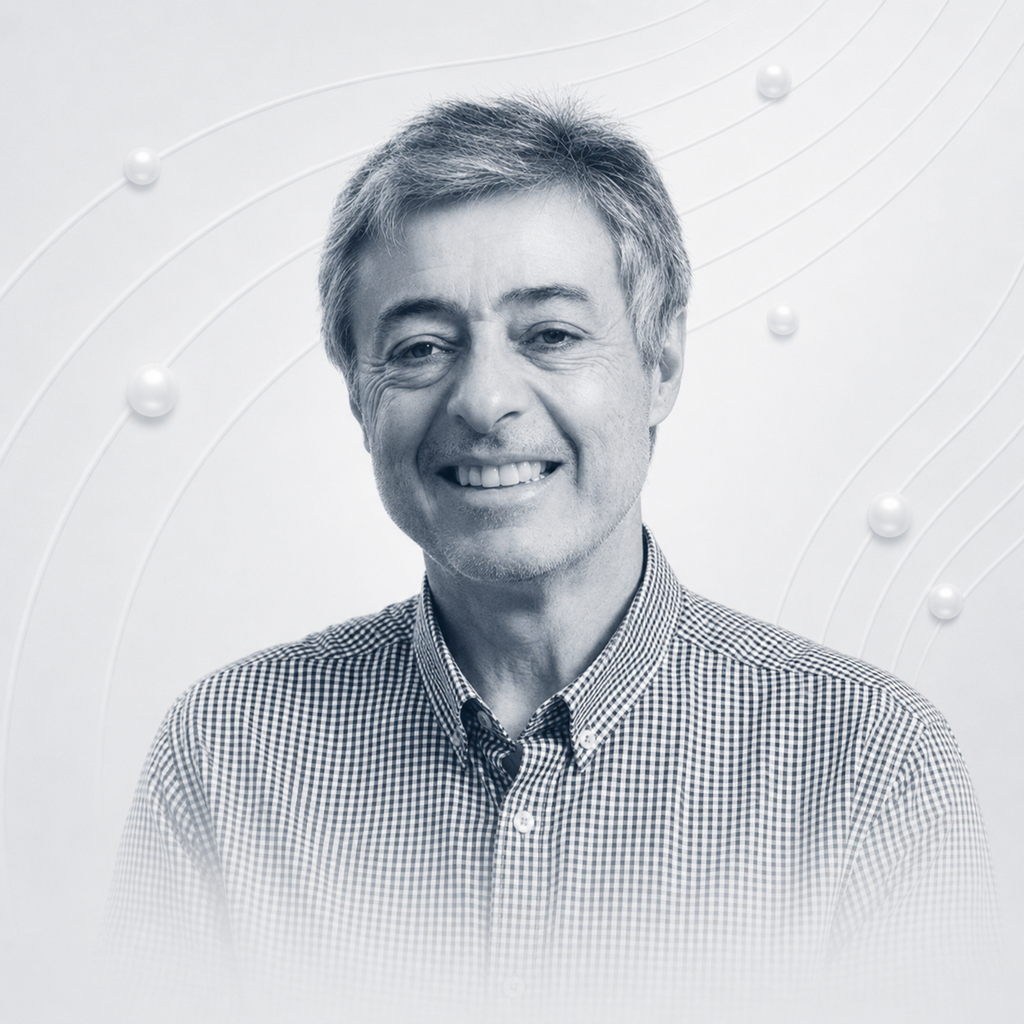
Jonatas Manzolli on music and mathematics and algorithmic composition
Episode 21 30.03.2021
-
 play_arrow
PLAY EPISODE
Description arrow_drop_down

Description
Can mathematics compose music? Can robots create art that is genuinely good for people? Brazilian mathematician and composer Jonatas Manzolli explores the collision between understanding and interpretation , and why collaboration between art and science may be essential for humanity’s survival. Subscribe for more episodes on how collaboration works across disciplines. Jonatas Manzolli occupies a rare intersection: trained in mathematics, driven by music composition, and committed to building bridges between algorithmic understanding and artistic interpretation. As head of the Interdisciplinary Center for Sound Communication at the University of Campinas in Brazil, he has spent decades pushing students and collaborators to confront a fundamental question , whether the purpose of human endeavor is to understand the world or to live in it. The conversation opens with Manzolli’s formative tension. Studying mathematics and music simultaneously, he found himself caught between two demands: mathematicians wanted him to understand; musicians wanted him to interpret and feel. His PhD in music composition was an attempt to resolve this by emphasizing creation, but the resolution came not as a choice between the two but as a commitment to being an interface , translating between the possibilities of understanding and the necessities of expression. This personal trajectory becomes a lens for examining collaboration itself. Manzolli argues that the most productive collaborations happen when participants bring genuinely different modes of thinking , not just different expertise within the same paradigm. His work with Paul Verschure on robotic systems that interact with human performers illustrates this: the question shifted from “how does the robot talk to the system?” to “how do we produce artifacts that are good for people?” , a move from technical capability to human benefit. The pandemic reshaped Manzolli’s understanding of collaborative practice. Isolated in a small space, experiencing what he calls “the aesthetics of compression,” he began writing musical letters , short scores sent to friends as a form of connection. When 15 dancers responded with movement to a poem he wrote, he used algorithmic composition to merge their movement and voice into something he calls music, even though it contains no traditional notes. The result demonstrates how collaboration can emerge from constraint when participants trust each other enough to respond authentically. On the relationship between art and survival, Manzolli is direct: not all problems can be solved by science alone. Environmental crises have layers, ecological, historical, relational, that require cultural and artistic engagement alongside technical solutions. A future society that eliminates space for art, science, and culture in equal measure will not survive its own intolerance. His proposed change to humanity is the capacity to believe in other people and to become tolerant of others , a deceptively simple formulation that connects mathematical precision with artistic generosity. Part of the Ernst Strüngmann Forum series on Collaboration, produced with the Convergent Science Network.
Tagged as:
algorithmic composition collaboration mathematics music Music Composition Understanding
About the author call_made
CSN Podcasts
Both the triumphs of humanity and its most evil deeds have resulted from collaboration. In a time where humanity is required to aspire to the former and minimize the latter, the question arises of how collaboration arises and why it fails. Surprisingly, this phenomenon, so central to who we are, is not well understood. Hence, a collaborative effort is required to understand collaboration in its full biological, psychological, sociological, cultural, and economic complexity and to translate this understanding into operational impact. This series of podcasts is one step toward achieving these complementary goals. The Collaboration Podcast presents interviews with people who are central orchestrators of collaboration in various domains including business, government, science, art, health, sustainability, and the military. The discussions were conducted by Prof. Dr. Paul F.M.J. Verschure and members of the Program Advisory Committee of the Ernst Strungmann Forum on Collaboration (https://www.esforum.de/forums/ESF32_Collaboration.html) during 2021 and had the goal to sketch a map of opportunities, challenges, and obstacles in human collaboration. The forum took place in May 2022, and now we would like to share this series of interviews with a broader audience. The full report of the Forum will be published in 2023 by MIT Press. The podcast was produced by the Convergent Science Network (https://www.convergentsciencenetwork.org/). Context: The stability of social systems depends critically on realizing sustainable methods of “collaboration,” yet how and by which means collaboration is achieved is not clearly understood; neither are the conditions or processes that lead to its breakdown or failure. Collaboration can be understood as cooperation between agents toward mutually constructed goals. Part of the reason for our lack of understanding is that the phenomenon of collaboration is, by nature, a highly multidisciplinary problem, and effective research into its complexities has been difficult to achieve across the broad range of scientific and technical disciplines involved. The need for a fundamental understanding of collaboration, however, has become increasingly important. Not only does humankind demand answers as it attempts to address critical challenges at multiple scales (e.g., climate change, migration, enhanced automation, social and economic inequality), but ever-increasing technological and economic means of interconnecting people and societies are disrupting long-established, familiar patterns of how we interact. Radical technological changes that are ongoing have the potential to reshape collaboration in ways that are currently hard to predict or influence (e.g., by altering configurations in interaction, information creation, and modes of communication). On one hand, such changes could disrupt hitherto stable forms of collaboration by affecting critical communication channels and traditional roles, as can be observed in the rapidly changing patterns in governance, commerce, and social interaction. Conversely, technology could lead to the emergence of novel, successful forms of collaboration that deviate from traditional “hierarchical” architectures. Evidence of this can be seen in areas as diverse as highly automated manufacturing plants, the open science movement, collaborative software repositories, user-centered services, and the sharing of economy-based modes of organization. Without a fundamental understanding of the mechanisms, processes, and boundary conditions of collaboration, it is not possible to evaluate or predict which of these possible scenarios are sustainable or even plausible. The Forum “How Collaboration Arises and Why it Fails” (May 8–13, 2022, Location: Frankfurt am Main, Germany) Chairs: Andreas Roepstorff and Paul Verschure Program Advisory Committee: Jenna Bednar, Julia R. Lupp, Bhavani R. Rao , Andreas Roepstorff, Ferdinand von Siemens, and Paul Verschure
Episodes
play_arrow
play_arrow
play_arrow

play_arrow
Timestamp
- fast_forward00:00:04 - Welcome to the Convergent Science and Ernst Schumann Forum podcast on collaboration.
- fast_forward00:00:09 - I'm Paul Versteur, together with my colleague Julia Lupp, who speak with Professor
- fast_forward00:00:14 - Giannis Manzotti, composer, mathematician, and research leader of the Interdisciplinary
- fast_forward00:00:19 - Nucleus of Sound Communication at the University of Campinas in Brazil.
- fast_forward00:00:24 - His research is focused on applications of mathematical models of complex systems
- fast_forward00:00:29 - to music composition and interactive systems. As a composer,
- fast_forward00:00:34 - he has created and performed dozens of orchestra pieces and operas.
- fast_forward00:00:38 - Jonathan reflects on collaboration in the performing arts. Welcome to the podcast.
- fast_forward00:00:44 - Really, it's amazing to be with you, Paul.
- fast_forward00:00:48 - For a long time, we don't see each other in presence.
- fast_forward00:00:52 - And also, Julia, it's an immense pleasure. And thank you for inviting me to this talk.
- fast_forward00:00:59 - Great. Well, so, Jonathas, before we start to discuss collaboration,
- fast_forward00:01:05 - could you give a short description of your career path so far that brought you
- fast_forward00:01:11 - to this point of the discussion with us on collaboration?
- fast_forward00:01:16 - Okay, I think my, if I'm going to say something about that, I think the story
- fast_forward00:01:21 - starts when I decided to follow classes in the universe.
- fast_forward00:01:26 - I was doing maths, and also I decided to go to follow musical classes.
- fast_forward00:01:31 - I have done musical classes before and so on.
- fast_forward00:01:35 - And suddenly these things crash in my mind or in my view of the world,
- fast_forward00:01:42 - because on one side I have people trying to say to me that I have to understand things.
- fast_forward00:01:48 - And the other side, I have people try to make me think about emotion.
- fast_forward00:01:55 - About interpretation, and about how interpretation can be a word model.
- fast_forward00:02:00 - And the other side, the mathematicians try to understand. You have to understand.
- fast_forward00:02:05 - And I think from that, I think I became a little bit a slave of this.
- fast_forward00:02:10 - I don't know if my life is for interpretation or if my life is for understanding.
- fast_forward00:02:18 - And I don't know. I think for humankind, is that the biggest problem?
- fast_forward00:02:23 - If you understand things or if you do interpretations of things.
- fast_forward00:02:27 - And after that, when I was doing math and music, I decided to go to a master's degree in math.
- fast_forward00:02:35 - So I decided to understand, in
- fast_forward00:02:39 - that case, is understand how the musical instrument works in an orchestra.
- fast_forward00:02:44 - And it was immense work. And when I came out of that, I didn't make any kind
- fast_forward00:02:49 - of musical composition.
- fast_forward00:02:52 - I was a little bit frustrated because I understood the orchestra and I make
- fast_forward00:02:56 - a very sophisticated mathematical model, but I didn't play with it.
- fast_forward00:03:01 - One main thing, I understand it, but I don't produce art.
- fast_forward00:03:05 - I didn't produce art. So that I decided to move to my PhD in composition,
- fast_forward00:03:11 - so the emphasis should be or would be in creation.
- fast_forward00:03:16 - But also, I started to go and understand this.
- fast_forward00:03:21 - And always in the PhD, I have this discussion about, are you producing music
- fast_forward00:03:27 - with maths or are you producing arts or something like that?
- fast_forward00:03:32 - I think it's my entire life.
- fast_forward00:03:34 - So after that, I understood, and I'm not going to go into details,
- fast_forward00:03:39 - that what I'm doing now and what's my purpose in life is to be a kind of interface, a kind of bridge.
- fast_forward00:03:46 - Between possibilities of understanding and interpretation.
- fast_forward00:03:53 - For me, art is not for understanding anything.
- fast_forward00:03:57 - Art in music is for interpretation, is to produce things that make us to,
- fast_forward00:04:03 - not to understand the world, but to live.
- fast_forward00:04:07 - And for the other side, science is somehow made for understanding.
- fast_forward00:04:13 - But I think both profit from each other Because if you make a question about
- fast_forward00:04:19 - how the universe starts, you understand that you wouldn't know what it means.
- fast_forward00:04:25 - Because life is not only depends on how the universe starts,
- fast_forward00:04:30 - it depends on many, many other things.
- fast_forward00:04:33 - So in that sense, after that, I started to teach at the University of Campinas.
- fast_forward00:04:39 - And from there, I drive my students in this kind of questions.
- fast_forward00:04:45 - And for many years, I was the head of the...
- fast_forward00:04:51 - The Interdisciplinary Nucleus for Sound Studies, and I have their students from
- fast_forward00:04:57 - music, from dance, from engineering.
- fast_forward00:05:00 - And one day in my life, I met Paul in Unicamp.
- fast_forward00:05:04 - We had this conversation how our robots can drive a program or a system that
- fast_forward00:05:12 - was developing with a system that's based on maths.
- fast_forward00:05:17 - So the idea is how this robot talks to the system.
- fast_forward00:05:21 - And from that, we developed many, many, many, let's say, many conversations.
- fast_forward00:05:28 - And coming to today, inside this COVID pandemics,
- fast_forward00:05:36 - I start to think that the best for this kind of research is not only to produce
- fast_forward00:05:43 - artifacts Artifacts that interact with people, but produce artifacts that make good for people.
- fast_forward00:05:51 - It's different, you know?
- fast_forward00:05:56 - Paul, I didn't get it. I don't listen to your... Yeah, I'm sorry.
- fast_forward00:06:00 - But you started in the musical domain as an accomplished pianist,
- fast_forward00:06:05 - right? And then you also became a conductor.
- fast_forward00:06:09 - You moved to interactive music systems. You are also a composer.
- fast_forward00:06:13 - So there's a very broad set of experiences you have there, right?
- fast_forward00:06:17 - And in parallel, you are also a mathematician and you're teaching a number of
- fast_forward00:06:23 - courses in that domain, right?
- fast_forward00:06:25 - So you have always been balancing these two experiences.
- fast_forward00:06:28 - Now, in that context, so given that, how would you define collaboration?
- fast_forward00:06:35 - What is collaboration and what is it good for?
- fast_forward00:06:39 - I think I have two words to define collaboration. Dialogue and good heart. Okay.
- fast_forward00:06:49 - Two, okay. It's three, okay. But good heart is, oh, try to understand the other.
- fast_forward00:06:55 - I think it's about to listen to people. Collaboration is more than trying to make people do things.
- fast_forward00:07:03 - Collaboration is about to make people talk. And also it's more about to listen
- fast_forward00:07:10 - to people than, let's say, try to make them develop something.
- fast_forward00:07:17 - Can I ask a follow-up question to that first?
- fast_forward00:07:23 - I want to go back just a step before I get to this point right here.
- fast_forward00:07:27 - And that is you describe composing or compositions as being the interpretation of something.
- fast_forward00:07:34 - So if we take an example like the Rite of Spring, Stravinsky would have taken
- fast_forward00:07:39 - the creation or the evolution and interpreted it in this musical composition.
- fast_forward00:07:46 - Am I understanding you correctly?
- fast_forward00:07:48 - Exactly. And of course. First, please, Julia, go.
- fast_forward00:07:54 - So as a composer, you try to create a dialogue with the listener in as much
- fast_forward00:08:03 - as you're trying to project a concept,
- fast_forward00:08:07 - you're trying to interpret a concept and give it to the listener for that listener
- fast_forward00:08:12 - to take it up and understand as he or she would understand the concept.
- fast_forward00:08:17 - Is that your goal as a composer?
- fast_forward00:08:21 - I think my goal as a composer is to give them the opportunity to make their own interpretation.
- fast_forward00:08:27 - I don't think my personal interpretation is the main task of a composer.
- fast_forward00:08:33 - It's my opinion, the main task of a composer.
- fast_forward00:08:36 - A composer is, let's say, if he's responsible, he is a person that opens a door
- fast_forward00:08:43 - for other people's interpretation.
- fast_forward00:08:45 - Of course, if Stravinsky let's take another model of creation or let's take
- fast_forward00:08:51 - another thing in his worldview, his music is going to be a little bit different. Of course it will be.
- fast_forward00:09:00 - But on the other hand, the way people take Stravinsky music and share,
- fast_forward00:09:06 - let's say, emotionally,
- fast_forward00:09:08 - and also combine the ideas of Stravinsky with their own ideas,
- fast_forward00:09:13 - I think it's a matter of art.
- fast_forward00:09:16 - I think, at least for me, it's a matter of composition.
- fast_forward00:09:21 - So I want to understand something here, right? I want to understand something. I'm not creating.
- fast_forward00:09:28 - Of course and and so what i
- fast_forward00:09:31 - tried to now now we now we're on the track of the composer okay so the composer
- fast_forward00:09:35 - now the composer tries to also orchestrate or define a form of collaboration
- fast_forward00:09:42 - so what is it what are you exactly defining among all these agents that you're trying to now.
- fast_forward00:09:50 - Proactively control how do you structure that what's happening i think it's
- fast_forward00:09:55 - a very complex kind of collaboration.
- fast_forward00:09:57 - Let's take a piece of music. Let's take Stravinsky again.
- fast_forward00:10:01 - Imagine, you have to collaborate with the orchestra. You have to collaborate with the conductor.
- fast_forward00:10:08 - Okay, this is in a technical level.
- fast_forward00:10:11 - And there are composers that maybe they say, okay, it's enough.
- fast_forward00:10:15 - Let's say if the orchestra and the conductor understand my score, my function is done.
- fast_forward00:10:22 - It's not what I think. I think it's partially done.
- fast_forward00:10:27 - Because there's another collaboration that is the collaboration of the meaning
- fast_forward00:10:32 - that I'm sharing with people.
- fast_forward00:10:35 - And this is a spontaneous thing that comes from me, comes from my music,
- fast_forward00:10:40 - comes from my score and goes to people. Okay, but let's first look at the technical part, okay?
- fast_forward00:10:46 - Okay. The technical part, because now you use a notation system.
- fast_forward00:10:51 - You use a notation system to, if you want, program future actions of a bunch
- fast_forward00:10:58 - of agents in the orchestra and the conductor.
- fast_forward00:11:02 - So technically, how do you structure that? What are the key ingredients of that
- fast_forward00:11:08 - algorithm, if you want, to make that composition work?
- fast_forward00:11:13 - You know that I work with algorithmic composition. Yeah, that's why I thought I would...
- fast_forward00:11:19 - But I'm not going to answer you in this way. Look, I'm trying. Of course.
- fast_forward00:11:26 - What I want to tell you is that somehow there are rules, of course.
- fast_forward00:11:33 - There are ways of organization and also we
- fast_forward00:11:36 - know that for many times we
- fast_forward00:11:39 - say music is organized sounds you
- fast_forward00:11:42 - know but the point is the organization can be done in many levels of course
- fast_forward00:11:49 - one level is the level of the way you write music okay you have a symbolic notation
- fast_forward00:11:57 - that many people understand and around this symbolic notation,
- fast_forward00:12:02 - people can produce and make it one of interpretation of music. This is one level.
- fast_forward00:12:08 - The second level is the way the sound is linked to the symbolic score.
- fast_forward00:12:16 - So that means, I go in the way of work, but because this sound is not always
- fast_forward00:12:23 - what is written in the score, People say, why not? Of course it's not.
- fast_forward00:12:29 - Because the instruments, they have different shapes.
- fast_forward00:12:32 - It's very complex. And the people playing one instrument is different from the
- fast_forward00:12:37 - other. So I have this second level, the level of the sound.
- fast_forward00:12:41 - And I have the third level that I would say the emotional level,
- fast_forward00:12:45 - or the level of the relationship between these two with the audience and with
- fast_forward00:12:51 - myself and with the social relationship.
- fast_forward00:12:56 - So my research for many years and now I think.
- fast_forward00:13:03 - Consists of trying to understand the symbolic notation, and for that I work with parameters.
- fast_forward00:13:11 - So I represent the symbolic notation, mathematical parameters,
- fast_forward00:13:15 - and I work with computers to produce some score. This is one level.
- fast_forward00:13:21 - And I had this experience in Ada.
- fast_forward00:13:24 - When you put there the machines producing sounds and people start to react,
- fast_forward00:13:30 - we have these two second levels because Because the sound itself,
- fast_forward00:13:33 - it's not what you write, but it's what people listen to.
- fast_forward00:13:37 - So you have to do research in perception.
- fast_forward00:13:41 - I understand. But before we go there, Jonathan, in structuring your score, right?
- fast_forward00:13:46 - So for instance, recently, I think you finished, you wrote an opera,
- fast_forward00:13:49 - right? Recently, you wrote an opera.
- fast_forward00:13:51 - So in structuring your score, you
- fast_forward00:13:54 - want to make sure that all the future
- fast_forward00:13:58 - orchestra members and the choir and so on
- fast_forward00:14:01 - collaborate together to realize
- fast_forward00:14:04 - what you intend they realize so do
- fast_forward00:14:08 - you that's one level no no that's one level but still just at that level do
- fast_forward00:14:13 - you structure this around a goal for do you give them a goal do you declare
- fast_forward00:14:17 - a goal or is it more microscopic in the way you work with them.
- fast_forward00:14:23 - Okay, I got to your question.
- fast_forward00:14:25 - I think I have, for orchestration, I'm teaching orchestration for many years,
- fast_forward00:14:33 - and I always say to my students that orchestration is architecture.
- fast_forward00:14:38 - So, how you work in orchestration, you think about the building when people
- fast_forward00:14:44 - are going to live, or the building when people are going to listen to music.
- fast_forward00:14:48 - So, you have many layers of the orchestra, the instruments, you have the layer of the notes.
- fast_forward00:14:54 - But how it comes to you, how it comes to you, how do you start to work with that?
- fast_forward00:15:01 - I think the best thing I gave to my students is that you should have a holistic
- fast_forward00:15:10 - idea, a general idea of the concept.
- fast_forward00:15:14 - Because if you don't have this general idea, you go to the details and your
- fast_forward00:15:21 - composition does not survive.
- fast_forward00:15:24 - I understand. How this general idea comes to you?
- fast_forward00:15:29 - Many ways. Anyways, for me, for example, I'm very visual.
- fast_forward00:15:34 - So sometimes I have visual ideas.
- fast_forward00:15:37 - And for me, and I think we should do research on that, I think all persons,
- fast_forward00:15:43 - all people are synesthetic.
- fast_forward00:15:45 - What I mean by that, so when I listen to a sound, it comes to me with images.
- fast_forward00:15:51 - But I don't think it's only to me, it's for everybody. body because I think
- fast_forward00:15:56 - we have a big confusion when we talk about organization of sounds that we talk
- fast_forward00:16:02 - only about the level of the writing.
- fast_forward00:16:05 - Okay but are you saying that then in developing a piece.
- fast_forward00:16:14 - Driven by an image you have, you try to get that image in the head of everyone
- fast_forward00:16:18 - who has to realize that piece.
- fast_forward00:16:20 - Not that image, but that image might drive other people's image.
- fast_forward00:16:26 - The point is that I'm not the composer.
- fast_forward00:16:29 - You know that idea of the romantic composer.
- fast_forward00:16:33 - I don't like this idea that the romantic composer is a superhero that is a genius
- fast_forward00:16:38 - and what is inside his brain or his mind goes to everybody and his has to be
- fast_forward00:16:44 - immortal because this is going to be forever. I don't believe on that.
- fast_forward00:16:48 - Is it correct to say, going back to your original discussion of dialogue,
- fast_forward00:16:55 - social relationship, that as a composer you're trying to create a dialogue and
- fast_forward00:17:00 - this is the collaboration, you're giving ideas to,
- fast_forward00:17:04 - spark an exchange.
- fast_forward00:17:07 - And also people after the concert or the The musicians, when we do the rehearsal,
- fast_forward00:17:13 - and my students, everybody, they give feedback to me.
- fast_forward00:17:17 - I think it's not about to impose an idea, but it's about to drive a pendulum.
- fast_forward00:17:26 - The pendulum, you know, the pendulum comes to me, goes to you, and comes back.
- fast_forward00:17:31 - You have this feedback. And for me, the better way of describing how it's driving
- fast_forward00:17:38 - ideas is somehow like a self-organized system.
- fast_forward00:17:43 - Yeah, but that's a tricky one, right? Because what does it mean? Yes, of course.
- fast_forward00:17:49 - And also still, as a composer, you are writing your score.
- fast_forward00:17:52 - So, for instance, in the piece, in the orchestra, you might want to have the
- fast_forward00:17:57 - strings to sort of interact with the wind instruments in some way.
- fast_forward00:18:00 - So you want them to collaborate so how do you implement that then,
- fast_forward00:18:05 - as your component piece I know I write there the score and ask people to play
- fast_forward00:18:11 - what I wrote but what I try to say in the level of the symbolic score the symbolic
- fast_forward00:18:16 - score is not enough to do it but I'm trying to force,
- fast_forward00:18:23 - you to say in some sense is what's
- fast_forward00:18:25 - really that architecture what's that building what are the structural.
- fast_forward00:18:30 - How the ideas are driven in a piece of music, as I told you previously,
- fast_forward00:18:36 - we have the symbolic notation. This is one layer, okay?
- fast_forward00:18:41 - This and if i work with notation
- fast_forward00:18:46 - in that layer this layer is for 400 years
- fast_forward00:18:49 - uh let's say in the hands of the composers we learn how to use it so in that
- fast_forward00:18:55 - layer i of course i customize my ideas in in details i give to the flute the
- fast_forward00:19:02 - notes the flute has to play i give to the clarinet the the notes,
- fast_forward00:19:07 - I have the articulation,
- fast_forward00:19:09 - I describe also the way they have to do in terms of dynamics,
- fast_forward00:19:14 - and also I give some guides in the rehearsal time to the conductor.
- fast_forward00:19:21 - So this is one level. I call this level of symbolic communication.
- fast_forward00:19:26 - Let's describe symbolic to me is based on a notation. Okay, when the rehearsal
- fast_forward00:19:33 - starts, the orchestra starts, many other things come out.
- fast_forward00:19:38 - One of the things is not only about the score.
- fast_forward00:19:42 - It's about the position where the musician is sitting, the relation with the sound.
- fast_forward00:19:48 - And so this realm of complex relationships also are there in the orchestra.
- fast_forward00:19:56 - Orchestra so in that sense i call the second
- fast_forward00:19:59 - layer the layer of the sound i'll say
- fast_forward00:20:02 - the layer when people because the orchestra has to
- fast_forward00:20:05 - build a sound for my music or for
- fast_forward00:20:08 - any music of anybody so it's one point that people don't know and people that
- fast_forward00:20:13 - has this misunderstand the function of the conductor my god the conductor is
- fast_forward00:20:19 - there really to help the orchestra to build this sound it's very special and he's not sorry.
- fast_forward00:20:28 - Could I ask if I'm interpreting you correctly
- fast_forward00:20:31 - in going back to Paul's question of wanting
- fast_forward00:20:34 - an architecture you're saying that the score your composition is the framework
- fast_forward00:20:41 - for the collaboration among the people involved among the orchestra but also
- fast_forward00:20:47 - probably including the people who are listening to it the score itself sets
- fast_forward00:20:53 - up an interaction,
- fast_forward00:20:56 - first among the musicians,
- fast_forward00:21:00 - and then further out in how it's interpreted by the listeners.
- fast_forward00:21:06 - I think I couldn't describe better the idea of framework.
- fast_forward00:21:11 - Thank you very much. And that, but the point is that, the point is,
- fast_forward00:21:16 - since it's the framework,
- fast_forward00:21:18 - and many times when do collaboration, we understand the framework or is the
- fast_forward00:21:24 - rule where people has to behave very much,
- fast_forward00:21:28 - let's say, in a very strict way.
- fast_forward00:21:32 - And I think, I think, of course, the musicians, they have their freedom to do
- fast_forward00:21:36 - interpretation, even in a big orchestra.
- fast_forward00:21:40 - But, Jonathan, now I might annoy you because I could now say your description,
- fast_forward00:21:48 - in some sense, has still turned all the agents in the system downstream in automata.
- fast_forward00:21:57 - No, not at all. I have not understood. I have not said that.
- fast_forward00:22:01 - How did you orchestrate their collaboration?
- fast_forward00:22:06 - What makes it collaborative, what they do? That's the point.
- fast_forward00:22:09 - I think sometimes there are people that believe that the conductor is a kind
- fast_forward00:22:14 - of king or rector or ship, and people do everything he or she says.
- fast_forward00:22:22 - I think if it happens, the music is going, there's no expression.
- fast_forward00:22:28 - The point in the orchestra is that we're going to stay forever in the orchestra.
- fast_forward00:22:33 - The orchestra, for me, is a good example of collaboration.
- fast_forward00:22:36 - It's because it's a kind of framework where you have to have a kind of tolerance.
- fast_forward00:22:44 - Let's talk between the collaborators, the musicians, the conductor,
- fast_forward00:22:51 - and the collaboration with the composer that maybe is not there.
- fast_forward00:22:55 - But he produced the score, he gave guides for them, and in a way,
- fast_forward00:23:02 - you have to respect the score as much as you respect yourself,
- fast_forward00:23:08 - and it's a good example because how people work together in an orchestra is
- fast_forward00:23:14 - every person, each person has a unique way of performing instruments.
- fast_forward00:23:22 - Even if it is a kind of, let's say, very uniform orchestra where the sound sounds
- fast_forward00:23:29 - beautiful, you know, this big orchestra in Europe, for example.
- fast_forward00:23:34 - So even that, you have this small collaboration of everybody.
- fast_forward00:23:40 - Body so my point is that if they
- fast_forward00:23:43 - all have to collaborate if they are a
- fast_forward00:23:47 - kind of automata there is no
- fast_forward00:23:50 - there wouldn't be any kind of meaning really no meaning because let me finish
- fast_forward00:23:57 - the meaning comes from this small
- fast_forward00:24:00 - variations that each person in his own interpretation give for the sound,
- fast_forward00:24:07 - and give for the framework that the composer proposed.
- fast_forward00:24:12 - And in that sense, it's a very good example of synergy. Okay,
- fast_forward00:24:17 - but then what makes that collaborative, Jonatas?
- fast_forward00:24:21 - Okay, that's another point. Well, that's the one I'm after.
- fast_forward00:24:26 - No, no, no, of course. I described how I believe the system behaves, or the system works.
- fast_forward00:24:33 - What makes them collaborative I think
- fast_forward00:24:36 - there are many ways there are good
- fast_forward00:24:39 - ones and there are bad ones maybe the salary or they
- fast_forward00:24:42 - are there of course but they are also but I think in my view when they are sitting
- fast_forward00:24:49 - and start to play there's a goal of making this piece of music as the better
- fast_forward00:24:55 - as they can they are there engaged for that so that means and.
- fast_forward00:25:01 - If they don't do individual collaboration, that means play what they have to
- fast_forward00:25:06 - play, but play what they have to play with their own interpretation.
- fast_forward00:25:10 - The whole system is not going to give that interpretation.
- fast_forward00:25:15 - As you say, for example, Stravinsky has been played many times.
- fast_forward00:25:26 - If you listen to one interpretation, you have to listen to another. other.
- fast_forward00:25:29 - So it's the same music, the framework is the same, but there are many, many variations.
- fast_forward00:25:35 - Where are these variations?
- fast_forward00:25:38 - Of course in the way the conductor gives cues for the musicians,
- fast_forward00:25:44 - but also in the collaboration of the orchestra.
- fast_forward00:25:47 - And also, and I'm sitting there in the audience and I have a new,
- fast_forward00:25:52 - I listen again Stravinsky again and I say, oh, this is a new interpretation.
- fast_forward00:25:57 - And this new interpretation gives a new meaning to me. So that means it's the end.
- fast_forward00:26:02 - I don't think it's the end, but it's the way that the music conveys meaning
- fast_forward00:26:08 - by sharing the dialogue with the composer.
- fast_forward00:26:14 - With the musician, and with the audience.
- fast_forward00:26:18 - The dialogue and the social interaction among the... Social interaction.
- fast_forward00:26:25 - Technical one, technical one, that there are only people that has the technology,
- fast_forward00:26:30 - but there are many others.
- fast_forward00:26:35 - I'm taking another example a little bit out of the, let's say, the orchestra.
- fast_forward00:26:42 - Let's take, for example, the example of Steve Reich.
- fast_forward00:26:46 - When he was there in Africa, tried to study how people do music.
- fast_forward00:26:52 - So he established some relations with his approach for minimal music.
- fast_forward00:26:58 - So suddenly he realized that there are people playing music and they play together
- fast_forward00:27:07 - and there's no conductor,
- fast_forward00:27:09 - there's no composer, but the music sounds very pleasant, very complex and immense interesting.
- fast_forward00:27:19 - What's the difference? Okay, for me, it's that the level of the interaction
- fast_forward00:27:25 - among the religion, the social relationship between them is very high,
- fast_forward00:27:33 - and they produce music because they listen to the other, and they have more
- fast_forward00:27:40 - freedom individually to add something.
- fast_forward00:27:44 - Of course, in the orchestra, let's go back to the orchestra.
- fast_forward00:27:47 - I think in the orchestra, the individuality has less importance, but it's still there.
- fast_forward00:27:55 - But there, in a ritual, when they do music, the individuality has more importance.
- fast_forward00:28:03 - But for me, both models are interesting.
- fast_forward00:28:07 - In one, you have the score that's the framework to give the opportunity to people to perform.
- fast_forward00:28:17 - And the other one, you have a kind of social relationship and kind of ritual
- fast_forward00:28:23 - that puts everybody together and tries to play music.
- fast_forward00:28:28 - Can you explain then, in these two situations you now describe,
- fast_forward00:28:34 - what's the role of something like trust?
- fast_forward00:28:38 - Or is there a role of something like trust in that?
- fast_forward00:28:42 - Many. I think this is a good word.
- fast_forward00:28:46 - Because what I mean by trust, and I don't know what you mean by trust,
- fast_forward00:28:51 - but what I mean by trust is not to believe in you.
- fast_forward00:28:53 - I mean by trust is that I give to you the opportunity to give something to me
- fast_forward00:29:01 - that please me. This is trust to me.
- fast_forward00:29:06 - It's not give you and say, I believe in you and I do to you.
- fast_forward00:29:11 - I believe in God, So I'm going to do everything God tells me. No, I'm not saying that.
- fast_forward00:29:16 - I say, if something comes to me that pleases me, and I trust that comes from
- fast_forward00:29:20 - you, I think trust is this pleasure to, not to serve, but this pleasure of staying
- fast_forward00:29:26 - together and amplify this.
- fast_forward00:29:30 - And trust has to be between the conductor and the musicians.
- fast_forward00:29:34 - And in another situation, Africa, the trust between them.
- fast_forward00:29:38 - They are, and it makes a community. minutes.
- fast_forward00:29:42 - So I don't know. How do you, how do you, if you want to orchestrate that as,
- fast_forward00:29:48 - as a conductor or as a composer or as an instrumentalist?
- fast_forward00:29:55 - But the point is that there are situations when they need to compose.
- fast_forward00:29:59 - There are other situations they don't need.
- fast_forward00:30:01 - So let's take again this Reich example.
- fast_forward00:30:05 - After being there in Africa, he came back to New York and we wrote,
- fast_forward00:30:12 - for example, clapping music.
- fast_forward00:30:13 - So he takes a little bit the structure, what he heard and he thought about the structure of the pulse.
- fast_forward00:30:22 - This post and rewrote it and he composed a piece of music in that sense the
- fast_forward00:30:27 - process the process that people are using there this composer make an abstraction and brought it in
- fast_forward00:30:36 - another framework there in africa the firm works not the score the firm work
- fast_forward00:30:43 - there is the the social relationship, and the word you said, the trust.
- fast_forward00:30:48 - And after that, when clapping music was performed many times,
- fast_forward00:30:53 - there's one layer that I call the symbolic notation, and the other layer is
- fast_forward00:30:59 - the way people play this chord.
- fast_forward00:31:01 - And here, there's one point that I think is important.
- fast_forward00:31:06 - The composer, sometimes, he's the person that brings this abstraction,
- fast_forward00:31:13 - like for this example to the framework, to the score he brings it but I don't
- fast_forward00:31:20 - think the score is enough.
- fast_forward00:31:22 - That's what I indeed wanted to understand because I could imagine that as you
- fast_forward00:31:27 - put a score together you put ingredients in there of for instance transiently
- fast_forward00:31:32 - entraining certain instruments,
- fast_forward00:31:35 - so in that sense you could also try to build up a trust relation because there
- fast_forward00:31:40 - is some reciprocal interaction between them.
- fast_forward00:31:43 - Is that the case? Would you use elements of that kind to construct trust?
- fast_forward00:31:50 - Yes, I think so. I think this way, our talk goes in a very good direction,
- fast_forward00:32:02 - the direction that I believe. Let's say clearly.
- fast_forward00:32:05 - For example, I worked at the Unicamp a symphony orchestra for many years.
- fast_forward00:32:10 - They have made many world premieres of works of mine.
- fast_forward00:32:15 - So let's talk about, for example, this couverture. That was an opera, okay?
- fast_forward00:32:20 - And I go to this kind of, I go to the trust, but I need a minute to explain.
- fast_forward00:32:28 - So in that opera, the idea was to celebrate the 15th anniversary of Unicamp.
- fast_forward00:32:34 - And also, I had the idea to convey with my music that celebration.
- fast_forward00:32:43 - One point that I start to think, it's I describe the history of somebody that's
- fast_forward00:32:48 - found the Unicamp or another big scientist.
- fast_forward00:32:52 - I'm not going to describe Unicamp history, but I'm going to describe somebody's
- fast_forward00:32:58 - history that's important to Unicamp.
- fast_forward00:33:02 - And after many times, I realized that the best to describe creation in Unicamp
- fast_forward00:33:10 - exactly is describe how people work when they are doing creation.
- fast_forward00:33:16 - So in that opera, Descoberta, there's no narrative. There's no character.
- fast_forward00:33:23 - There's only the process of creation
- fast_forward00:33:27 - and how I represent it because it's a metaphor for our discussion.
- fast_forward00:33:31 - I decided that I have a score, of course, but I need to have the collaboration
- fast_forward00:33:39 - of other people. I have dancers.
- fast_forward00:33:42 - Okay. I have a percussionist, a special group of percussion.
- fast_forward00:33:47 - I have the orchestra and I have a team of technicians that are going to build
- fast_forward00:33:53 - up the multimodal system that's going to amplify and describe the movement for the audience.
- fast_forward00:34:03 - So, when I have this big project, I have to combine the different levels of
- fast_forward00:34:10 - understanding between these different disciplines.
- fast_forward00:34:16 - For example, for the dancers, the time to make the choreography is much longer than for the musicians.
- fast_forward00:34:25 - For the production of the whole choreography, they took around six months, almost.
- fast_forward00:34:36 - And for the score for the orchestra, the research rehearsal was around 15 days, half a month.
- fast_forward00:34:47 - And for the percussionists, because there's a kind of special sounds,
- fast_forward00:34:53 - they expand a little around two months.
- fast_forward00:34:56 - So, and my question is, why for the same score, we have this difference between
- fast_forward00:35:03 - this time difference for the interpretation?
- fast_forward00:35:06 - Okay. For example, for the dancers, they have to learn with their bodies and
- fast_forward00:35:13 - make the expression in their bodies.
- fast_forward00:35:15 - There's no instrument and my score does
- fast_forward00:35:18 - not work for them as works for the
- fast_forward00:35:21 - musicians because for musicians they have
- fast_forward00:35:24 - a prescription of notes and the dancers
- fast_forward00:35:27 - they don't have any prescriptions prescription they
- fast_forward00:35:31 - have to build up the choreography uh step by step and and for for the percussionist
- fast_forward00:35:38 - they are they are combined these two levels because they they have the level
- fast_forward00:35:43 - of the body because I think percussion is one of the musical instruments that
- fast_forward00:35:48 - involves too much of the body.
- fast_forward00:35:51 - And also I put the instruments in the opera in many different places,
- fast_forward00:35:57 - in the percussion instrument, in many different places of the stage.
- fast_forward00:36:03 - But when I was developing this whole project, I had to trust Cinthia,
- fast_forward00:36:09 - that was the conductor, I have to trust Daniel, I have to trust Fernando,
- fast_forward00:36:14 - and also the technicians, but we are involved.
- fast_forward00:36:18 - And I think the most important factor that's make this project being a success,
- fast_forward00:36:26 - was for me, from my point of view,
- fast_forward00:36:29 - to understand the different time that people have to work and to collaborate between languages.
- fast_forward00:36:38 - For example, the musicians, with their protocol, they act a little bit fast, okay?
- fast_forward00:36:47 - But the dancers, they have to build up the protocol.
- fast_forward00:36:52 - And the percussionists, They are between them.
- fast_forward00:36:55 - And the score of this opera, it's there with the notes, okay?
- fast_forward00:37:01 - But it's not the choreography.
- fast_forward00:37:04 - And, of course, you have to talk about it.
- fast_forward00:37:08 - My question was, Jonathas, whether you then include in the composition elements
- fast_forward00:37:14 - to instill trust and instill the collaboration.
- fast_forward00:37:18 - For instance, by building dialogues inside the piece.
- fast_forward00:37:23 - That's a good question. I decided to put some spice, let's call this spice.
- fast_forward00:37:31 - That's our moments of, let's say, I wouldn't say cues, because cues is too little.
- fast_forward00:37:39 - But there is a small space in the score that represents space for,
- fast_forward00:37:46 - I would say, kind of bifurcation. I'll give you an example.
- fast_forward00:37:53 - For example, when the orchestra is performing a piece of music,
- fast_forward00:37:59 - everybody is sitting there in the stage.
- fast_forward00:38:03 - And the public is sitting here and listening to that. We call this Italian theater
- fast_forward00:38:09 - for this opera, because I was describing I was interested in describing the creation process.
- fast_forward00:38:17 - I put some cues in this space.
- fast_forward00:38:21 - It's not only the position of the conductor, but the position of the dancers
- fast_forward00:38:26 - in this space that you give cues for interpretation.
- fast_forward00:38:31 - So this was prescribed on the score.
- fast_forward00:38:34 - There's a chance of that happening. But of course, the time when it happened
- fast_forward00:38:40 - and why it happens depends very much on the choreographer.
- fast_forward00:38:46 - And it's a little bit different from the musical score, because the musical
- fast_forward00:38:50 - score, the time when something is going to happen is there.
- fast_forward00:38:54 - You have the bar number, one number there, 20, 21, doesn't matter.
- fast_forward00:39:02 - But even there, when you have the time to produce something,
- fast_forward00:39:06 - you have a small chance of modulating for the dance when you add the space in their body,
- fast_forward00:39:17 - the tolerance of the score has to be larger. That's to be great.
- fast_forward00:39:23 - But Jonathan, I don't know if I'm answering your question.
- fast_forward00:39:28 - I think I make a lot of confusion, but let's try to combine this.
- fast_forward00:39:33 - It's because I'm working not only with musicians, I'm working with dancers,
- fast_forward00:39:37 - and I'm working with engineering,
- fast_forward00:39:39 - I try to tell you that the trust not only depends on the score and the frameworks,
- fast_forward00:39:45 - depends also the level of response each element of the system has to the stimulus.
- fast_forward00:39:57 - And depends the way their work mind.
- fast_forward00:40:06 - And the way they take the project.
- fast_forward00:40:10 - In engineering, in the opera, it takes the project in one way,
- fast_forward00:40:14 - the dancer in another way, and the musician in another way.
- fast_forward00:40:17 - So that means to make it possible to do this collaboration, we have to respect
- fast_forward00:40:23 - that level of acquisition of knowledge and also in producing results.
- fast_forward00:40:30 - If you have a group with many different kinds, not only people,
- fast_forward00:40:34 - but with different kinds of approach.
- fast_forward00:40:37 - You have to respect these as well. I understand, I think.
- fast_forward00:40:41 - But now you gave this one example, right, for this complex piece you put together.
- fast_forward00:40:49 - But can you give an example of other experiments you've done,
- fast_forward00:40:55 - also composing a piece, conducting a piece, where it just didn't work,
- fast_forward00:41:00 - where it really failed, where this creative collaboration does really not come off the ground?
- fast_forward00:41:07 - What's failure in that case?
- fast_forward00:41:10 - I love this too much. I don't know what to think about.
- fast_forward00:41:13 - Let me think about it. Maybe I'll give an example. I remember.
- fast_forward00:41:20 - So I wrote a piece of music for percussion and string quartet, okay? And.
- fast_forward00:41:32 - My mistake was to think that the sound,
- fast_forward00:41:38 - the way I was going to prescribe the sound on the score, the string for the
- fast_forward00:41:44 - performer, it would sound like, for example, the sounds of the percussion.
- fast_forward00:41:49 - My mental goal was to make the string orchestra become a kind of percussion
- fast_forward00:41:59 - orchestra and the percussion instrument become a string.
- fast_forward00:42:03 - I tried to invert the function.
- fast_forward00:42:08 - And what happened? I was there with the conductor.
- fast_forward00:42:11 - I explained to them the idea, but they don't get it. Not get it.
- fast_forward00:42:17 - Maybe they don't like it. And they said, no, the strings are not rough like you want that we play,
- fast_forward00:42:29 - because I want them to make very close to rock.
- fast_forward00:42:34 - And I pushed them to say, you have to take the taché, not, you have to do this
- fast_forward00:42:40 - very rough, and change the way you do the interpretation of the string instrument.
- fast_forward00:42:45 - And I asked the percussionist, when you play the...
- fast_forward00:42:50 - I asked them to play a vibraphone, play this... And he's going to play the vibraphone
- fast_forward00:42:56 - with the bow as one string instrument. Play, this is very soft.
- fast_forward00:43:02 - It sounds like a string.
- fast_forward00:43:08 - So the point is, I think...
- fast_forward00:43:11 - I like my project, But when I came in front of the orchestra and described to them my proposal,
- fast_forward00:43:17 - they said, no, it's impossible because you change too much the function of the
- fast_forward00:43:23 - instrumentation in the traditional way.
- fast_forward00:43:27 - You want to make us to do what we don't think, we don't believe,
- fast_forward00:43:32 - we don't trust in that idea.
- fast_forward00:43:34 - But then, how I say, but this is the answer.
- fast_forward00:43:38 - It's very interesting because when you're in the audience,
- fast_forward00:43:43 - you often at any performance, whether it's a classical music concert or a vanguard
- fast_forward00:43:48 - dance company, you have the sensation or the understanding that everything is
- fast_forward00:43:54 - hierarchically structured.
- fast_forward00:43:55 - But what you have just portrayed is this dialogue between conductor and the
- fast_forward00:44:01 - various people who are involved in it.
- fast_forward00:44:04 - When it breaks down, you have a problem. When the dialogue is good and there's
- fast_forward00:44:10 - an understanding or a cooperation between an understanding of what the framework is supposed to project,
- fast_forward00:44:18 - then you get the individuals collaborating with each other to meet the goal of the music.
- fast_forward00:44:23 - Is that correct in my interpretation? Yes, that's correct.
- fast_forward00:44:26 - But I think it's more frequently, and it's because I work more frequently in
- fast_forward00:44:31 - new music. I'm a composer.
- fast_forward00:44:33 - I'm making new proposals. That means if you take an interpretation of Mozart,
- fast_forward00:44:39 - maybe the framework is more stable.
- fast_forward00:44:44 - People, they have some reference.
- fast_forward00:44:46 - Even they play Mozart for many years and they have many ideas.
- fast_forward00:44:51 - And the conductors say, how about bar number 55?
- fast_forward00:44:56 - You do a small conlang or whatever. And they know that because they played their entire life this music.
- fast_forward00:45:03 - When you come to orchestra with new music, OK, you have the framework.
- fast_forward00:45:11 - You have the people's life, the way they believe music is.
- fast_forward00:45:16 - You have your belief. And it's really matter.
- fast_forward00:45:19 - It's really important that the score tells
- fast_forward00:45:23 - them something but the score it's not able to tell everything because it's new
- fast_forward00:45:30 - music there are things there in the score that was not prescribed but now Jonathan
- fast_forward00:45:37 - you have to work together and that,
- fast_forward00:45:41 - sort of bit that is not described then is moved forward on the basis of trust.
- fast_forward00:45:49 - For sure okay for sure but now you also
- fast_forward00:45:52 - said that in your experiment to do the the string percussion inversion that
- fast_forward00:45:58 - didn't work out because you were too far beyond people's expectations right
- fast_forward00:46:04 - so would this mean that also within a piece and within the way an orchestra might perform a peace,
- fast_forward00:46:12 - if there are events that are too far out of this proximal zone of expectation,
- fast_forward00:46:19 - the peace collapses. Does that happen?
- fast_forward00:46:24 - Yes, but that's the big, big, big challenge of in writing contemporary music.
- fast_forward00:46:31 - So, and could collapse. I'm going to give an example.
- fast_forward00:46:35 - I don't know if it's for you, that's it. There's a Brazilian composer I'm not
- fast_forward00:46:39 - going to mention because... Jonatas Manzoli.
- fast_forward00:46:42 - No, okay, let's say Jonatas Manzoli, no problem. And he went to a very important
- fast_forward00:46:47 - festival in Brazil, and he came with a score that was a ball,
- fast_forward00:46:53 - a crystal ball, like it have notes there inside.
- fast_forward00:46:57 - And he asked people to make an interpretation of that ball, that it would be the score, okay?
- fast_forward00:47:06 - But before he start to perform the music, because the orchestra was not so keen
- fast_forward00:47:12 - about that, they make an agreement.
- fast_forward00:47:15 - Agreement, we are going to play only B flat because they are free to play what they see in the ball.
- fast_forward00:47:24 - And they came to the concert and when that part where they have freedom, they play the same note.
- fast_forward00:47:31 - That's completely not what the composer wants, but they make this why they made it.
- fast_forward00:47:38 - Because they don't want to collaborate because the freedom that the composer gave to them,
- fast_forward00:47:47 - giving a score like a ball, and they have to see there's some notation and make their interpretation,
- fast_forward00:47:54 - they don't take it as for good because they don't trust that kind of freedom
- fast_forward00:48:00 - that the composer gave to them.
- fast_forward00:48:03 - I don't know if it's a good example. It reminds me of an example that I give to my students in class.
- fast_forward00:48:11 - And there came another point here. How they score is very important.
- fast_forward00:48:18 - How they score is good for giving cues.
- fast_forward00:48:26 - I said, it looks like I do everything I don't care. I care very much.
- fast_forward00:48:31 - And how the score is good to give cues.
- fast_forward00:48:33 - For example, if some student come to me and say, Professor, I want to make a graphic score.
- fast_forward00:48:40 - I want to make a little ball. I always talk to them.
- fast_forward00:48:45 - I say, first question I ask them, what you intend and which sound do you want to produce?
- fast_forward00:48:54 - So, since you have this model, how the sound has to sound like,
- fast_forward00:49:00 - now we have to find a better way
- fast_forward00:49:03 - to communicate it to the orchestra and to communicate it to the musicians.
- fast_forward00:49:09 - And there's a second question that has to be asked.
- fast_forward00:49:13 - This piece is a solo piece, this piece is an orchestral piece,
- fast_forward00:49:18 - or this piece is a chamber music piece. It's very different.
- fast_forward00:49:23 - For example, if it's a soloist piece, you might invent something and you have
- fast_forward00:49:30 - an incredible soloist that he plays the violin here or in the back.
- fast_forward00:49:37 - It's a unique piece and you can put everything there.
- fast_forward00:49:42 - So you have many freedoms. If you go to chamber music, you have also freedom,
- fast_forward00:49:48 - but you have to deal with four, five, six, eight people.
- fast_forward00:49:53 - So the social relationship and the way they use to interpret the score take
- fast_forward00:50:00 - them a little bit more, let's say, freedom than, for example,
- fast_forward00:50:05 - when you go to orchestra.
- fast_forward00:50:07 - So, and when I shouldn't come to me and say, I'm going to write a piece for orchestral piece,
- fast_forward00:50:14 - or I'm going to write a chamber music, we discuss about, I would say,
- fast_forward00:50:20 - the tolerance of your writing.
- fast_forward00:50:23 - Let's explain it.
- fast_forward00:50:27 - How good are the symbols and the way you write to convey your ideas?
- fast_forward00:50:35 - If it's chamber music, you can put extended techniques, you can explore many
- fast_forward00:50:41 - possibilities of the instrument, you can change the sound of the instruments.
- fast_forward00:50:46 - For example, if my piece for percussion and string instrument,
- fast_forward00:50:53 - and was what I did later, was for a string quartet and for a percussion,
- fast_forward00:50:59 - it didn't have a problem.
- fast_forward00:51:01 - Because a small group of four musicians, and I go there even close to them,
- fast_forward00:51:07 - I tell them, play in this way, and he's going to listen and realize that.
- fast_forward00:51:13 - But when I propose this for the whole orchestra, it's different.
- fast_forward00:51:19 - So that means the way you...
- fast_forward00:51:24 - You write, you communicate this score for a different kind of ensemble,
- fast_forward00:51:31 - it's also very important.
- fast_forward00:51:33 - And the same idea, same musical idea being performed by an orchestra,
- fast_forward00:51:41 - being performed by a chamber, chamber group, an ensemble, and being performed as a solo,
- fast_forward00:51:47 - it has to be, it has a a completely different representation in the score.
- fast_forward00:51:53 - So that means as I told you, even that, how do you, let's say, how do you drive it?
- fast_forward00:52:04 - How do you drive the response of the interpretation?
- fast_forward00:52:10 - So I think for soloists, it's very much in new music, talk to them.
- fast_forward00:52:15 - Really, talk to them. The composer has to talk to them.
- fast_forward00:52:18 - And also there are times when I'm writing new techniques that I call that person how about it,
- fast_forward00:52:27 - and we dialogue he said no it
- fast_forward00:52:30 - doesn't work if you go to a chamber so
- fast_forward00:52:33 - maybe you describe a little bit more people you talk to them but you don't have
- fast_forward00:52:38 - this really good relationship to follow up on this so now in some sense you
- fast_forward00:52:44 - are in this more or less comfortable zone where you as a human conductor or
- fast_forward00:52:50 - composer are interacting with other humans.
- fast_forward00:52:53 - But actually, you are also one of the pioneers of interactive music systems,
- fast_forward00:52:57 - with which you started in the early 90s or maybe even earlier,
- fast_forward00:53:01 - which in some sense forces you to formalize a lot of these ideas about musical
- fast_forward00:53:09 - collaboration now into an algorithm that actually is executed by a computer
- fast_forward00:53:15 - and maybe an interaction with other computers or other humans creates a piece of music, right?
- fast_forward00:53:21 - So how is that translation step then done from that perspective of collaboration?
- fast_forward00:53:29 - Wow, okay, thank you for that question.
- fast_forward00:53:32 - So when I started to work with algorithmic composition many years ago, before I started my PhD.
- fast_forward00:53:43 - Long ago. Yeah, my goal was to make a kind of automatic generative composition that using computer,
- fast_forward00:53:53 - it's going to represent completely my musical ideas with an algorithm with mathematical laws.
- fast_forward00:54:02 - Okay, I started to work on that was the start of my PhD.
- fast_forward00:54:05 - My goal was to use a nonlinear system in this whole complex.
- fast_forward00:54:12 - When I was doing the PhD in that moment, one question that came to me and that's
- fast_forward00:54:18 - making me change instead of working on algorithmic composition,
- fast_forward00:54:23 - I'm working interactive algorithmic composition.
- fast_forward00:54:27 - What's the difference? So when I start to work on that, and when I receive the
- fast_forward00:54:34 - response of the machine,
- fast_forward00:54:36 - of the parameters that was imposed to the computer, sometimes I'll say, okay, I am happy.
- fast_forward00:54:44 - But I said, but I'm not completely happy.
- fast_forward00:54:48 - Why am I not completely happy? Because I started to understand that that music
- fast_forward00:54:52 - that the computer is performing is an instantiation of many other music or many
- fast_forward00:55:00 - other ideas that it's conveying in my proposal.
- fast_forward00:55:07 - Let's be clear. When you work with a piece of art, you can paint, okay?
- fast_forward00:55:12 - But you have this concept, the general concept of that piece of art that you're going to make.
- fast_forward00:55:21 - So in algorithmic composition, from my perspective, when you finish and the
- fast_forward00:55:26 - computer generates that kind of music automatically, The machine is,
- fast_forward00:55:32 - let's say, is performed one small part of this whole concept that you parametrize, parametrize it.
- fast_forward00:55:42 - That means the math serves you to represent the idea in terms of parameters,
- fast_forward00:55:50 - but the math doesn't give you the whole interpretation.
- fast_forward00:55:55 - Because to make the algorithm, you have to reduce the complexity of your idea,
- fast_forward00:56:02 - because the numbers are not enough and your solo is not enough to represent everything.
- fast_forward00:56:10 - Yeah. And I was very frustrated. I said, oh my God.
- fast_forward00:56:13 - And I said, I'm not going to finish this PhD because I want,
- fast_forward00:56:20 - I'll go back to write music by hand, I said.
- fast_forward00:56:24 - And in that sense, I'm very thankful to my supervisor at the time,
- fast_forward00:56:31 - Jim Fulkerson, that was a composer that has worked with John Cage for many years.
- fast_forward00:56:36 - So he came to me and said, the problem is that you don't want to have an automatic,
- fast_forward00:56:44 - finished piece of music.
- fast_forward00:56:46 - You want to give space for interpretation.
- fast_forward00:56:50 - And the computer has to become part of the game.
- fast_forward00:56:54 - But the computer is not the guy that is going to perform exactly what you prescribe.
- fast_forward00:57:02 - And that makes the whole difference in my entire life. And we are talking here because of that.
- fast_forward00:57:08 - So when I realized that, I started to understand that sometimes,
- fast_forward00:57:14 - you can use the math and the algorithm to give boundaries of tolerance where
- fast_forward00:57:22 - some behaviors are allowed and other behaviors are not allowed.
- fast_forward00:57:27 - But you're not describing the behavior.
- fast_forward00:57:31 - And you give space for interaction.
- fast_forward00:57:36 - And after that, I started to work with me any kind of interaction.
- fast_forward00:57:42 - So in my PhD, for example, a long time ago, I developed a glove because also
- fast_forward00:57:50 - I was a conductor for many years.
- fast_forward00:57:52 - So I decided that the movement of my hands are going to give the variations
- fast_forward00:57:58 - inside that space of sounds.
- fast_forward00:58:05 - So that means the maths give me that space and I move my hands inside the space.
- fast_forward00:58:12 - Of course, I don't have numbers.
- fast_forward00:58:14 - I have only sounds. And that's another point that I would like to say,
- fast_forward00:58:19 - after having the representation in the algorithm, the task is not to put numbers again.
- fast_forward00:58:28 - The task is to make the sound as close as possible to your interpretation.
- fast_forward00:58:34 - So that means you come back to the level of instrumentation or performance.
- fast_forward00:58:42 - So this is now, you move towards interactive music system, but now you talk
- fast_forward00:58:50 - about interaction there, right?
- fast_forward00:58:52 - So what would distinguish interaction with an artificial music generating system
- fast_forward00:58:57 - and collaboration with that system?
- fast_forward00:59:02 - I think artificial system, I think I would say a machine or synthetic machine
- fast_forward00:59:10 - developed system, I would say that this is one thing.
- fast_forward00:59:16 - Many. I do synthetic system to make music, okay, but the point is there where
- fast_forward00:59:24 - you put the interest of your design.
- fast_forward00:59:28 - So I have to come to Ada, you know, to Robozer.
- fast_forward00:59:33 - So let's go to Robozer because it's the work we did together.
- fast_forward00:59:37 - So when we matched in the Robozer, I had this concept, I describe it now.
- fast_forward00:59:47 - Let's say in a system that I called Curvação in Portuguese.
- fast_forward00:59:52 - That means a curve that makes sound. That means I was looking for ways of drawing
- fast_forward00:59:59 - in this space of tolerance,
- fast_forward01:00:03 - of possible instantiations of music, exploration of that space, creative exploration.
- fast_forward01:00:12 - When I saw Kepera, the small robot, walking in the arena,
- fast_forward01:00:19 - and we are there discussing about if the robot is attracted or not for the lights and so on,
- fast_forward01:00:26 - What came to my mind is this path of exploration in the arena might be equivalent
- fast_forward01:00:34 - to the path that a composer who works in an interactive system might develop.
- fast_forward01:00:44 - So that means the small robot was not there to really perform the music in that
- fast_forward01:00:53 - sense of performing notes.
- fast_forward01:00:54 - The robot is there to collaborate with a behavior,
- fast_forward01:01:01 - a dynamic behavior, that will take out some change in some principles that was
- fast_forward01:01:09 - available in the system.
- fast_forward01:01:13 - So that means… It's a variability, right?
- fast_forward01:01:18 - Exactly. But what I was wondering about, if you would now look at the next step
- fast_forward01:01:25 - of such a music system, and it has to be collaborative,
- fast_forward01:01:28 - what features would you have to add to Roboser to make Roboser collaborative and not interactive?
- fast_forward01:01:38 - Yeah, I think the problem there at Roboz was that Roboz does not listen to the music it plays.
- fast_forward01:01:50 - And we have been working a lot about it. But what I mean by listen, that's a point, okay?
- fast_forward01:01:58 - In music, we talk about a lot of scuta, listen.
- fast_forward01:02:03 - And there are many layers of listening to things. Okay, listen to words, listen to music.
- fast_forward01:02:09 - But I think it's very special when you listen to music, because music is a very
- fast_forward01:02:14 - plastic material that penetrates our brain in many different layers.
- fast_forward01:02:22 - So that means if you define listen to music only in the acoustic level, it's one thing.
- fast_forward01:02:27 - And of course, listen to music can go in the acoustic level,
- fast_forward01:02:34 - and maybe it goes in the social level, go in, let's say, in psychological level.
- fast_forward01:02:40 - So, but going back to robozer, I think I would say that if you have built a
- fast_forward01:02:46 - feedback system that let the robozer to listen the sounds that is performed in the environment,
- fast_forward01:02:52 - it will improve the system.
- fast_forward01:02:56 - I think, of course, next week we try to do that in ADA.
- fast_forward01:03:01 - But also Ada, Ada performed music and we have many people interact with Ada,
- fast_forward01:03:08 - but Ada also, Ada was not listening to herself.
- fast_forward01:03:15 - Ada was trying to understand the behavior of people inside the room.
- fast_forward01:03:19 - But and also in the end that means why Ada or Roboza has to listen to the music
- fast_forward01:03:28 - they are performing because they need to have a pleasure also so if they have
- fast_forward01:03:35 - a pleasure to listen what they are.
- fast_forward01:03:38 - Performing, they would make change in the algorithm.
- fast_forward01:03:42 - Because the algorithm, not in the algorithm, they would make change in the possibilities
- fast_forward01:03:48 - the machine is exploring in this space.
- fast_forward01:03:52 - But then that would be your optimization objective, you're saying?
- fast_forward01:03:56 - I would say that today is what I'm working on.
- fast_forward01:04:01 - And so because of it, I'm working too much with dancers in this moment,
- fast_forward01:04:08 - because I think not because they listen to music better than musicians,
- fast_forward01:04:13 - it's not because of that.
- fast_forward01:04:14 - I think because also in modern dance, it's not ballet-like.
- fast_forward01:04:22 - So that means they have this possibility of adjusting, adjusting the sound, adjusting their body.
- fast_forward01:04:31 - And I think it's a good paradigm to that relationship between mind and body.
- fast_forward01:04:38 - And it's a good representation of embodiment or embodied cognition.
- fast_forward01:04:45 - But now, if we now step outside of this domain of music, right?
- fast_forward01:04:50 - So it's very advanced. You have a very deep understanding of how to structure
- fast_forward01:04:57 - collaboration there and how to produce beauty with that if you want.
- fast_forward01:05:03 - But let's now generalize that just the domain of human collaboration in general.
- fast_forward01:05:08 - So let's say you want to manage a big organization, right?
- fast_forward01:05:12 - So what lessons would you extract
- fast_forward01:05:15 - from that domain of music to structure collaboration in a big business?
- fast_forward01:05:25 - I think I would say that the rules are not for being perceived as a command.
- fast_forward01:05:34 - The rules are going to be perceived as a possibility of interpretation.
- fast_forward01:05:40 - So you are not there to receive commands.
- fast_forward01:05:44 - You are there to make an interpretation. So, secondly, if you are in charge
- fast_forward01:05:49 - of the whole community, you are not there to write the rules.
- fast_forward01:05:55 - You are there to collaborate in the structure of the rules, in the prescription of the rules.
- fast_forward01:06:05 - And second, I would try to make people believe that all kind of work is a kind of creative process.
- fast_forward01:06:16 - No matter, no matter what you do, no matter, it's a creative,
- fast_forward01:06:21 - you're doing a creation.
- fast_forward01:06:23 - So if somebody there in the chain of action doesn't feel good and doesn't feel
- fast_forward01:06:30 - creative in that work, I think something is wrong.
- fast_forward01:06:33 - So that means, I don't know.
- fast_forward01:06:37 - I'm not running any company, of course. I don't know how it is going to be implemented.
- fast_forward01:06:43 - But this is my perspective.
- fast_forward01:06:45 - And also because I understand interpretation of giving meaning to something.
- fast_forward01:06:53 - It's an act of, it's a creative act.
- fast_forward01:06:58 - So that means if you don't give space to create creativity in the chain of the
- fast_forward01:07:06 - actors, I think maybe your work is going to be done in some ways,
- fast_forward01:07:11 - but it's not going to be well done, in my opinion.
- fast_forward01:07:15 - Because it's not only to make an execution of that, but it's make it good,
- fast_forward01:07:21 - make people feel good. Right.
- fast_forward01:07:24 - So now we are again almost back in a confinement period because of COVID-19.
- fast_forward01:07:34 - So, what did we learn about human collaboration in this period?
- fast_forward01:07:42 - I might tell you my experience because the first thing I think we have to learn
- fast_forward01:07:50 - from this period is that collaboration is the base of survival.
- fast_forward01:07:57 - So that means, let's take this problem of vaccine.
- fast_forward01:08:01 - Okay, I might believe that vaccine is not good for me for many reasons because
- fast_forward01:08:06 - I don't trust science or whatever.
- fast_forward01:08:09 - I don't say, personally, I think that.
- fast_forward01:08:13 - But if I don't believe that vaccination is about the collectiveness that I'm
- fast_forward01:08:20 - making good for everybody, so I'm not, I didn't learn anything.
- fast_forward01:08:27 - And this is one big, I think this is one consequence of that.
- fast_forward01:08:33 - People start to think too much about their own. They are isolated,
- fast_forward01:08:38 - but they forget about the whole.
- fast_forward01:08:42 - And we have now this problem. We are seeing how it's going to happen the next.
- fast_forward01:08:47 - Second thing that I learned to myself, I think in the, I call this the statics of compression.
- fast_forward01:08:57 - What's the static of compression when you
- fast_forward01:09:01 - have to express yourself in small space
- fast_forward01:09:04 - and with repetition of patterns you know so many other things happen continuously
- fast_forward01:09:10 - you put yourself inside that cave so you you have to take things from your values
- fast_forward01:09:20 - if you don't have values if you
- fast_forward01:09:22 - not think about your values you have to build up them because
- fast_forward01:09:26 - if you don't do that you're going to become crazy and
- fast_forward01:09:30 - for sure and what what i did personally
- fast_forward01:09:33 - was at the beginning of of uh pandemics
- fast_forward01:09:37 - i was a little bit stressed and crazy so i decided i'm going to write letters
- fast_forward01:09:42 - musical letter and i write many musical letters to friends of mine musical letters
- fast_forward01:09:48 - are a small score that take five minutes or six minutes to play them.
- fast_forward01:09:54 - But in doing that, I start to talk to people and people start to come back.
- fast_forward01:09:59 - And the largest experience of collaboration, I think I showed you, Paul,
- fast_forward01:10:06 - I wrote a poetry, a small poetry describing that behavior of being reconnected.
- fast_forward01:10:15 - And I sent this to to 15 dancers, and they bring them back with movement.
- fast_forward01:10:22 - There's no music. There's no music. They bring them back with movement and ask
- fast_forward01:10:27 - them to read, to read the poetry.
- fast_forward01:10:31 - Let's say in that sense, there's no music. What I did is when I received their
- fast_forward01:10:36 - movement and their voice, in that sense, I use algorithmic composition, but not.
- fast_forward01:10:44 - To produce notes, to produce a kind of expression that mixed up their movement with their voice.
- fast_forward01:10:53 - And now I call this result as music.
- fast_forward01:10:57 - That is very beautiful. There's no note.
- fast_forward01:11:00 - There's even one note there. But why I call this as music?
- fast_forward01:11:05 - Because it serves me as a composer to express a kind of will.
- fast_forward01:11:10 - But also, it's in the sound domain, it's organized, it makes a kind of melody,
- fast_forward01:11:18 - it makes a kind of harmony, but it's not necessary using pitch material.
- fast_forward01:11:24 - And also, of course, there are rhythms. So I don't know if I answered your question.
- fast_forward01:11:29 - Yeah, you did. But, Jonathas, another question is, do you believe,
- fast_forward01:11:34 - as you say now, right? So in this COVID period, you saw people also withdrawing more onto themselves.
- fast_forward01:11:43 - And in that sense, also, that's a risk for collaboration.
- fast_forward01:11:47 - But do you believe that humanity as such, let's say we look at massive challenges, right?
- fast_forward01:11:53 - Ecological collapse, look at Brazil, deforestation, the problems are massive.
- fast_forward01:11:58 - Do you believe, if you look at your own background and what you achieved,
- fast_forward01:12:03 - that humanity at large will be able to develop sustainable, long-term collaboration?
- fast_forward01:12:10 - Are we really able to do it?
- fast_forward01:12:14 - I think we need. That was not the question.
- fast_forward01:12:19 - Let me say, a difficult question. But I tend to be that when people need things, they go for it.
- fast_forward01:12:28 - For example, if I'm starving, I go. So I believe that this new generation,
- fast_forward01:12:33 - these students of mine, my son, they are going to make it for the good. We have to survive.
- fast_forward01:12:40 - I think that situation we are living now is a big alarm.
- fast_forward01:12:44 - And also, I think it's very important we take care of culture and art in that future society.
- fast_forward01:12:52 - Because many of the problems we have to solve.
- fast_forward01:12:57 - Are not only in the hands of science. And I'm talking about not only about environmental problems.
- fast_forward01:13:04 - I'm talking because environmental problems, they take many layers,
- fast_forward01:13:08 - layers of, you say, the forest.
- fast_forward01:13:11 - Other story that the, but also we have this level of relationship.
- fast_forward01:13:20 - So you see how people tend to be very, let's say, intolerant today.
- fast_forward01:13:29 - I think one of the things that collaboration arts and cultures might lead us
- fast_forward01:13:35 - is to survive and build up a society of more homogeneity.
- fast_forward01:13:41 - Not so with spikes.
- fast_forward01:13:45 - I mean, we have a society all in spikes and knives and forks.
- fast_forward01:13:51 - Give me, I'm going to eat it.
- fast_forward01:13:53 - I'm going to eat. So that's the problem.
- fast_forward01:13:57 - But I think in the future, we have to give space for art, science,
- fast_forward01:14:03 - and culture if you want to succeed.
- fast_forward01:14:05 - Not only science. Of course, science has its role.
- fast_forward01:14:10 - But Jonas, last question. If you could change one thing in humans,
- fast_forward01:14:15 - right? You can change one thing by magic, anything.
- fast_forward01:14:19 - What's the one thing you would change to make them better collaborators?
- fast_forward01:14:25 - I would change their capacity of believing in other people.
- fast_forward01:14:32 - I would change their ability of being tolerant.
- fast_forward01:14:36 - Dominus Manzoni, thank you very much for this conversation.
- fast_forward01:14:41 - Hi, you listened to one of our podcasts in the series on collaboration produced
- fast_forward01:14:47 - by the Ernst Trumund Forum and the Convergent Science Network.
- fast_forward01:14:50 - You can find more episodes on our website.
Tags
Brain brain evolution Cerebellar cerebellum collaboration consciousness Cortex Cortical decision making disorders of consciousness Framework grid cells Memory mirror neurons Motor motor cortex neocortex Neural Neurons place cells Populations prediction prefrontal cortex Robots scientific collaboration Spatial

Exploring the convergence of neuroscience, robotics, and AI through conversations with leading researchers since 2010.
A project of the Convergent Science Network Foundation.
Follow us on
© CSN Podcasts. Developed by IMCreative & WEBC
Be the first to leave a comment