


play_arrow
Listeners:
Top listeners:
00:00
00:00
volume_up
chevron_left
-
 play_arrow
Paul Verschure on consciousness and distributed adaptive control CSN Podcasts
-
 play_arrow
Edvard Moser on grid cells and entorhinal cortex CSN Podcasts
-
 play_arrow
Giacomo Rizzolatti on mirror neurons and action understanding CSN Podcasts
-
 play_arrow
Robert Axelrod on game theory and prisoner's dilemma CSN Podcasts
-
 play_arrow
Adrian Owen on disorders of consciousness and vegetative state CSN Podcasts
-
 play_arrow
Jonathan Whitlock on markerless motion capture and posterior parietal cortex CSN Podcasts
-
 play_arrow
Luis Puelles on neuroanatomy and prosomeric model CSN Podcasts
-
 play_arrow
Zoltan Molnar on subplate neurons and cortical development CSN Podcasts
- arrow_back Home
- keyboard_arrow_right Podcast
- keyboard_arrow_right Season 2021
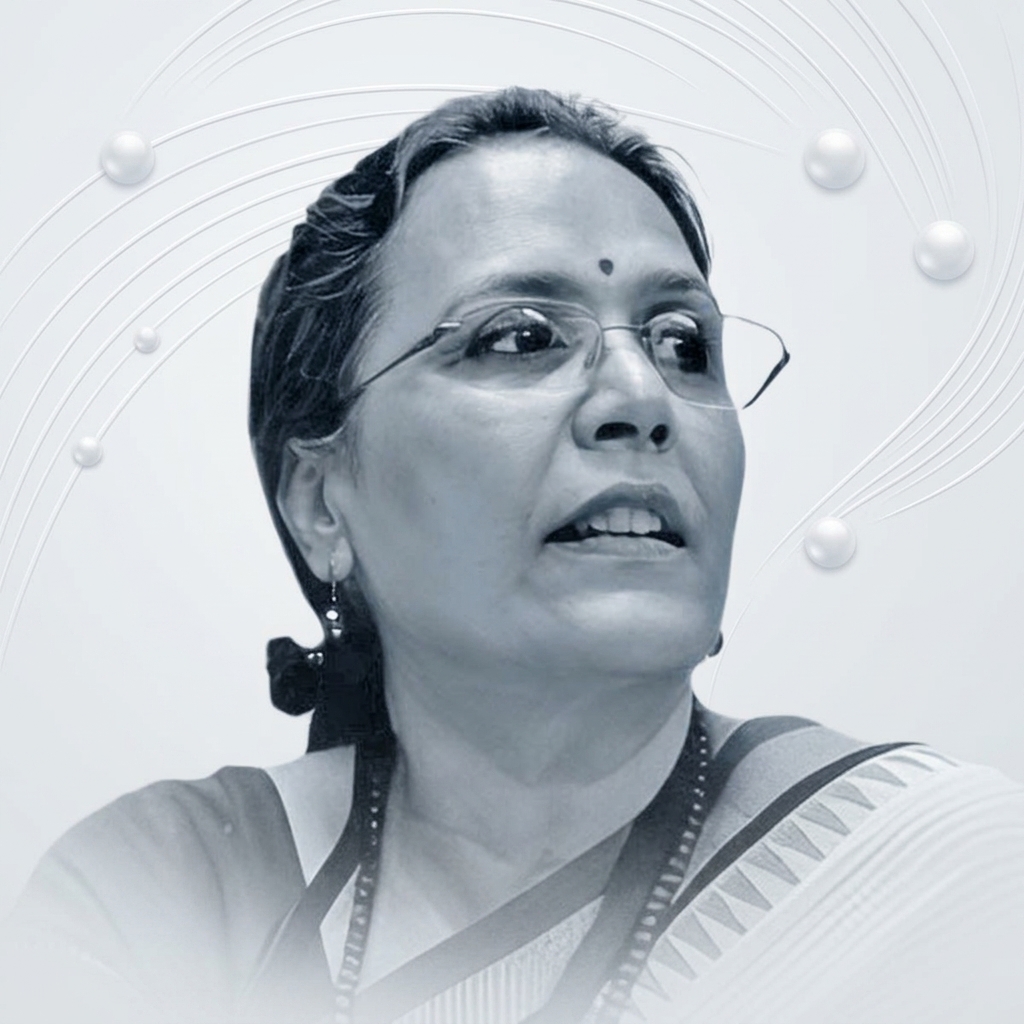
Nandita Chaudhary on family dynamics and cultural psychology
Episode 17 30.03.2021
-
 play_arrow
PLAY EPISODE
Description arrow_drop_down

Description
What can Indian family dynamics teach us about collaboration at every scale? Developmental psychologist Nandita Chaudhary reveals why affection, trust, and empathic leadership are the invisible infrastructure behind every successful partnership , from raising children to running organizations. Subscribe and follow for more conversations on how collaboration works in practice. Nandita Chaudhary, a scholar in child development, family studies, and cultural psychology, joins Paul Verschure and Julia Lupp to explore collaboration through the lens of family life , a perspective rarely examined in organizational or scientific contexts. Drawing on decades of fieldwork with Indian families and international academic experience, Chaudhary offers insights that challenge Western-centric models of teamwork and leadership. The conversation begins with Chaudhary’s formative experience as a Fulbright scholar, where she encountered the hidden power dynamics of international academic collaboration. Arriving in the U.S. as an expert in her field, she was told she was there to learn , an imbalance that shaped her understanding of how collaboration can mask hierarchy. Growing up in a large Indian family had equipped her to read social cues, but the experience revealed how cultural assumptions about knowledge and authority distort collaborative relationships. From there, the discussion turns to family as the original collaborative unit. Chaudhary identifies commonality of purpose, mutual consideration, and affection as the core ingredients. She argues that successful collaboration requires genuine respect for the other person, not just their output, and that collaborations built purely on contractual obligation rarely produce meaningful results. Her example of contributing data to a 36-country study, only to be treated as a passive supplier rather than an intellectual partner, illustrates how extraction masquerades as collaboration. Cross-cultural observations anchor the conversation in concrete detail. Chaudhary describes how something as simple as the absence of pacifiers in India led to a research inquiry , sparked by seeing pacifier trees in Denmark. Collaboration, she argues, is necessary not only to understand others but to understand oneself. Difference is the catalyst. On leadership, Chaudhary makes a distinctive claim: the most important quality for sustaining collaboration is not strategic vision but personal warmth , the ability to draw people toward you. She illustrates this with a story about a daycare caretaker whose value was measured not by stimulation metrics but by whether children ran to her. This quality, she argues, should be present at every node of a collaborative network. The conversation addresses trust directly. Chaudhary describes how large-scale academic collaborations often fail because participants feel surveilled rather than supported. Without the familial template of mutual care, institutional collaboration becomes transactional and fragile. When asked whether humanity can achieve collaboration at the scale our challenges demand, Chaudhary is unequivocal: yes. She points to the global vaccine effort as evidence, while acknowledging imperfections. Her parting insight invokes the Dalai Lama’s emphasis on compassion, understanding the situation of the other person, as the missing element in most collaborative frameworks. Part of the Ernst Strüngmann Forum series on Collaboration, produced with the Convergent Science Network.
Tagged as:
collaboration cultural psychology family dynamics Indian Family International Academic
About the author call_made
CSN Podcasts
Both the triumphs of humanity and its most evil deeds have resulted from collaboration. In a time where humanity is required to aspire to the former and minimize the latter, the question arises of how collaboration arises and why it fails. Surprisingly, this phenomenon, so central to who we are, is not well understood. Hence, a collaborative effort is required to understand collaboration in its full biological, psychological, sociological, cultural, and economic complexity and to translate this understanding into operational impact. This series of podcasts is one step toward achieving these complementary goals. The Collaboration Podcast presents interviews with people who are central orchestrators of collaboration in various domains including business, government, science, art, health, sustainability, and the military. The discussions were conducted by Prof. Dr. Paul F.M.J. Verschure and members of the Program Advisory Committee of the Ernst Strungmann Forum on Collaboration (https://www.esforum.de/forums/ESF32_Collaboration.html) during 2021 and had the goal to sketch a map of opportunities, challenges, and obstacles in human collaboration. The forum took place in May 2022, and now we would like to share this series of interviews with a broader audience. The full report of the Forum will be published in 2023 by MIT Press. The podcast was produced by the Convergent Science Network (https://www.convergentsciencenetwork.org/). Context: The stability of social systems depends critically on realizing sustainable methods of “collaboration,” yet how and by which means collaboration is achieved is not clearly understood; neither are the conditions or processes that lead to its breakdown or failure. Collaboration can be understood as cooperation between agents toward mutually constructed goals. Part of the reason for our lack of understanding is that the phenomenon of collaboration is, by nature, a highly multidisciplinary problem, and effective research into its complexities has been difficult to achieve across the broad range of scientific and technical disciplines involved. The need for a fundamental understanding of collaboration, however, has become increasingly important. Not only does humankind demand answers as it attempts to address critical challenges at multiple scales (e.g., climate change, migration, enhanced automation, social and economic inequality), but ever-increasing technological and economic means of interconnecting people and societies are disrupting long-established, familiar patterns of how we interact. Radical technological changes that are ongoing have the potential to reshape collaboration in ways that are currently hard to predict or influence (e.g., by altering configurations in interaction, information creation, and modes of communication). On one hand, such changes could disrupt hitherto stable forms of collaboration by affecting critical communication channels and traditional roles, as can be observed in the rapidly changing patterns in governance, commerce, and social interaction. Conversely, technology could lead to the emergence of novel, successful forms of collaboration that deviate from traditional “hierarchical” architectures. Evidence of this can be seen in areas as diverse as highly automated manufacturing plants, the open science movement, collaborative software repositories, user-centered services, and the sharing of economy-based modes of organization. Without a fundamental understanding of the mechanisms, processes, and boundary conditions of collaboration, it is not possible to evaluate or predict which of these possible scenarios are sustainable or even plausible. The Forum “How Collaboration Arises and Why it Fails” (May 8–13, 2022, Location: Frankfurt am Main, Germany) Chairs: Andreas Roepstorff and Paul Verschure Program Advisory Committee: Jenna Bednar, Julia R. Lupp, Bhavani R. Rao , Andreas Roepstorff, Ferdinand von Siemens, and Paul Verschure
Episodes
play_arrow
play_arrow

play_arrow

play_arrow
Timestamp
- fast_forward00:00:05 - Hi, I'm Paul Vacheron, together with my colleague Julia Lupp.
- fast_forward00:00:09 - We're speaking today with Nandita Chaudhary, an expert on child development,
- fast_forward00:00:13 - family studies, and cultural psychology, with specific reference to Indian communities.
- fast_forward00:00:19 - A former professor at Laney Urban College at the University of Delhi,
- fast_forward00:00:22 - Nandita began her academic career as a Fulbright Scholar and is currently a
- fast_forward00:00:27 - Senior Fellow of the Indian Council of Social Science Research. search.
- fast_forward00:00:32 - Nandita, welcome to our podcast.
- fast_forward00:00:37 - So, Nandita, could you maybe first give us a little bit of a sketch of your
- fast_forward00:00:43 - professional trajectory that brought you to where you are today with also your
- fast_forward00:00:50 - specific view on collaboration?
- fast_forward00:00:53 - I graduated from
- fast_forward00:00:58 - University of Delhi in what seems like another lifetime ago in 1978 and did
- fast_forward00:01:11 - a little bit of fieldwork work with rural families after that.
- fast_forward00:01:15 - And after that, I joined my alma mater for teaching and have worked there for 37 years.
- fast_forward00:01:23 - In between, I went for my PhD on a Fulbright scholarship to the US at Clark University,
- fast_forward00:01:31 - which, you know, Fulbright is, I don't, I'm sure you're all familiar with it,
- fast_forward00:01:38 - Julia, you would be familiar with it.
- fast_forward00:01:40 - Fulbright is a wonderful opportunity for people from other countries to get together.
- fast_forward00:01:47 - But the excitement of joining the Fulbright program came with a lot of.
- fast_forward00:01:59 - Undisclosed power dynamics um
- fast_forward00:02:03 - so for uh we we
- fast_forward00:02:06 - went for our what is called a pre uh
- fast_forward00:02:10 - for bright training at wharton in
- fast_forward00:02:13 - pennsylvania and that was when i began to see the side of academic collaborations
- fast_forward00:02:21 - which you know till then i was just this wide-eyed uh young scholar and i thought
- fast_forward00:02:27 - Not everybody would just welcome us with open arms and,
- fast_forward00:02:30 - you know, we could say what we liked and give our reviews.
- fast_forward00:02:34 - So I became aware of very quickly.
- fast_forward00:02:38 - So we've grown up in large families and, you know, very used to watching for cues from other people.
- fast_forward00:02:48 - Either way. So if somebody welcomes you, you're quick to pick it up.
- fast_forward00:02:52 - And if somebody tries to sort of ignore you, I mean, even ignoring is a social cue, right?
- fast_forward00:03:02 - So with that kind of social training as a child and as an adolescent,
- fast_forward00:03:09 - I was far perhaps maybe too sensitive to some of these cues.
- fast_forward00:03:16 - It could have been nicer. I wouldn't have noticed many things. So in that training.
- fast_forward00:03:23 - Orientation training, I realized that actually we were informed that when Fulbright
- fast_forward00:03:33 - scholars travel from the U.S.
- fast_forward00:03:36 - To other countries, they go as experts.
- fast_forward00:03:40 - And when Fulbright scholars come into the U.S., they come to learn.
- fast_forward00:03:45 - So, there is a very fundamental imbalance in the way that the Fulbright Scholarship worked.
- fast_forward00:03:54 - And yet, you still have the same label.
- fast_forward00:04:00 - So there's no difference in the label.
- fast_forward00:04:03 - So you don't realize until you are in it that, you know, it's something.
- fast_forward00:04:10 - Anyway, the Fulbright experience was wonderful.
- fast_forward00:04:15 - I learned so much and I was pretty good at computers.
- fast_forward00:04:19 - I really enjoyed deep based in the old format. And I picked up stuff in Clark University.
- fast_forward00:04:26 - Then it was wonderful. wonderful i decided to
- fast_forward00:04:29 - make the best of it um i had
- fast_forward00:04:33 - two young children and you know decided that i
- fast_forward00:04:36 - couldn't leave them behind for nine months so
- fast_forward00:04:39 - i on a shoestring budget we invested all our savings in in traveling and my
- fast_forward00:04:48 - husband uh did join us and you know waited at tables to earn some extra money
- fast_forward00:04:55 - and still the usual thing,
- fast_forward00:04:57 - wonderful times as we remember them, but when you're going through it, it was hard.
- fast_forward00:05:05 - So that was my first experience of collaboration and from which I learned a
- fast_forward00:05:11 - lot, both academically as well as socially, as well as internationally.
- fast_forward00:05:16 - So I was determined that I wanted to come back because first of all, it's an exchange visa.
- fast_forward00:05:23 - So if you uh in my family
- fast_forward00:05:26 - we have four uh siblings two of
- fast_forward00:05:29 - my siblings are very successfully uh
- fast_forward00:05:33 - integrated into the american community one was an iit engineer he still is and
- fast_forward00:05:43 - a technocrat and my sister was a pediatrician so you know we were i mean we
- fast_forward00:05:49 - were all very successful academically So,
- fast_forward00:05:52 - when I had traveled to the US before that, we had seen a very different America.
- fast_forward00:06:01 - And when I went as a scholar, I don't know if you know Worcester,
- fast_forward00:06:06 - which is close to Boston, where Clark University is.
- fast_forward00:06:10 - It was literally in a dump.
- fast_forward00:06:14 - And I saw the side of America that I hadn't seen.
- fast_forward00:06:18 - So again, you know, in terms of experiences, that side of it,
- fast_forward00:06:24 - it was known as a sort of area where Vietnamese immigrants choose to live.
- fast_forward00:06:32 - Many of them who didn't even speak English. So I was actually in that school,
- fast_forward00:06:37 - I was perhaps the most qualified.
- fast_forward00:06:39 - So they put me on the board of the school, which was good fun.
- fast_forward00:06:43 - So that was my initiation into the taste of international politics,
- fast_forward00:06:52 - the beauty of it, the wonder of collaboration,
- fast_forward00:06:58 - as well as the power struggle of wanting to speak.
- fast_forward00:07:02 - I had a good mentor, and she kind of told me that she didn't really understand my work.
- fast_forward00:07:14 - So it was halfway through my PhD that I went because she doesn't know the language.
- fast_forward00:07:21 - But she was very happy to let me express myself, learn whatever I wanted.
- fast_forward00:07:28 - And I remember I used to write my essays for class.
- fast_forward00:07:35 - She used to call them squibs and everyone else would type them and we didn't
- fast_forward00:07:40 - have a computer until halfway through.
- fast_forward00:07:45 - And I remember her saying that I miss your handwriting because your essays always
- fast_forward00:07:51 - add something different to offer.
- fast_forward00:07:54 - So little things like this where your disadvantage advantage seemed to be like
- fast_forward00:08:00 - an advantage, but wasn't really an advantage. So, uh.
- fast_forward00:08:07 - I returned to India to my job. I was on leave again in the university and very happy to come back.
- fast_forward00:08:14 - The label of the Fulbright did a lot for my future.
- fast_forward00:08:20 - So, you became like someone who has returned from a U.S. university.
- fast_forward00:08:25 - And I got the taste of what it is to publish more and to speak in ways
- fast_forward00:08:34 - where you could present your work to someone who doesn't know the background.
- fast_forward00:08:42 - So little things I would say about, let's say, multiple mothering,
- fast_forward00:08:46 - people would be astonished.
- fast_forward00:08:48 - I mean, students in class, scholars at conferences, many went.
- fast_forward00:08:53 - So that taste of that, you know, people enjoying what you say,
- fast_forward00:08:58 - even though they don't know the context, how much to explain,
- fast_forward00:09:01 - and the balance between not wanting to romanticize India, because I think all
- fast_forward00:09:10 - cultures have their problems as well as their beauty.
- fast_forward00:09:16 - I always wanted to make sure that I didn't want to land up, and that was actually
- fast_forward00:09:22 - my kids and my husband were always, look, don't make it sound like it's the
- fast_forward00:09:27 - best place on earth, because it isn't.
- fast_forward00:09:29 - So, that balancing and grounding has always come from my family, actually.
- fast_forward00:09:38 - Which department did you return to when you went back to your university?
- fast_forward00:09:44 - I was in the Department of Human Development and Childhood Studies in the university.
- fast_forward00:09:51 - It comes under the umbrella of home economics.
- fast_forward00:09:57 - And, you know, but when I, for my first ride, I went to the Department of Psychology.
- fast_forward00:10:04 - Okay. So it was, it could be called the discipline of child psychology is where
- fast_forward00:10:09 - I was. Child psychology and family studies.
- fast_forward00:10:11 - Right. But then from there and from your role as an academic in India,
- fast_forward00:10:17 - you also became active in many different organizations and bodies,
- fast_forward00:10:23 - right? So you didn't stay inside academia.
- fast_forward00:10:26 - No. No, because when I returned, the institution in which I work has a very
- fast_forward00:10:35 - high commitment to community development.
- fast_forward00:10:38 - So it was always told to us that in a poor country, you cannot afford just to write academic papers.
- fast_forward00:10:46 - You need to be involved with society, with decision making, with administration.
- fast_forward00:10:50 - So don't just do that part of it, do your work for development,
- fast_forward00:10:56 - share your knowledge with others.
- fast_forward00:10:58 - So that, you know, parent meetings, teacher training programs,
- fast_forward00:11:05 - high court, child custody issues.
- fast_forward00:11:08 - So these were the other things in which I became involved,
- fast_forward00:11:12 - along with which the label and the successful completion of Hopeful Bright gave
- fast_forward00:11:20 - me the entry into international conferences,
- fast_forward00:11:25 - how you write papers, how you present yourself.
- fast_forward00:11:28 - How you prepare presentations.
- fast_forward00:11:31 - Presentations so i was able to
- fast_forward00:11:34 - keep these different sides
- fast_forward00:11:38 - of the only thing i never really enjoyed was administration so i'll be honest
- fast_forward00:11:45 - when i had to do it uh it was a headache and i had to do it twice over so it's
- fast_forward00:11:51 - the six years of headship of my department and i wasn't happy doing that.
- fast_forward00:11:56 - It took away time from doing the things I love.
- fast_forward00:11:59 - And Nandita, currently, what are your main activities in that trajectory?
- fast_forward00:12:05 - Where do you spend most of your time on?
- fast_forward00:12:08 - Okay, so I chose to quit my work in 2016.
- fast_forward00:12:15 - I would have been on the faculty till 2022, but.
- fast_forward00:12:22 - For personal reasons, my husband was posted in Bombay and I hadn't had enough.
- fast_forward00:12:27 - My kids had left and they were studying and they got married and left the country.
- fast_forward00:12:33 - And I decided I just didn't want to stay alone.
- fast_forward00:12:37 - And I wanted to do, I just quit actually.
- fast_forward00:12:42 - In retrospect, I can attribute reasons.
- fast_forward00:12:46 - But that time, people said, why don't you take leave? I said, no, I want a clean break.
- fast_forward00:12:52 - From academics, from teaching, not from academics.
- fast_forward00:12:57 - Now, Nandita, if we focus a minute on the work that you have done over the years
- fast_forward00:13:03 - in terms of looking at patterns of child care in families,
- fast_forward00:13:10 - perhaps now that you have a little bit of distance, you can also look at it
- fast_forward00:13:15 - reflecting back in a slightly different manner.
- fast_forward00:13:19 - And I think it would be interesting to spend a moment thinking
- fast_forward00:13:23 - about these patterns of child care
- fast_forward00:13:26 - because in a way a family is
- fast_forward00:13:29 - nothing but a big collaborative effort to raise children and could you perhaps
- fast_forward00:13:34 - um do you see different patterns in different areas rural versus urban um say
- fast_forward00:13:44 - let's focus on india first so uh.
- fast_forward00:13:49 - A lot of what,
- fast_forward00:13:53 - so I could never quit thinking about the family and about childhood, right?
- fast_forward00:13:59 - So my mind is always alert to what's going on on the street,
- fast_forward00:14:05 - in the neighborhood, if I'm traveling in a train or a bus or a plane.
- fast_forward00:14:09 - So if I see a father holding a baby, so I do a lot of posts on Facebook.
- fast_forward00:14:15 - Book and then I started my blog which was really
- fast_forward00:14:18 - to express myself which really filled in the space that teaching had left it
- fast_forward00:14:25 - was like an extended classroom for me so I began to sort of consolidate some
- fast_forward00:14:31 - of the work that I was doing and writing for the lay public,
- fast_forward00:14:38 - was something that although mostly I think it was just the students who were
- fast_forward00:14:44 - loyal to me who who were reading my blog, honestly.
- fast_forward00:14:47 - But I imagined a larger audience.
- fast_forward00:14:52 - And it also, very strangely, these ideas would come to me.
- fast_forward00:15:00 - A single encounter could initiate a whole article.
- fast_forward00:15:06 - So as I said, you see physical punishment, as you may know, is a very difficult issue.
- fast_forward00:15:16 - Or you hear a father saying something or you hear a grandparent doing something.
- fast_forward00:15:23 - It lets off, you know, like, for instance, there was just this idea when I went
- fast_forward00:15:30 - to Denmark, for a conference, we saw this pacifier trees.
- fast_forward00:15:33 - So in Denmark, I don't know if you know, they hang the, they call it dummies,
- fast_forward00:15:40 - or they hang them on trees so that the child has a sort of, you,
- fast_forward00:15:45 - okay, here, you give up your pacifiers now.
- fast_forward00:15:47 - So there are like Christmas decorations. I was stunned by that.
- fast_forward00:15:53 - And then the question came up in my head.
- fast_forward00:15:57 - I don't see pacifiers in India. What is behind it? So I came back and I initiated a conversation.
- fast_forward00:16:04 - Now, none of this is part of any formal research study, but I had students who
- fast_forward00:16:10 - were, I would just write to them and say, look, can you ask 10 people about
- fast_forward00:16:16 - this or do it as a class assignment?
- fast_forward00:16:19 - And we came up with, you know, sort of anecdotal responses Responses to why
- fast_forward00:16:25 - pacifiers are just not something that are used in India.
- fast_forward00:16:31 - And at the end of the day, you may give a thousand philosophical explanations,
- fast_forward00:16:35 - but it's a tropical country and you can get infected.
- fast_forward00:16:39 - Right. So, Nandita, to a very straightforward question, how do you define collaboration?
- fast_forward00:16:48 - What is collaboration and what is it good for?
- fast_forward00:16:55 - In order, I think that for academics, isolated, let me put it the other way.
- fast_forward00:17:06 - Academic ventures without collaboration are meaningless for me.
- fast_forward00:17:11 - Because unless you bounce your ideas, unless they are mirrored of someone else,
- fast_forward00:17:16 - Like, for instance, had I not traveled, had I not seen those pacifier trees,
- fast_forward00:17:25 - I would not have looked back at our families and realized, hey, this is missing.
- fast_forward00:17:34 - Why is it missing? when you talk
- fast_forward00:17:38 - about sleeping who sleeps by whom um
- fast_forward00:17:41 - you know i remember so clearly
- fast_forward00:17:45 - that uh you know students still
- fast_forward00:17:49 - very warmly used to
- fast_forward00:17:52 - talk about sleeping with their mothers when their dads were
- fast_forward00:17:55 - away so when it is
- fast_forward00:17:58 - when you see difference that
- fast_forward00:18:03 - you can look back at yourself so i think that collaboration is necessary not
- fast_forward00:18:08 - only to understand the other but also to understand the self but but now if
- fast_forward00:18:13 - we look at the family dynamics as you described it just earlier what makes that
- fast_forward00:18:21 - collaborative under what what features make interactions in a family collaborative.
- fast_forward00:18:30 - Um within a family or between but let's start within the family yes commonality
- fast_forward00:18:36 - of purpose um ideology um um consideration
- fast_forward00:18:43 - for each other love affection i would say so that can carry on,
- fast_forward00:18:49 - um i would not i have done
- fast_forward00:18:52 - some collaborations with people i didn't like they were
- fast_forward00:18:55 - never successful so for me that underlying thread
- fast_forward00:18:59 - of affection is very important even within the family uh you know if if i lose
- fast_forward00:19:06 - respect for someone so respect for the other person and his or her scholarship
- fast_forward00:19:11 - i have to look up to something in the other person in order to collaborate,
- fast_forward00:19:17 - even if it's somebody much younger than I.
- fast_forward00:19:20 - Sure, but can you unpack affection and love? What does that mean in that context, actually?
- fast_forward00:19:31 - Like conversations with the person? So the person listens to you,
- fast_forward00:19:35 - you listen to that person, I would say.
- fast_forward00:19:42 - You know the person makes you want to
- fast_forward00:19:44 - smile i mean it's it's it's uh if you
- fast_forward00:19:48 - are struggling to present yourself and
- fast_forward00:19:51 - also the person accepts you for who you are not
- fast_forward00:19:54 - what they want me to be so for example i collaborated with a project which was
- fast_forward00:20:00 - like 36 countries okay I was just
- fast_forward00:20:04 - like this passive bit of India that they wanted data from and that's it.
- fast_forward00:20:13 - After that, we had nothing to say, nothing to do.
- fast_forward00:20:16 - So unless I could speak up, I never went back to that because I realized that I had been sucked upon.
- fast_forward00:20:26 - Something had been sucked out of me, taken
- fast_forward00:20:30 - away and used in my name
- fast_forward00:20:33 - is there on the publications i don't you know it doesn't it's meaningless for
- fast_forward00:20:38 - me honestly but would you still consider that a collaboration or would that
- fast_forward00:20:43 - be something else is it more coercion no abuse or it's it's uh it's not a collaboration it's.
- fast_forward00:20:51 - Perhaps, I think it's unethical. I mean, that kind of collaboration is not acceptable to me.
- fast_forward00:20:59 - So, you know, at the slightest hint of it, I became better at realizing who
- fast_forward00:21:07 - to avoid as I went on in my, you know.
- fast_forward00:21:13 - And somehow, I've never been attracted by large funds. Money has never been
- fast_forward00:21:20 - something that I have run after.
- fast_forward00:21:23 - So, you know, it gives you so free to say, no, I'm not interested.
- fast_forward00:21:29 - So commonality of purpose is not enough in this case in academic collaboration.
- fast_forward00:21:36 - What about, say, a collaborative view of the family where commonality of purpose
- fast_forward00:21:44 - obviously is to raise children?
- fast_forward00:21:47 - Children, what other elements are important in the family unit to ensure successful child rearing?
- fast_forward00:21:56 - I think I will admit, even though I'm not good at administration myself,
- fast_forward00:22:01 - I will admit that you need well-defined rules and, you know, an acceptance.
- fast_forward00:22:08 - Acceptance and uh i have
- fast_forward00:22:11 - been very fortunate in the fact that not only do my husband and i share an affection
- fast_forward00:22:18 - and whenever i've seen that in families i can pick it up immediately but he
- fast_forward00:22:23 - has great regard for me as a mother so in front of the children so i see that as a very important
- fast_forward00:22:31 - element of uh collaboration and commonality of purpose i mean there are families
- fast_forward00:22:37 - in which it doesn't happen where you know there are different individuals who
- fast_forward00:22:41 - are living together i don't see that as a collaborative relationship so um you
- fast_forward00:22:47 - know this triangulation so in in.
- fast_forward00:22:52 - For the researchers, now, if we are talking about the researchers who are actually
- fast_forward00:23:01 - going out into the field,
- fast_forward00:23:02 - you can collaborate with them or you can give them instructions.
- fast_forward00:23:08 - I don't see just giving instructions as collaboration.
- fast_forward00:23:12 - That's right. Unless they are at the desk and there is a mutuality of discussion
- fast_forward00:23:17 - and they have the authority to speak up and say, no, this is wrong.
- fast_forward00:23:22 - You're interpreting this.
- fast_forward00:23:25 - I was there. I know what it's like. So I see democratic structures as a very,
- fast_forward00:23:34 - I don't mean democratic in the sense that my kids could do what they like.
- fast_forward00:23:40 - No, we were paying the bills, so we could decide, look, you can't buy this.
- fast_forward00:23:45 - However, for speaking up about in a research collaboration or in a family collaboration.
- fast_forward00:23:58 - Especially once the kids are old enough or the researcher is an expert enough,
- fast_forward00:24:03 - I'm using the same metaphor here.
- fast_forward00:24:08 - Participation in the uh in the
- fast_forward00:24:13 - process and the outcome and looking
- fast_forward00:24:16 - back at it i mean i how many times
- fast_forward00:24:19 - with with the kids i've sat down and you know how
- fast_forward00:24:22 - am i as a mother i mean so we sort of sit and
- fast_forward00:24:26 - evaluate and i know it wasn't always
- fast_forward00:24:28 - fun for them because can you please stop you know
- fast_forward00:24:31 - you're you're fine we are we'll be okay
- fast_forward00:24:34 - but uh this making the
- fast_forward00:24:40 - other person feel um significant
- fast_forward00:24:45 - for what you're collaborating towards so it's nandita you're also working Working
- fast_forward00:24:55 - with the Delhi High Court Mediation Center for Child Custody Cases, right, as an expert.
- fast_forward00:25:01 - And in some sense, those are the examples where this kind of family collaboration is breaking down.
- fast_forward00:25:09 - So what makes the difference in those cases? Is there a pattern to that where you say,
- fast_forward00:25:14 - well, across the board, across all these cases I looked at, it always breaks
- fast_forward00:25:20 - down along predictable patterns. Is there such a pattern to that?
- fast_forward00:25:28 - One of the things that I've noticed is that there is something like unhealthy
- fast_forward00:25:37 - love for your child or for your idea or your project.
- fast_forward00:25:48 - If you love, I mean, at least in the high court cases, I always said that it
- fast_forward00:25:54 - was not that the child is not loved, but you love the child so much that you want to own it.
- fast_forward00:25:59 - And if you're not getting along with someone, you're not able to get along with that other person.
- fast_forward00:26:04 - So in most cases of child custody, where mostly women would completely undermine the role of the father.
- fast_forward00:26:18 - To the child as well as to the court in order to claim ownership of the child.
- fast_forward00:26:24 - So running down the father was a very important, or father or his family.
- fast_forward00:26:29 - And I have seen grandparents. So in India, we have kin terminology that distinguishes
- fast_forward00:26:35 - between the maternal and the paternal grandparents.
- fast_forward00:26:39 - So it's very easy. In one word, you can make out which side of the family you're talking about.
- fast_forward00:26:45 - I've seen it even more seriously in grandparents.
- fast_forward00:26:50 - So they become so overpowering. The love for the daughter and for the grandchild
- fast_forward00:26:55 - is so much that this other person is seen as outside.
- fast_forward00:26:59 - And trying to even tell them that, look, the child has a right to the father.
- fast_forward00:27:04 - The father has a right to the child. But Nandita,
- fast_forward00:27:08 - is that always love with a big L or is it also instrumentalization of that child
- fast_forward00:27:17 - because that child is also contributing to your own future?
- fast_forward00:27:22 - I'm using the terminology of the client.
- fast_forward00:27:26 - They say it is their love for the child. I can see it differently.
- fast_forward00:27:30 - But who am I to put words into their mouth and to evaluate what their love is?
- fast_forward00:27:37 - Because ultimately, at the end of the day, I don't know the full story.
- fast_forward00:27:41 - I can never know the full story as the other.
- fast_forward00:27:45 - It is only what is presented. Some of it will be exaggerated.
- fast_forward00:27:48 - Some of it will be silenced. So it's, I don't know, when I'm not inside the
- fast_forward00:27:56 - high court, I would always be overcome with worry.
- fast_forward00:28:01 - About will I be able to see and do justice for the children.
- fast_forward00:28:07 - Because the High Court is relying on you as an expert.
- fast_forward00:28:10 - So in some sense, the High Court wants you to translate that love to them. So let me finish.
- fast_forward00:28:18 - However, when I was in the room,
- fast_forward00:28:22 - I never had any, I didn't have doubts.
- fast_forward00:28:28 - Somehow I could see and I would just write out if I did have,
- fast_forward00:28:34 - so I was never asked to appear.
- fast_forward00:28:37 - I would be asked to give a written report.
- fast_forward00:28:40 - So if there were areas, I would write out exactly what I thought.
- fast_forward00:28:50 - Was happening there. right and
- fast_forward00:28:54 - what the recommendation would be so i would always insist that you know i don't
- fast_forward00:29:01 - know i mean we have so much uh you know media coverage of uh,
- fast_forward00:29:12 - women's issues in my experience i have found that in cases of family dynamics
- fast_forward00:29:20 - it is really the a father who suffers far more, in my experience.
- fast_forward00:29:26 - Maybe I'm wrong.
- fast_forward00:29:29 - But the claim that the mother has and the ease with which fathers are dismissed,
- fast_forward00:29:35 - I cannot speak of other countries.
- fast_forward00:29:38 - I don't know the legal dynamics there. there but um
- fast_forward00:29:42 - i see that
- fast_forward00:29:45 - as a very uh critical loss for the children who are growing up in how do you
- fast_forward00:29:53 - explain that is that the bias in the system or um um i think we over dramatize uh.
- fast_forward00:30:04 - Motherhood yes I would say that there is a
- fast_forward00:30:07 - lot of romanticism about being mother and
- fast_forward00:30:10 - you know with Bollywood and you have things of okay if you've had your mother's
- fast_forward00:30:16 - milk uh then you are you know it binds you forever and you know all that kind
- fast_forward00:30:22 - of uh I I don't really buy into that I could see how much of that is just hyperbolic but.
- fast_forward00:30:32 - I don't see that much in terms of fatherhood.
- fast_forward00:30:36 - It hasn't kept pace with so and we have very,
- fast_forward00:30:44 - serious feminist movements which all they do I mean they do protect women against
- fast_forward00:30:54 - abuse and And I'm not saying that that's not an important issue,
- fast_forward00:30:57 - but to ensure that we don't lose sight of the place of every member in the family,
- fast_forward00:31:07 - including grandparents.
- fast_forward00:31:09 - I mean, in Indian families, grandparents play a key role.
- fast_forward00:31:12 - So the politics of the family is something that is very hard to describe, but often easy to sense.
- fast_forward00:31:28 - But now, do you apply certain models to that?
- fast_forward00:31:32 - Do you have, let's say, an X number of models of family dynamic and say,
- fast_forward00:31:38 - oh, this is model one and this is model two?
- fast_forward00:31:41 - No i don't no i
- fast_forward00:31:44 - do it just really from the seat of my chair because i'm not trained as a counselor
- fast_forward00:31:51 - and uh they kept calling me back i kept saying look i'm not trained in counseling
- fast_forward00:31:58 - but one thing did happen which is the reason why i um.
- fast_forward00:32:06 - Eased off is that I didn't know how to stand back and just return to my life.
- fast_forward00:32:18 - So I would, you know, I would ruminate over these cases and I would talk to
- fast_forward00:32:23 - my children and I would come home and I'd talk to my husband and like, how can people do this?
- fast_forward00:32:29 - So that was taking a toll on me.
- fast_forward00:32:32 - So when i uh quit work and i moved
- fast_forward00:32:35 - to bombay i was quite relieved and
- fast_forward00:32:39 - i haven't actually told them that i've come back to delhi
- fast_forward00:32:42 - so you can see that somewhere it was taking um too much of my i it would just
- fast_forward00:32:49 - break my heart to um and i didn't know i wasn't trained to uh protect myself
- fast_forward00:32:57 - from In these cases, Nandita,
- fast_forward00:33:00 - is there a pattern in terms of the base family dynamics?
- fast_forward00:33:05 - For example, I recall some of the descriptions you made earlier in the context
- fast_forward00:33:12 - of the attachment and bonding form about families where the father took a primary
- fast_forward00:33:18 - role in caregiving because the women were going to the market working outside.
- fast_forward00:33:23 - And so I'm asking, do you see patterns of behavior where there's this major breakdown?
- fast_forward00:33:30 - You speak of where the fathers suffer.
- fast_forward00:33:34 - Is it in families where the fathers are playing a primary care role or a secondary? No, the secondary.
- fast_forward00:33:43 - It is one thing I noticed very clearly.
- fast_forward00:33:47 - When the maternal grandparents are too close to the mother and participate in
- fast_forward00:34:00 - every single decision that she takes.
- fast_forward00:34:05 - That is the situation that i have
- fast_forward00:34:08 - seen very often and that isolates the farm so
- fast_forward00:34:12 - in fact uh my problem although it's a patriarchal unit and you know indian families
- fast_forward00:34:18 - by and large not all are patriarchal by and large uh you live with and closer
- fast_forward00:34:25 - to your paternal grandparents i see the
- fast_forward00:34:30 - mother and mother's mother.
- fast_forward00:34:34 - When this bond is too strong,
- fast_forward00:34:39 - at least four or five of the cases were such that my precious girl,
- fast_forward00:34:48 - how could this happen to her?
- fast_forward00:34:53 - In fact, I'm realizing this as I'm speaking with you uh.
- fast_forward00:35:01 - I see that as, and not so much.
- fast_forward00:35:04 - Of course, this also would play out far more in relationships where the couple
- fast_forward00:35:11 - were not terribly close to each other or didn't get along.
- fast_forward00:35:15 - So it exacerbated that. But the mother is too close to her mother,
- fast_forward00:35:20 - hasn't been able to disengage.
- fast_forward00:35:22 - Nandita, doesn't it also play a role that the parents of the wife,
- fast_forward00:35:29 - of the mother in some sense also often have committed a dowry into the wedding does that not,
- fast_forward00:35:39 - strengthen or amplify their concerns like oh we have actually put our life savings
- fast_forward00:35:44 - into this and now it's that we stand to lose it all that's information i would not have access to,
- fast_forward00:35:53 - I have not heard I have not heard anyone
- fast_forward00:35:56 - say that it's mostly that you know the people who come into the high court for
- fast_forward00:36:05 - mediation were mostly middle and upper middle class not all were highly educated so in which.
- fast_forward00:36:16 - Which, the case of dowry did come up when one couple was trying to divide property.
- fast_forward00:36:24 - But not as I invested in my daughter.
- fast_forward00:36:30 - Maybe it's there at the back of the mind, but it never surfaced during in my experience at all.
- fast_forward00:36:36 - But now also, you mentioned this power imbalance.
- fast_forward00:36:39 - Do you see that as a major underlying factor that, for instance,
- fast_forward00:36:48 - the wife-mother with her parents have developed so much of a dominance in the
- fast_forward00:36:56 - discussion, in the discourse,
- fast_forward00:36:58 - that the man-husband without, let's say, family support is sort of a minority
- fast_forward00:37:06 - and cannot push back against that?
- fast_forward00:37:08 - So are these power relationships important here?
- fast_forward00:37:15 - Absolutely i would say that they're
- fast_forward00:37:18 - critical here and um in in the case
- fast_forward00:37:21 - of one uh grandparent of the
- fast_forward00:37:25 - uh the paternal grandparent also
- fast_forward00:37:28 - it's it's crazy but in
- fast_forward00:37:30 - all of these cases there has been the role
- fast_forward00:37:34 - of the grandparents has been critical but then you
- fast_forward00:37:37 - know knowing the indian family that's not coming as a surprise
- fast_forward00:37:40 - so i don't know how often it
- fast_forward00:37:43 - is that it's just two people
- fast_forward00:37:46 - who are falling out of love with each other i don't remember a single case like
- fast_forward00:37:52 - that right but that raises the next question right but what what defines the
- fast_forward00:37:58 - force behind the power is it also the husband having fear of losing face?
- fast_forward00:38:07 - Is it fear of being, let's say, confronted with emotion or to lose love of the
- fast_forward00:38:17 - wife and her family or lose the children?
- fast_forward00:38:20 - So what are the underlying forces?
- fast_forward00:38:22 - Mostly the loss of face.
- fast_forward00:38:25 - And I would say the loss of face for the daughter
- fast_forward00:38:29 - and the daughter's family would in the
- fast_forward00:38:31 - traditional system be far
- fast_forward00:38:35 - more serious than for the man this is something
- fast_forward00:38:38 - you hear all the time in India that it's much easier for men I don't know about
- fast_forward00:38:42 - the west I don't know about you know Germany for instance but here we keep saying
- fast_forward00:38:49 - that it's it's very easy for a man to get remarried much harder for a woman
- fast_forward00:38:54 - to get remarried especially if there are children.
- fast_forward00:39:00 - I think the loss of pace issue is there for all it's not but it something has
- fast_forward00:39:06 - changed in the last 10 years and,
- fast_forward00:39:10 - It's far more common in the families, at least now that I'm not practicing for
- fast_forward00:39:19 - the last so many years, among our acquaintances to break off.
- fast_forward00:39:25 - Now people say, now we're not going to stay together like our parents.
- fast_forward00:39:29 - It's not something that I'm going to tolerate.
- fast_forward00:39:33 - So a lot of women are standing up and walking out. and some people in the older
- fast_forward00:39:41 - generation you hear them saying that women are becoming too intolerant.
- fast_forward00:39:46 - And you know families are
- fast_forward00:39:51 - breaking so the change is very significant
- fast_forward00:39:54 - in all social classes I would say
- fast_forward00:39:57 - my the person who works in my house her daughter
- fast_forward00:40:00 - has married this is her
- fast_forward00:40:03 - she was engaged aged it broke off she got married she broke it off because she
- fast_forward00:40:07 - didn't like the guy she's now married to a third person has a child but doesn't
- fast_forward00:40:11 - like to live in the village and she's living with the next to next door to her
- fast_forward00:40:16 - mother and raising her child so it's becoming far more acceptable,
- fast_forward00:40:21 - in cities and towns to
- fast_forward00:40:25 - break off villages i would
- fast_forward00:40:28 - say it's still harder so okay but there is
- fast_forward00:40:30 - a a paradox in that right because earlier
- fast_forward00:40:33 - you said that often it's the man who has the short end of the stick in your
- fast_forward00:40:39 - experience while another it also is the case that the man apparently has much
- fast_forward00:40:47 - more opportunity to just leave and break off the whole the whole marriage and go.
- fast_forward00:40:52 - Well, I don't, that's what people say. I'm not sure.
- fast_forward00:40:56 - In my experience, I think men have the short end of the stick.
- fast_forward00:41:00 - Like even with my helper's daughter, who's now gone through a second marriage,
- fast_forward00:41:06 - I feel bad for the guy because she just told him, I don't like living in the village.
- fast_forward00:41:11 - And, you know, either you come and live here or we are done.
- fast_forward00:41:14 - So, patriarchy perhaps is based on the fragility of men.
- fast_forward00:41:34 - I don't know. I mean, I'm just speculating.
- fast_forward00:41:39 - So, there are different ramifications of this, right? So we looked at family
- fast_forward00:41:44 - structure, also in your experience, especially in the Indian context.
- fast_forward00:41:50 - And this raises, of course, the question whether the family is sort of the proto-collaborative unit.
- fast_forward00:41:58 - So you could also say from an evolutionary perspective, that's how collaboration
- fast_forward00:42:04 - emerged. It started with family units or larger family units,
- fast_forward00:42:08 - and from there, it developed and became more structured.
- fast_forward00:42:13 - Is that how you would see it? Do you really see the family unit as the proto-form of collaboration?
- fast_forward00:42:22 - Even autobiographically, I would say that my family, I learned so much,
- fast_forward00:42:28 - and I was so sensitive to what I didn't learn from my family as well.
- fast_forward00:42:33 - So it's not just what you learn, but what you realize, oh my God,
- fast_forward00:42:37 - I never knew this, or my mother never pointed this out to me.
- fast_forward00:42:44 - So in my judgment.
- fast_forward00:42:50 - Family screws you for life, sorry for what, you know, all of us have been impacted
- fast_forward00:42:57 - by the families in which we've grown up.
- fast_forward00:43:01 - You can either be very sensitive to the issue or you react to it,
- fast_forward00:43:06 - but you can never be indifferent to what you experience.
- fast_forward00:43:09 - So, for instance, if there is an alcoholic father, let's just take a severe
- fast_forward00:43:16 - example, you would either become like that yourself, and I'm not saying family is destiny.
- fast_forward00:43:22 - I mean, it's not that you cannot get out of it, but or you will become so sensitive.
- fast_forward00:43:29 - You will never remain indifferent to the serious aspects of what you have experienced.
- fast_forward00:43:40 - I don't really know if this is what you wanted to talk about.
- fast_forward00:43:43 - The other aspect is, and that's also what Julia mentioned at the beginning,
- fast_forward00:43:48 - one of the issues that you also insist on is cultural difference.
- fast_forward00:43:54 - To say, look, there's no universality here. And that's also your example of
- fast_forward00:43:58 - your Fulbright experience, the asymmetry in the perception of that.
- fast_forward00:44:04 - So now we can look again at this family model of collaboration,
- fast_forward00:44:08 - and then what are the cultural differences that you see there, if any?
- fast_forward00:44:17 - Well, I think that, you know….
- fast_forward00:44:24 - The power that the older generation exerts on the younger,
- fast_forward00:44:32 - places certain limits that I see being crossed in other cultures.
- fast_forward00:44:41 - Where obligatory actions are not seen as something, I'm not going to just appear
- fast_forward00:44:49 - for this ceremony because the family is getting together because I'm obliged to you.
- fast_forward00:44:55 - Whereas here, a lot of time is spent in that, you know, a peace.
- fast_forward00:45:01 - I don't know if it's appeasement would be too much, but you also get back in
- fast_forward00:45:08 - these asymmetrical relationships.
- fast_forward00:45:11 - And believe me, by asymmetrical, I don't mean undemocratic.
- fast_forward00:45:16 - It may be, you know, paradoxical what I'm trying to say Because I think asymmetry
- fast_forward00:45:24 - is a key fact of human relationships,
- fast_forward00:45:31 - but that doesn't imply absolute power over others, because that would be unacceptable.
- fast_forward00:45:39 - You know, it would be an unhealthy relationship to live in.
- fast_forward00:45:44 - But as often as that I have seen enmeshed relationships in the name of what love be as hurtful,
- fast_forward00:45:58 - towards others because when you have that much affection for one person it's
- fast_forward00:46:03 - always at the expense of others so if you have two children you have to have a certain sense of,
- fast_forward00:46:12 - you know.
- fast_forward00:46:15 - Equity between the two relationships.
- fast_forward00:46:19 - So, in spite of the hierarchical structures,
- fast_forward00:46:26 - there has to be a sense of justice in order for there to be genuine and happy collaboration,
- fast_forward00:46:35 - whether it's families or professions.
- fast_forward00:46:38 - An important aspect in collaboration is also a notion of trust.
- fast_forward00:46:43 - Is trust in some sense encapsulated in this sense of love that you spoke about earlier?
- fast_forward00:46:51 - Is that also trust or is that something else?
- fast_forward00:46:57 - I'll give you an example of a collaboration that I did where I came to realize
- fast_forward00:47:06 - how critical trust was for me.
- fast_forward00:47:08 - Um perhaps because i
- fast_forward00:47:11 - have had a very trusting um
- fast_forward00:47:15 - very trusting parents
- fast_forward00:47:18 - and grandparents with many other faults but they trusted us uh and and we trusted
- fast_forward00:47:26 - that our love for them and the fact that they would provide for us there was
- fast_forward00:47:32 - a collaboration that we did in which um.
- fast_forward00:47:36 - For the first time, rather than doing observations of children in the home.
- fast_forward00:47:43 - We decided, the person decided that he wanted to do a lab study.
- fast_forward00:47:49 - Okay, so please set up a lab because we want a structured setting.
- fast_forward00:47:54 - So we set up a lab. We tried getting parents to come.
- fast_forward00:47:59 - And parents, these are parents of 12 to 18-month-old children.
- fast_forward00:48:03 - So we had somebody would relatives have
- fast_forward00:48:06 - come or somebody would fall sick you didn't get
- fast_forward00:48:09 - transport then we said okay so at
- fast_forward00:48:13 - every point we tried to communicate with the person who had given the grant
- fast_forward00:48:19 - and who was the project director to say look okay let's try making satellite
- fast_forward00:48:24 - labs so let's find Find an institution closer to the residential areas,
- fast_forward00:48:31 - get a group of kids together, and let them come.
- fast_forward00:48:35 - It was so hard to find safe places that would fulfill the requirement and pay rent for these.
- fast_forward00:48:44 - In the end, we were able to get only one-fourth of the target sample,
- fast_forward00:48:50 - whereas we had never had a problem in home-based studies because parents are very welcoming.
- fast_forward00:48:56 - Oh, you've landed up? Okay, let's accommodate you.
- fast_forward00:48:59 - But to take the initiative to come out to a lab, even though,
- fast_forward00:49:04 - so he was a German professor, so he said, but they gave you an appointment.
- fast_forward00:49:12 - I said, look, they may have, but they haven't landed up.
- fast_forward00:49:17 - It was so hard for me to communicate. decade
- fast_forward00:49:20 - so at that point that person wrote an
- fast_forward00:49:23 - email to me saying that your research
- fast_forward00:49:26 - staff that you know something about i
- fast_forward00:49:29 - trusted you with this and i just lost
- fast_forward00:49:33 - that is one direct um
- fast_forward00:49:38 - you know email exchange that i have
- fast_forward00:49:41 - had with this person and of course he's and we
- fast_forward00:49:44 - had a long-standing in collaboration and he's we
- fast_forward00:49:47 - have a mutual friend whom I hold in very
- fast_forward00:49:50 - high regard and I tried but after
- fast_forward00:49:53 - that I just decided I said you know
- fast_forward00:49:56 - when that you haven't understood the setting
- fast_forward00:50:00 - in which we were and he's not it's not that he wasn't familiar with the he's
- fast_forward00:50:06 - traveled to India he's lived with us and you know lived in my home I've never
- fast_forward00:50:11 - had problems with extending understanding hospitality because i know how hard
- fast_forward00:50:15 - it is to do field work in india,
- fast_forward00:50:18 - and at the end of the day to say that you didn't finish what was your commitment
- fast_forward00:50:23 - and i trusted you to do that that was for me uh you know a closed issue i just
- fast_forward00:50:32 - would not want to collaborate with something like this because Because...
- fast_forward00:50:37 - I don't know why but I expect people to trust me 100% and I do the same with
- fast_forward00:50:44 - someone else when often in personal relationships if I'm disappointed then I'm
- fast_forward00:50:50 - really badly disappointed.
- fast_forward00:50:52 - So you're absolutely right, being trusted for me is perhaps even more important than trusting.
- fast_forward00:51:07 - Because Indians are known as shifty-eyed or whatever.
- fast_forward00:51:11 - I mean, they're poor, so they will misappropriate funds.
- fast_forward00:51:17 - I'm very sensitive to those, even if they are hinted at.
- fast_forward00:51:22 - But now in the context of the family dynamic that you also studied,
- fast_forward00:51:28 - there are different trust-based relations, right?
- fast_forward00:51:32 - Also, the children trust their parents, they trust their family almost as a given.
- fast_forward00:51:41 - So what's the dynamics of trust there? How does it get built up and how does it get destroyed?
- fast_forward00:51:54 - How it would get destroyed is very hard for me to say.
- fast_forward00:51:59 - How it is built up is that it's tied so closely to the issue of affection and
- fast_forward00:52:05 - love that I was talking about,
- fast_forward00:52:08 - because I cannot imagine love without trust and trust without love.
- fast_forward00:52:19 - This is really interesting, right? Because if we now start to generalize,
- fast_forward00:52:23 - let's now look at collaboration, the big picture type collaboration,
- fast_forward00:52:27 - like your project with 30 partners.
- fast_forward00:52:30 - And their standard view is, well, you need shared goals and you need trust.
- fast_forward00:52:36 - But now, does it actually imply that what we're really talking about is also
- fast_forward00:52:40 - love for that conglomerate, love for those goals?
- fast_forward00:52:46 - Would you find that a plausible generalization? Or is that notion of trust actually
- fast_forward00:52:51 - something else than the trust inside the family?
- fast_forward00:52:54 - I would say that the minute it becomes,
- fast_forward00:52:59 - when an idea becomes an industry, when it becomes, I do believe that a small group is far more,
- fast_forward00:53:11 - you know, it's far more possible to be trustworthy and to be trusting in a smaller group.
- fast_forward00:53:18 - When there are these 30 countries and 30 or let's say 60 different collaborations
- fast_forward00:53:25 - with satellite members,
- fast_forward00:53:28 - I have experienced that there is….
- fast_forward00:53:36 - A lack of trust. Okay, so how did you get this? Or what did you mean by this? Why is this missing?
- fast_forward00:53:42 - The way in which the questions go and perhaps because the template of the family
- fast_forward00:53:49 - is so strong in my heart that I tend to want to work with people whom I like
- fast_forward00:53:56 - to spend time with and that's just not possible in a large group.
- fast_forward00:54:00 - So perhaps that's why I quit work at a certain point
- fast_forward00:54:03 - and you know reduce the but
- fast_forward00:54:07 - now if we could engineer it right if
- fast_forward00:54:10 - we could engineer trust also in those environments
- fast_forward00:54:14 - how would you change the process
- fast_forward00:54:17 - or change the participants imagine you would have a magic power to change the
- fast_forward00:54:23 - participants and the process what would you change to see i i would look for
- fast_forward00:54:29 - someone who was a mentor-like person at every nodal point.
- fast_forward00:54:36 - There needs to be someone who would be someone who is easy to trust,
- fast_forward00:54:48 - easy to like, a likable person.
- fast_forward00:54:51 - I mean, all the things that we perhaps don't look for when we are hiring people.
- fast_forward00:54:56 - You're looking for communication skills.
- fast_forward00:54:59 - I remember a story from when my children were young.
- fast_forward00:55:08 - And it was the first time my kids were going to daycare.
- fast_forward00:55:14 - The daycare was at the ground floor of the department.
- fast_forward00:55:18 - The department and we had an elderly maternal sort of person who was the creche
- fast_forward00:55:28 - in charge and she had helped us to do a lot of the physical work and at some
- fast_forward00:55:33 - point somebody complained that she is not.
- fast_forward00:55:37 - Stimulating the children enough so
- fast_forward00:55:41 - our um director of
- fast_forward00:55:44 - the institution uh just sat us down and
- fast_forward00:55:47 - we were i mean i was younger at that time
- fast_forward00:55:50 - and we had this whole idea that kids should be
- fast_forward00:55:53 - kept actively engaged and they should
- fast_forward00:55:56 - have lots of activities and stuff
- fast_forward00:55:58 - she said simple thing do the
- fast_forward00:56:01 - children go to her or not tell me
- fast_forward00:56:05 - that and my son when
- fast_forward00:56:08 - he moved from that from the creche
- fast_forward00:56:11 - to the daycare to the nursery school he didn't cry for me he cried for so she
- fast_forward00:56:18 - just said she just looked at whether the children want to go to her so i see
- fast_forward00:56:24 - that you know When you are able to invite and welcome people to you,
- fast_forward00:56:31 - that's the kind of quality in a leader that I would say you need good.
- fast_forward00:56:39 - Considerate, empathic leaders at every point in order for collaborations to thrive.
- fast_forward00:56:52 - If it's just contractual, sorry for the interruption, if it's just contractual,
- fast_forward00:56:58 - maybe it'll work but you see what happens in Amazon.
- fast_forward00:57:02 - I mean the bigger it gets, the the messier it gets, the more exploitative it gets.
- fast_forward00:57:09 - But now… One… Sorry. No, no. Go ahead. Go ahead. No, no, no.
- fast_forward00:57:15 - It's just Amazon and Google that get… Okay. But now, so what I'm wondering about
- fast_forward00:57:21 - is that if you look at India, you look at the world, we have massive challenges in front of us.
- fast_forward00:57:27 - To deal with these challenges effectively, collaboration is an essential requirement.
- fast_forward00:57:32 - It's not optional. We have to, at a massive scale.
- fast_forward00:57:36 - Do you believe, in your experience, that humans are even capable of approximating that for 10% or 20%?
- fast_forward00:57:47 - Do you think we're capable as humans to achieve that level of clarity? Of course. Okay.
- fast_forward00:57:53 - In that sense, I'm a diehard optimist. Okay.
- fast_forward00:57:57 - I mean, yes, we're capable of that.
- fast_forward00:58:01 - And I think we I mean look at what
- fast_forward00:58:04 - we've done with the vaccine and fine
- fast_forward00:58:07 - China is not giving us data and we cannot
- fast_forward00:58:10 - trust the information that comes out of China forget it
- fast_forward00:58:13 - it's over that part is done look at
- fast_forward00:58:16 - the collaborations that have happened so in order
- fast_forward00:58:20 - to stay afloat I find things to be joyful about every single day even if it's
- fast_forward00:58:29 - the smallest of things and when that happens I share that with everyone in my
- fast_forward00:58:34 - circle and I don't just mean my kids so I'm.
- fast_forward00:58:39 - That that sense of
- fast_forward00:58:42 - joy i see that also as
- fast_forward00:58:45 - collaboration i see my posts on facebook as collaboration even though it you
- fast_forward00:58:51 - know i don't even know if anybody is receiving it so the idea is to keep the
- fast_forward00:58:57 - joy and the affection towards others and i i do believe that humanity is,
- fast_forward00:59:05 - very, very capable of realizing a better world.
- fast_forward00:59:12 - We are a better world than we were so many years.
- fast_forward00:59:16 - Great. So, Nandita Sundari.
- fast_forward00:59:21 - Power and politics, yeah. Notwithstanding. Thank you very much for this conversation.
- fast_forward00:59:27 - Hi, you listened to one of our podcasts in the series on collaboration produced
- fast_forward00:59:32 - by the Ernst Trommel Forum and the Convergent Science Network.
- fast_forward00:59:35 - You can find more episodes on our website.
Tags
Brain brain evolution Cerebellar cerebellum collaboration consciousness Cortex Cortical decision making disorders of consciousness Framework grid cells Memory mirror neurons Motor motor cortex neocortex Neural Neurons place cells Populations prediction prefrontal cortex Robots scientific collaboration Spatial

Exploring the convergence of neuroscience, robotics, and AI through conversations with leading researchers since 2010.
A project of the Convergent Science Network Foundation.
Follow us on
© CSN Podcasts. Developed by IMCreative & WEBC
Be the first to leave a comment