


play_arrow
Listeners:
Top listeners:
00:00
00:00
volume_up
chevron_left
-
 play_arrow
Paul Verschure on consciousness and distributed adaptive control CSN Podcasts
-
 play_arrow
Edvard Moser on grid cells and entorhinal cortex CSN Podcasts
-
 play_arrow
Giacomo Rizzolatti on mirror neurons and action understanding CSN Podcasts
-
 play_arrow
Robert Axelrod on game theory and prisoner's dilemma CSN Podcasts
-
 play_arrow
Adrian Owen on disorders of consciousness and vegetative state CSN Podcasts
-
 play_arrow
Jonathan Whitlock on markerless motion capture and posterior parietal cortex CSN Podcasts
-
 play_arrow
Luis Puelles on neuroanatomy and prosomeric model CSN Podcasts
-
 play_arrow
Zoltan Molnar on subplate neurons and cortical development CSN Podcasts
- arrow_back Home
- keyboard_arrow_right Podcast
- keyboard_arrow_right Season 2012
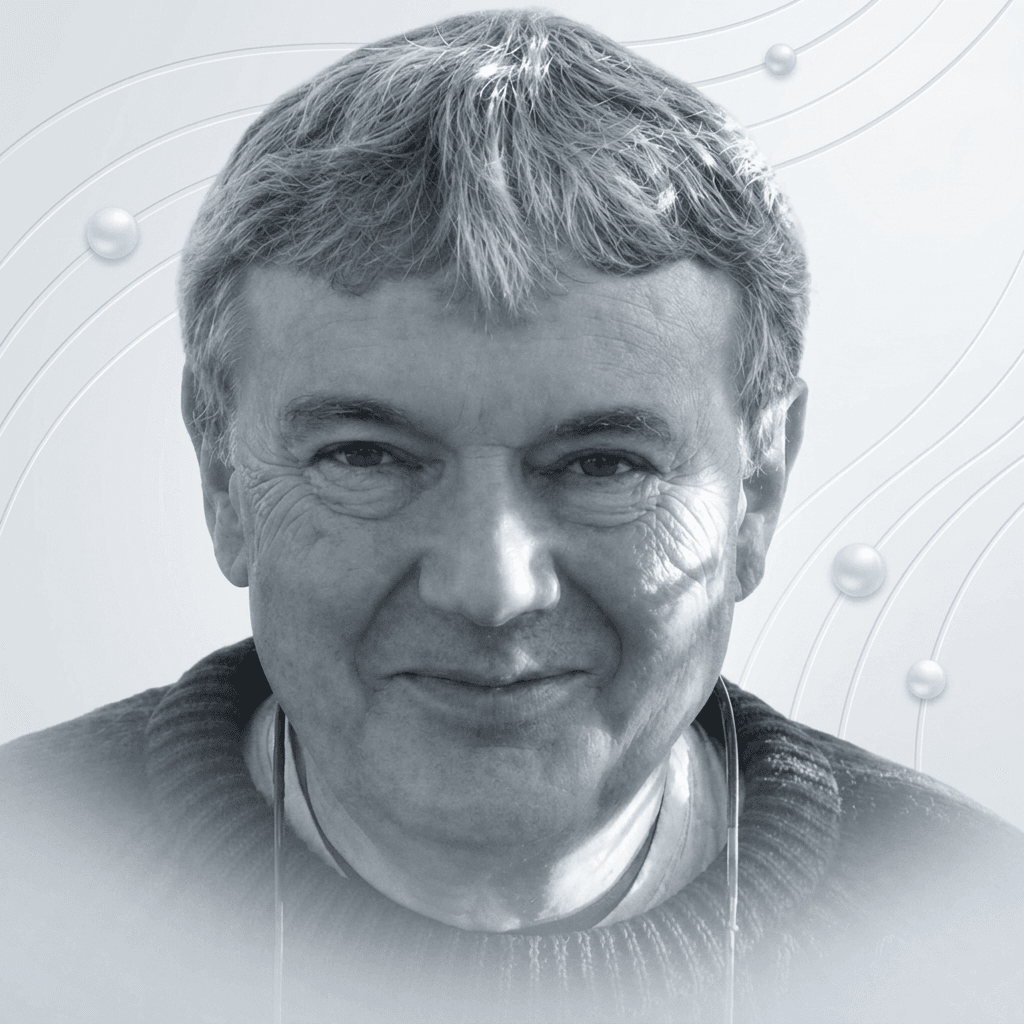
Nick Strausfeld on brain evolution and cambrian explosion
Episode 20 14.03.2012
-
 play_arrow
PLAY EPISODE
Description arrow_drop_down

Description
What can a 535-million-year-old fossilized brain tell us about the origins of our own nervous system? Nick Strausfeld reveals how ancient arthropod fossils are rewriting the evolutionary history of the brain.
Subscribe for more from the Convergent Science Network podcast series.
Nick Strausfeld makes a compelling case for why neuroscience must be grounded in evolutionary and comparative biology. He argues against the over-reliance on a handful of model organisms, insisting that understanding the brain’s design principles requires studying nervous systems across a wide range of species. The conversation traces the deep architectural features shared by insect and crustacean brains, revealing a common organizational template built around glomerular processing units that can serve olfactory, visual, or tactile modalities with fundamentally similar computational circuits.
Strausfeld describes a hierarchical brain architecture where sensory-specific processing occurs at peripheral levels while higher centers like mushroom bodies and the central body complex provide substrates for allocentric memory, behavioral choice, and complex decision-making. He proposes that these integrative structures may derive from an ancient, pre-segmental ancestor shared with polychaete worms, representing a “brain within the brain” that was later incorporated into the arthropod head. The discussion explores how ecological pressures drive variation in neural organization, with examples of how different fly species show divergent lobular plate architectures corresponding to their distinct flight behaviors.
The most striking revelation concerns Strausfeld’s discovery of fossilized brains from the Cambrian period. Working with specimens from the Chengjiang mudstone dating to 535 million years ago, he identified a stem-group arthropod called Fuxianhuia whose brain shows three fused ganglia and three nested optic neuropils characteristic of modern crustaceans, despite having an extremely simple body plan. This finding overturns the assumption that branchiopods represent the ancestral condition and demonstrates that sophisticated neural architecture preceded the explosive diversification of body forms during the Cambrian.
The episode challenges the intuition that brains evolve from simple to complex, highlighting examples of evolutionary reversal and loss, and argues that direct anatomical evidence from fossils is essential for reconstructing neural evolution in ways that molecular phylogenetics alone cannot achieve.
Tagged as:
Arthropod Brain brain evolution cambrian explosion Evolutionary
About the author call_made
CSN Podcasts
Both the triumphs of humanity and its most evil deeds have resulted from collaboration. In a time where humanity is required to aspire to the former and minimize the latter, the question arises of how collaboration arises and why it fails. Surprisingly, this phenomenon, so central to who we are, is not well understood. Hence, a collaborative effort is required to understand collaboration in its full biological, psychological, sociological, cultural, and economic complexity and to translate this understanding into operational impact. This series of podcasts is one step toward achieving these complementary goals. The Collaboration Podcast presents interviews with people who are central orchestrators of collaboration in various domains including business, government, science, art, health, sustainability, and the military. The discussions were conducted by Prof. Dr. Paul F.M.J. Verschure and members of the Program Advisory Committee of the Ernst Strungmann Forum on Collaboration (https://www.esforum.de/forums/ESF32_Collaboration.html) during 2021 and had the goal to sketch a map of opportunities, challenges, and obstacles in human collaboration. The forum took place in May 2022, and now we would like to share this series of interviews with a broader audience. The full report of the Forum will be published in 2023 by MIT Press. The podcast was produced by the Convergent Science Network (https://www.convergentsciencenetwork.org/). Context: The stability of social systems depends critically on realizing sustainable methods of “collaboration,” yet how and by which means collaboration is achieved is not clearly understood; neither are the conditions or processes that lead to its breakdown or failure. Collaboration can be understood as cooperation between agents toward mutually constructed goals. Part of the reason for our lack of understanding is that the phenomenon of collaboration is, by nature, a highly multidisciplinary problem, and effective research into its complexities has been difficult to achieve across the broad range of scientific and technical disciplines involved. The need for a fundamental understanding of collaboration, however, has become increasingly important. Not only does humankind demand answers as it attempts to address critical challenges at multiple scales (e.g., climate change, migration, enhanced automation, social and economic inequality), but ever-increasing technological and economic means of interconnecting people and societies are disrupting long-established, familiar patterns of how we interact. Radical technological changes that are ongoing have the potential to reshape collaboration in ways that are currently hard to predict or influence (e.g., by altering configurations in interaction, information creation, and modes of communication). On one hand, such changes could disrupt hitherto stable forms of collaboration by affecting critical communication channels and traditional roles, as can be observed in the rapidly changing patterns in governance, commerce, and social interaction. Conversely, technology could lead to the emergence of novel, successful forms of collaboration that deviate from traditional “hierarchical” architectures. Evidence of this can be seen in areas as diverse as highly automated manufacturing plants, the open science movement, collaborative software repositories, user-centered services, and the sharing of economy-based modes of organization. Without a fundamental understanding of the mechanisms, processes, and boundary conditions of collaboration, it is not possible to evaluate or predict which of these possible scenarios are sustainable or even plausible. The Forum “How Collaboration Arises and Why it Fails” (May 8–13, 2022, Location: Frankfurt am Main, Germany) Chairs: Andreas Roepstorff and Paul Verschure Program Advisory Committee: Jenna Bednar, Julia R. Lupp, Bhavani R. Rao , Andreas Roepstorff, Ferdinand von Siemens, and Paul Verschure
Episodes



Timestamp
- fast_forward00:00:03 - This is the Convergent Science Network podcast. Leading researchers in the domain
- fast_forward00:00:10 - of neuroscience, brain theory and technology are interviewed by Paul Verschure and Tony Prescott.
- fast_forward00:00:19 - This is Paul Verschure and Tony Prescott with the Convergent Science Network
- fast_forward00:00:23 - podcast. In this episode that we record as part of the Converter Science Network
- fast_forward00:00:29 - Barcelona Cognition Brain Technology Summer School, we're talking with Nick Strausfeld.
- fast_forward00:00:33 - So Nick, you started your talk with this notion of placing the study of biology
- fast_forward00:00:39 - always in the context of evolution because it wouldn't make any sense.
- fast_forward00:00:42 - So where's that coming from?
- fast_forward00:00:43 - Well, it's coming from Theodosius Dabiansky's statement, which he made in the
- fast_forward00:00:48 - in the 50s, and I think was very relevant to what was happening in biology then,
- fast_forward00:00:56 - which was a lot of comparative work being done in all sorts of different fields.
- fast_forward00:01:00 - And it's worthwhile reminding people today of this, because we've become so
- fast_forward00:01:04 - incredibly specialized and canonized in our research.
- fast_forward00:01:08 - So there are these horrible things called model organisms, which I loathe the term model.
- fast_forward00:01:13 - These are animals. animals, but there is about three animals that have been
- fast_forward00:01:16 - funded, at least in America.
- fast_forward00:01:19 - You can't really tell anything about evolution from the three.
- fast_forward00:01:22 - Evolution will tell us about very, very interesting aspects of design.
- fast_forward00:01:27 - I don't mean that in the bad sense.
- fast_forward00:01:32 - I mean the results of evolutionary innovations and what was the beginning.
- fast_forward00:01:40 - In the nervous system, So, for example, what were the basic circuits that provided
- fast_forward00:01:45 - an organism with choice,
- fast_forward00:01:47 - with allocentric memory, with the ability to integrate odorant signals to provide behavior,
- fast_forward00:01:57 - and basically all the kind of senses it has, and what kind of nervous system
- fast_forward00:02:02 - allowed the integration of those senses to provide elaborate behaviors?
- fast_forward00:02:06 - And one is only going to get to those answers if one actually does comparative work.
- fast_forward00:02:11 - And thinks about how these things have evolved over time. But then,
- fast_forward00:02:15 - so where do you stand on that right now?
- fast_forward00:02:18 - So you're one of the world's experts on definitely the insect brain.
- fast_forward00:02:23 - So how should we think about the insect brain? What are then these basic design features it has?
- fast_forward00:02:28 - What are the basic functional capabilities that are supported with it?
- fast_forward00:02:31 - How should we think about that?
- fast_forward00:02:32 - Well, we have to start thinking about where do insects come from?
- fast_forward00:02:36 - And the evidence is very strong. and they have originated from marine ancestors,
- fast_forward00:02:40 - which we call the crustaceans.
- fast_forward00:02:43 - And then one has to ask, what does come between insects and crustaceans?
- fast_forward00:02:46 - What do their common ancestors perhaps look like?
- fast_forward00:02:49 - And if one can then, you know, resolve the commonalities of the two,
- fast_forward00:02:54 - then one has an idea of the ancestral brain, the common birth of insects and crustaceans.
- fast_forward00:02:59 - Then one has to go even deeper in time and ask, well, what about the ancestors of that ancestor?
- fast_forward00:03:06 - When did the first insect-like brain or the crustacean-like brain evolve in
- fast_forward00:03:11 - geological time? And that's much more difficult, of course.
- fast_forward00:03:14 - Right. But now, what are the core structures in that brain that you think we
- fast_forward00:03:18 - should be focusing on in that? in that exploration?
- fast_forward00:03:20 - Well, you can ask questions about the core structures, say, of a particular
- fast_forward00:03:24 - modality or sensory organ, such as the compound eye.
- fast_forward00:03:29 - So what are the core structures of the compound eye, the core circuits that
- fast_forward00:03:32 - allow motion detection, for example, motion vision, figure ground discrimination?
- fast_forward00:03:38 - You can actually resolve some
- fast_forward00:03:40 - of the neurons that are involved in those computations in a fly's eye.
- fast_forward00:03:47 - And then you need to get to the actual circuits that
- fast_forward00:03:49 - provide those computations and not just neurons that
- fast_forward00:03:53 - encode those computations and that's again
- fast_forward00:03:56 - more difficult so the search image could develop.
- fast_forward00:03:59 - From looking at much simpler systems what.
- fast_forward00:04:02 - Do they have in common with the fly system for example and so
- fast_forward00:04:06 - if you compare across many many different attacks or say
- fast_forward00:04:09 - of flies flies that have you know have
- fast_forward00:04:12 - they have ballistic flight of flies that can hover flies that
- fast_forward00:04:14 - do this that do that and then you ask what do they have in common
- fast_forward00:04:17 - all these visual systems what are the
- fast_forward00:04:20 - common denominators if you like and if you find those then
- fast_forward00:04:23 - you can ask questions about are those the really the
- fast_forward00:04:26 - principal elements that provide information about motion.
- fast_forward00:04:29 - Detection and then go to the crustaceans do those existing
- fast_forward00:04:32 - crustaceans and then go even to more
- fast_forward00:04:35 - simple organisms such as centipedes right so but then
- fast_forward00:04:38 - if you talk about search image you really mean a
- fast_forward00:04:41 - structural template it's an anatomical template or is
- fast_forward00:04:44 - more than that um the search
- fast_forward00:04:49 - image develops from from really understanding at
- fast_forward00:04:53 - least one circuit in one organism and you ask
- fast_forward00:04:56 - then is that circuit or are those neurons visible are
- fast_forward00:04:59 - they are they obtainable in other other species that's
- fast_forward00:05:03 - the search image yeah but now
- fast_forward00:05:06 - where do you see the the origins of that of that
- fast_forward00:05:08 - nervous system because in some sense you could also are you look at all
- fast_forward00:05:11 - started with let's say chemical sensing and the rest evolves from
- fast_forward00:05:14 - there from then absolutely right so yes yes
- fast_forward00:05:18 - i mean i i would i would envisage that the the chemical sensors are the earliest
- fast_forward00:05:22 - um before there was um highly developed vision um but the actual computational
- fast_forward00:05:30 - circuits that provides provided choice behavioral choice or for example memory of place.
- fast_forward00:05:36 - They can operate equally well in a chemical environment as in a visual environment
- fast_forward00:05:43 - or even a tactile environment.
- fast_forward00:05:45 - So the basic organization of the brain was, one could say, it was independent of the modality.
- fast_forward00:05:53 - Because it wasn't, because certainly it had to evolve in conjunction with the present modality.
- fast_forward00:05:58 - Right. But it can employ other modalities. In fact, we have a very good example
- fast_forward00:06:03 - in one species of insect, where the mushroom bodies, which are in Drosophila
- fast_forward00:06:07 - and many other insects, they get one of their major inputs from the olfactory system.
- fast_forward00:06:13 - In a species of insect called whirligig beetles, they completely switch modalities
- fast_forward00:06:17 - and get all their inputs from the visual system.
- fast_forward00:06:21 - If these are place memory centers, which we think they are, then in one instance
- fast_forward00:06:26 - they are using olfaction, and in the other they're using vision.
- fast_forward00:06:29 - You just get the switch. But then that would imply that you're thinking of some
- fast_forward00:06:33 - sort of backbone structure, a particular backbone structure that you can sort
- fast_forward00:06:37 - of mold to, let's say, the sensory ecology, the behavioral ecology of the organism.
- fast_forward00:06:41 - So what is that backbone structure? So I'll give you an example.
- fast_forward00:06:45 - The olfactory system of insects and also of crustaceans, the first synaptic
- fast_forward00:06:50 - neuropil is a system of glomeruli.
- fast_forward00:06:53 - And in insects, each glomerulus receives the inputs from a set of olfactory
- fast_forward00:06:58 - receptors that encode the same kinds of ligands.
- fast_forward00:07:06 - So one type of olfactory sensory receptor neuron will send its axon to one particular kind of glomerulus.
- fast_forward00:07:12 - So when you have 40 different kinds of receptors, you have 40 glomeruli each
- fast_forward00:07:17 - getting inputs from that particular type of receptor, right?
- fast_forward00:07:19 - So when you go to the visual system, you see the remarkable thing that in the
- fast_forward00:07:23 - next ganglia up, which is the proto cerebrum of the insect, you have a glomerular
- fast_forward00:07:27 - organization into which are segregating pathways in the visual system.
- fast_forward00:07:32 - And this suggests that you have this template of computational entities which
- fast_forward00:07:38 - are repeated segment for segment,
- fast_forward00:07:40 - which can deal with the visual input or with the olfactory input or with the
- fast_forward00:07:44 - tactile input, but the actual computational network can deal with.
- fast_forward00:07:49 - Is in principle the same for any sensory modality, which is remarkable.
- fast_forward00:07:54 - And this is quite, you know, worrying in a sense.
- fast_forward00:07:57 - Right. So, but in this example, you would say, I guess a lobular would have a glomerular.
- fast_forward00:08:02 - No, no, no, no, no, definitely not. Okay. The lobular is composed of many,
- fast_forward00:08:07 - many palisades of neurons, types of neurons, and each palisade encodes a visual
- fast_forward00:08:11 - primitive, such as an an oriented edge of one kind or the other.
- fast_forward00:08:17 - And each of these palisades then sends its axons convergently to a glomerulus.
- fast_forward00:08:21 - So each glomerulus represents a particular visual modality, an edge or a color or whatever.
- fast_forward00:08:26 - Then interactions amongst these glomeruli further reconstruct the visual image
- fast_forward00:08:32 - and further provide higher order primitives. The same is happening in the olfactory system.
- fast_forward00:08:36 - So each glomerulus receives information about a small sort of palette of ligands.
- fast_forward00:08:41 - And interactions amongst these various glomeruli provide information about the odor,
- fast_forward00:08:46 - not the odorant but the odor, the combinations so it's the same principle actually
- fast_forward00:08:51 - I understood the principle,
- fast_forward00:08:52 - I'm just trying to place it in this visual hierarchy because in the chemical
- fast_forward00:08:56 - sensing system it's just one step away from the receptor that's the question
- fast_forward00:09:01 - that is always addressed.
- fast_forward00:09:03 - The homologue, if you like, the functional homologue of the antenna in the visual
- fast_forward00:09:08 - system is the entire retentovic mosaic down to the output of the lobular.
- fast_forward00:09:12 - Oh, you mean the antenna in the chemical sensing system? Yes.
- fast_forward00:09:16 - The antenna in the chemical sensors, the equivalent of that in the visual system
- fast_forward00:09:19 - is the lamina medulla in the lobular.
- fast_forward00:09:21 - And the outputs in the lobular are equivalent to the outputs in the antenna.
- fast_forward00:09:25 - All right. Okay. So then where would I find the glomerular structures of the
- fast_forward00:09:30 - optic system it detects?
- fast_forward00:09:32 - Beneath the lobular. Okay. Very good. And you will find also an equivalent to
- fast_forward00:09:36 - something like a projection neuron type readout of this? Yes.
- fast_forward00:09:39 - These would be your whitefield neurons?
- fast_forward00:09:40 - Yes. That's what we're looking at right now. Okay. Very good. That's beautiful.
- fast_forward00:09:44 - But then in some sense, we're still talking about the sensory front end of this, right?
- fast_forward00:09:48 - So the core structure, this archetypical backbone structure should also be relying
- fast_forward00:09:52 - on structures that are mapping now sensor states into action.
- fast_forward00:09:56 - You're quite right. So you have these reiterated ganglia down the rest of the body.
- fast_forward00:10:01 - And in each ganglia, you have domains, glomerular-like domains.
- fast_forward00:10:04 - And each domain is receiving one or another kind of sensory input. often mapped.
- fast_forward00:10:09 - If it's an input of the mechanosensory system, then that particular type of
- fast_forward00:10:15 - receptor will invade one of these domains, and you'll have a map representation
- fast_forward00:10:19 - of those terminals in the domain.
- fast_forward00:10:21 - And then you have local interneurons linking these various domains and integrating
- fast_forward00:10:25 - all this sensory information just as it does in the olfactory system or the visual system.
- fast_forward00:10:29 - But what happened to these really central structures like mushroom bodies or protoceberum?
- fast_forward00:10:35 - I mean, they're sort of in between that mapping, right? And they're unique to
- fast_forward00:10:39 - the first segment of the brain.
- fast_forward00:10:42 - And where they come from is a real puzzle.
- fast_forward00:10:45 - And my suspicion is that they are actually derived from the ancestor of the
- fast_forward00:10:51 - Lophotrachazones and Ectisazones.
- fast_forward00:10:53 - And you see mushroom bodies and central body complexes in worms,
- fast_forward00:10:57 - in polychaete worms, in what's called the acron, which is an A-segmental neuropil.
- fast_forward00:11:06 - It does not belong to a segment.
- fast_forward00:11:08 - And so the idea is, and there are many opponents to this idea, idea.
- fast_forward00:11:13 - The idea is that the modern arthropod brain is actually composed of four components.
- fast_forward00:11:20 - Three of them derive from ganglia, primitively from ganglia,
- fast_forward00:11:23 - and the fourth component right at the front is the leftover from the common ancestor.
- fast_forward00:11:29 - And you still find this in polychaete worms separated from the rest of the system.
- fast_forward00:11:32 - And that's been integrated into the first segment of the insect or crustacean brain.
- fast_forward00:11:37 - And it is the substrate for the central body complex and the mushroom bodies. Right.
- fast_forward00:11:41 - And that then provides you, let's say, the integrative infrastructure for these
- fast_forward00:11:46 - different sensory modalities.
- fast_forward00:11:48 - It provides the substrates for high-level computations of, say, of allocentricity.
- fast_forward00:11:55 - A relative memory amongst individuals, and also behavioral choice,
- fast_forward00:12:01 - and complex things like dexterity and such like.
- fast_forward00:12:08 - These are the, this is the brain within the brain, if you like.
- fast_forward00:12:11 - Right. Okay. The integration amongst sensory systems can be quite local.
- fast_forward00:12:16 - To provide reflex actions. But the integration of accentuators and to provide
- fast_forward00:12:20 - these more complex behaviors requires these higher centers.
- fast_forward00:12:23 - Right. So now we have a bit of an idea what sort of the key components of such
- fast_forward00:12:28 - an archetypical brain could look like.
- fast_forward00:12:30 - But you also emphasize that, let's say, the specifics of the ecology of the
- fast_forward00:12:36 - animal might lead to variations now in that design.
- fast_forward00:12:39 - Yeah. So how does that really happen? Is it only through, let's say,
- fast_forward00:12:42 - evolutionary pressures or over long timescales?
- fast_forward00:12:45 - Or are there more rapid ways to let's say reconfigure and
- fast_forward00:12:49 - configure these these prototype brains
- fast_forward00:12:52 - you don't know how plastic they are um right in
- fast_forward00:12:55 - terms of the lifetime of a single organism but with regard
- fast_forward00:12:59 - to the structures and the number of neurons and the connectivities
- fast_forward00:13:02 - um the differences between taxa are clearly the result of of of many millions
- fast_forward00:13:09 - of years of evolution diversions but still you will you'll find also of slight
- fast_forward00:13:14 - deviations within specific taxa or species dependent on the ecologies they're in.
- fast_forward00:13:22 - The difference is that's the stuff of evolution.
- fast_forward00:13:24 - I mean, you look at the olfactory lobes across lots of Drosophila and you find
- fast_forward00:13:28 - all these sort of variations of wiring, but you've got to have this.
- fast_forward00:13:31 - Otherwise, you will not have selectivity. You will not have the species responding
- fast_forward00:13:37 - to selective pressures.
- fast_forward00:13:39 - Some of those variations are fitter, greater fitness than others on the organism.
- fast_forward00:13:45 - Yeah, you must have variation.
- fast_forward00:13:47 - How do you see that exploratory mechanism? Because, I mean, within every species,
- fast_forward00:13:53 - in this backbone neural structure that gives it the nervous system,
- fast_forward00:13:58 - there are exploratory mechanisms that now are imposing variability on this.
- fast_forward00:14:02 - And, for instance, in your talk you mentioned that possibly a computational
- fast_forward00:14:06 - substrate for this kind of variability in,
- fast_forward00:14:08 - let's say, visual processing could be the lobular plate because there you
- fast_forward00:14:12 - can start to play with how you integrate this kind of information so would
- fast_forward00:14:15 - you then predict that also it's leveled lobular plate you would find the highest
- fast_forward00:14:18 - variability to allow a species to explore let's say the variability of its visual
- fast_forward00:14:24 - space in which it has to behave yeah that's true and in fact when we look across
- fast_forward00:14:28 - different species of flies for example which and which have actually very different
- fast_forward00:14:32 - visual visually induced flying behaviors.
- fast_forward00:14:36 - We do find very, very fascinating differences of the organization of the lobular
- fast_forward00:14:39 - plate and the lobular, but not the medulla and lamina.
- fast_forward00:14:42 - Right, okay. What about the role of development here?
- fast_forward00:14:45 - Because I've heard, for instance, in the locust, a significant effect on the
- fast_forward00:14:52 - development of the brain, for instance, due to whether or not the animal is
- fast_forward00:14:56 - going to be part of a swarm,
- fast_forward00:14:58 - because there's a high density of population or is going to be perhaps more
- fast_forward00:15:02 - of a low-density individual locust.
- fast_forward00:15:05 - And being part of a swarm somehow makes the locus develop a larger brain.
- fast_forward00:15:10 - Yeah, that's a very interesting point.
- fast_forward00:15:13 - Actually, it's fascinating. What's happening in the locus? Are the neurons actually
- fast_forward00:15:17 - sprouting more dendrites?
- fast_forward00:15:18 - Certainly a radical difference of size of the brain overall.
- fast_forward00:15:24 - Does that pertain to all the centers? Does that pertain to certain neuropills?
- fast_forward00:15:29 - I would put my money on the central body complex and its associated structures
- fast_forward00:15:33 - and because that's the decision making part of the brain but
- fast_forward00:15:36 - i don't think it's been followed through yet and and and
- fast_forward00:15:39 - and i look forward to seeing papers that are following
- fast_forward00:15:42 - through on this but it's a you know
- fast_forward00:15:45 - it's it's very very very interesting but
- fast_forward00:15:48 - it does suggest that the real uh potential for
- fast_forward00:15:51 - the environment to affect the developmental process
- fast_forward00:15:54 - so that some of these differences we get uh are partly
- fast_forward00:15:58 - due to maybe some genetic change but also when the
- fast_forward00:16:01 - the environment changes that there's plasticity in the
- fast_forward00:16:04 - development of the system which can really result in some important changes
- fast_forward00:16:08 - one puzzle i think is that these changes happen
- fast_forward00:16:10 - before the locus mix becomes either a goes
- fast_forward00:16:14 - into you know into it into the swarming mode or or the or the actual wandering
- fast_forward00:16:20 - um continues the wandering mode that it had as as as a juvenile um so it's as
- fast_forward00:16:28 - if If the brain is preparing itself for the next role,
- fast_forward00:16:34 - which is really amazing, and it must be under some kind of hormonal control and so forth.
- fast_forward00:16:41 - Again, I think we know too little about what is actually changing to put one's
- fast_forward00:16:45 - finger on why it's changing.
- fast_forward00:16:48 - It is a pity. I'd like to know that. so what
- fast_forward00:16:51 - struck me about your talk is that one of the things that really fascinates you
- fast_forward00:16:56 - is to trace back modern brains or modern nervous systems to what the ancestral
- fast_forward00:17:02 - brains might have looked like and of course that's a task where you have to
- fast_forward00:17:07 - look at indirect evidence,
- fast_forward00:17:09 - because there are lots of clues but nothing definitive really that can tell
- fast_forward00:17:14 - us what was the path that evolution followed.
- fast_forward00:17:17 - So, can you just summarize quickly the range of clues that you think are important
- fast_forward00:17:22 - to reconstructing evolutionary history here?
- fast_forward00:17:26 - Yeah, well, the clues must be constrained to,
- fast_forward00:17:32 - to what one would imagine would be visible in a fossil.
- fast_forward00:17:35 - So, isolated neuro pills, one from the other, that are connected by tracts,
- fast_forward00:17:39 - for example, one would be able to see these clearly in a fossil if they existed.
- fast_forward00:17:44 - Internal structures of the brain would be very unlikely to see them, although,
- fast_forward00:17:48 - the brain I talked about today, which is 535 million years old in a stem group
- fast_forward00:17:53 - arthropod, we can actually see differences of texture within the outline of the brain.
- fast_forward00:18:00 - That suggests, for example, the olfactory lobes. And it would be nice to see
- fast_forward00:18:03 - then other striations or pronounced, you know, maybe outlines,
- fast_forward00:18:09 - internal outlines that would suggest,
- fast_forward00:18:11 - the presence of certain centers that we know are required for certain functions of the baby modern taxa.
- fast_forward00:18:22 - Another thing we would look for is the kind of fusion of segments that comprise the brain.
- fast_forward00:18:31 - In modern crustaceans, melacotra, crustaceans, and insects, there are three
- fast_forward00:18:35 - segments that are fused to comprise the brain.
- fast_forward00:18:38 - And in some species, even the subosophageal ganglia, the three subosophageal
- fast_forward00:18:43 - ganglia, have moved up and have become almost fused with the superosophageal
- fast_forward00:18:47 - ganglia so that the gut just penetrates the brain.
- fast_forward00:18:50 - There's no clear divisions of ganglia.
- fast_forward00:18:53 - The whole thing becomes highly condensed, which is a mark of modernity,
- fast_forward00:18:58 - perhaps evolutionary modernity.
- fast_forward00:19:00 - Now we're late to go and look at these ancient brains and
- fast_forward00:19:02 - ask is that true um how much condensation of
- fast_forward00:19:06 - the nervous system can one see in in the head and and for the one that the animal
- fast_forward00:19:10 - i was showing you today it's surprising that the first three segment of firstly
- fast_forward00:19:15 - brain fragments are fused we were really surprised to see this quite shocked
- fast_forward00:19:20 - actually um but that's shows us it's already quite advanced.
- fast_forward00:19:24 - So you're talking about the sort of anatomical morphological markers.
- fast_forward00:19:28 - Nowadays there are a lot of molecular tools looking at DNA, RNA and so on that
- fast_forward00:19:34 - can tell us a lot about the relationships between different animal groups.
- fast_forward00:19:38 - But I think you were persuading me in your talk this morning that this isn't
- fast_forward00:19:43 - enough although we might get some idea about what's related to what But if we
- fast_forward00:19:48 - really want to understand the history,
- fast_forward00:19:50 - we do need the anatomy. Yes.
- fast_forward00:19:54 - A case in point is the origin of insects. Did they derive from a brachiopod-like
- fast_forward00:20:00 - ancestor or a remipede-like ancestor or a malacostrican-like ancestor?
- fast_forward00:20:05 - The molecular studies suggest malacostric and remipede.
- fast_forward00:20:09 - But there are other molecular studies which would equally well suggest brachiopod.
- fast_forward00:20:15 - One wouldn't know unless one went to the morphology. And morphology suggests
- fast_forward00:20:19 - brachiopods are very simple, therefore they must be maybe more primitive than
- fast_forward00:20:23 - insects, which are more complex.
- fast_forward00:20:25 - Which then suggests that insect brains and malacostricum brains have evolved
- fast_forward00:20:28 - by convergence, which is probably nonsense.
- fast_forward00:20:31 - So one needs these various strategies for using cladistics to see whether or
- fast_forward00:20:39 - not there's evidence for reversal and for loss of structures.
- fast_forward00:20:43 - Structures, that gives the false impression of primitivity.
- fast_forward00:20:47 - And one cannot possibly do that just using molecular techniques.
- fast_forward00:20:51 - One has to go in there using anatomical methods.
- fast_forward00:20:54 - So there is this bias that we have to think that things get more complicated over time.
- fast_forward00:20:59 - But in fact, there's evidence that in some cases, things will actually get simpler.
- fast_forward00:21:04 - Like tapeworms, for example.
- fast_forward00:21:06 - Can you give an example of a reversal? of a reversal. Well, parasites.
- fast_forward00:21:11 - I mean, typeworms are leptotrichozoans. They don't even have a brain.
- fast_forward00:21:15 - I mean, they've lost everything, really.
- fast_forward00:21:17 - And they're just reproductive organs living off one's gut.
- fast_forward00:21:21 - I mean, there are lots of nematodes. These are ectozoans. They molt.
- fast_forward00:21:29 - Presumably, their ancestors had somewhat more complicated.
- fast_forward00:21:34 - So, that means there are a lot of examples of reduction and loss.
- fast_forward00:21:37 - But also, as Tony mentioned earlier, this sort of like simple heuristic that
- fast_forward00:21:42 - would say, look, brains go from simple to complex is not working.
- fast_forward00:21:46 - It's not as a guideline. It's not helping us. But what should replace this heuristic?
- fast_forward00:21:50 - What's the heuristic that we shouldn't follow?
- fast_forward00:21:53 - That's a difficult question to answer. Yeah.
- fast_forward00:21:57 - No heuristic i don't know i think stephen
- fast_forward00:22:01 - gould compared evolution to a drunk man
- fast_forward00:22:03 - stumbling along the pavement so sometimes you move
- fast_forward00:22:06 - further out from the wall which could be an increasing complexity sometimes
- fast_forward00:22:10 - you you move closer that's a nice analogy yeah so and
- fast_forward00:22:13 - another interesting thing i think that came from your
- fast_forward00:22:16 - talk which perhaps also links with some of stephen j gould's
- fast_forward00:22:19 - ideas is that we i think
- fast_forward00:22:22 - used to imagine that evolution was a slow process
- fast_forward00:22:25 - and a gradual process over hundreds of
- fast_forward00:22:28 - million years of years we got these advanced forms or
- fast_forward00:22:31 - these recent forms we see today but actually what
- fast_forward00:22:33 - was striking about your talk today was you were arguing that
- fast_forward00:22:37 - some of the things that we see in contemporary organisms were
- fast_forward00:22:40 - already present really shortly after the
- fast_forward00:22:43 - appearance of the first multi-celled animals yes shortly meaning yes well yes
- fast_forward00:22:48 - 50 million years is a very short time yes exactly so this is really quite quite
- fast_forward00:22:53 - fascinating you have You have this plethora of different body forms in Camry
- fast_forward00:23:00 - called the Camryn Explosion.
- fast_forward00:23:01 - These different arthropod-like animals suggesting very, very rapid evolution of morphologies.
- fast_forward00:23:08 - And yet, the ground pattern of the nervous system, probably across them all,
- fast_forward00:23:12 - is this very, very consistent organization that exists today. day.
- fast_forward00:23:17 - So you have, in a sense, stasis and slow elaboration of the ground pattern of the nervous system,
- fast_forward00:23:23 - and then this very, very rapid elaboration of appendages and other decorations
- fast_forward00:23:28 - that provide the inputs to this consistent organization of the CNS.
- fast_forward00:23:33 - Would you argue that then still that very basic proto-brain was the facilitator
- fast_forward00:23:39 - of all this variability? No.
- fast_forward00:23:42 - No, no, no. It had to accommodate this variability through evolutionary time.
- fast_forward00:23:47 - I don't think it was the facilitator. Although one can't really imagine how
- fast_forward00:23:52 - an organism could develop complicated mouth parts and sensory appendages if
- fast_forward00:23:57 - there was nothing there for them to actually supply information to.
- fast_forward00:24:01 - This was still the engine powering all these functional capabilities, right?
- fast_forward00:24:07 - So you could also argue, just to test out this idea,
- fast_forward00:24:10 - that evolution stumbled, if you want, into a brain prototype that suddenly facilitates
- fast_forward00:24:18 - the computational power to support all these different body machines.
- fast_forward00:24:22 - So you would not necessarily reject that interpretation. Not at all. Okay.
- fast_forward00:24:28 - But now the amazing thing that you also presented to us today is that you actually
- fast_forward00:24:34 - have found a way, if you want, to come up with sort of more direct evidence
- fast_forward00:24:38 - that evolution might have progressed in a very specific way, right?
- fast_forward00:24:42 - That we can go beyond conjecture, but actually look at what brains looked like
- fast_forward00:24:47 - during the Cambrian explosion, as opposed to having to speculate what they might have looked like.
- fast_forward00:24:51 - Yeah, I wouldn't say it progressed in
- fast_forward00:24:53 - a specific way. That's sort of too teleological for my taste. Thank you.
- fast_forward00:25:03 - Yeah, I wouldn't know really how to… I mean, clearly there was no progression,
- fast_forward00:25:09 - there was no internal engine that drove evolution.
- fast_forward00:25:17 - These things all occurred by accident and by selection depending upon their viability.
- fast_forward00:25:26 - So, yes, very early on the evolution gave rise to this thing we call the brain.
- fast_forward00:25:33 - The simple brain and that indeed allowed and its elaboration right um through process of of
- fast_forward00:25:41 - hit and miss evolution well let's just say change
- fast_forward00:25:44 - okay then if to keep it sort of neutral in that sense but
- fast_forward00:25:47 - i think that what was amazing was that you found a way to sort of travel back
- fast_forward00:25:51 - in time and try and direct evidence for whatever these changes were and i think
- fast_forward00:25:55 - this was really i think a very dramatic piece of evidence actually so maybe
- fast_forward00:25:59 - yeah you were lucky we were lucky so So maybe you can explain to us what was
- fast_forward00:26:04 - the question really that you were trying to answer and how did you answer it?
- fast_forward00:26:07 - The question derives from the cladistics that we were doing,
- fast_forward00:26:13 - trying to reconstruct phylogeners using brain characters.
- fast_forward00:26:17 - And it indicates that our results in this cladistic analysis indicated that
- fast_forward00:26:23 - branchia pods could not be the precursors of the insects and crustaceans.
- fast_forward00:26:27 - There must have been some kind of evolved loss.
- fast_forward00:26:31 - So, again, as I said in the talk, the only way to prove this is to go back in
- fast_forward00:26:35 - time and look at the early brains. Now, where did one find early brains?
- fast_forward00:26:37 - So, first of all, I went to the Smithsonian and looked through their fossil
- fast_forward00:26:41 - collection and found this one particular fossil that showed an early brain.
- fast_forward00:26:45 - But it wasn't really so satisfying.
- fast_forward00:26:48 - They were clearly very, very good optic lobes. It had very nice compound eyes.
- fast_forward00:26:52 - So, how can you see an early brain in a fossil? Because, I mean,
- fast_forward00:26:56 - the assumption most people have is that brains can't fossilize.
- fast_forward00:26:59 - Yes, but that is the assumption.
- fast_forward00:27:00 - And I never quite understood it because the brain is the most densely packed tissue in the body.
- fast_forward00:27:07 - You take an electromyograph through an insect brain or any brain,
- fast_forward00:27:11 - and it's packed, packed, packed, packed full of profiles.
- fast_forward00:27:15 - And these profiles have got lots and lots and lots of lipids.
- fast_forward00:27:18 - And inside there are lots of mitochondria and there's lots of iron.
- fast_forward00:27:21 - Iron, and it's a very bulky piece of tissue,
- fast_forward00:27:26 - and if you put that into quite reasonably anoxic conditions,
- fast_forward00:27:31 - it has a reasonable chance of surviving during mineralization.
- fast_forward00:27:38 - But there are very few taphinovic conditions that would allow this,
- fast_forward00:27:42 - and one is in the The Bird of Shale, as you know. And the other is in the Qingjiang Mudstone.
- fast_forward00:27:50 - So, that's where to go to. And you do see these trace internal organs, particularly gut.
- fast_forward00:27:58 - And gut's very popular amongst paleontologists. They love to say, oh, there's gut.
- fast_forward00:28:03 - But then you look in the head, in front of where the mouth was,
- fast_forward00:28:08 - and that could be gut diverticular.
- fast_forward00:28:10 - And indeed, in some specimens, you do have diverticular from the gut that invade the head capsule.
- fast_forward00:28:16 - But in others, you can clearly see the bundles, the nerves coming in from the
- fast_forward00:28:22 - antennae, the optic stalk tract going into a structure within the head capsule.
- fast_forward00:28:31 - And associated with that, you can also see ocelli, you can see the compound
- fast_forward00:28:35 - eyes and various other attributes, and also the paired nerve cords.
- fast_forward00:28:41 - And there you have then evidence of brain. So this is a fossil of an animal
- fast_forward00:28:45 - that lived 535 million years ago?
- fast_forward00:28:48 - Perhaps it was 500 or 500, the ones in the Qingchang in 535.
- fast_forward00:28:53 - And they're looking quite similar to some living animals?
- fast_forward00:28:57 - Yes, the ones from the Qingchang fauna, Fengxianhui, its brain is that of a
- fast_forward00:29:04 - modern malacostracan yes it has the three optic neuropills it has the fused ganglia uh.
- fast_forward00:29:12 - And its morphology the body morphology is incredibly simple,
- fast_forward00:29:17 - that's that's the fun part of it you have this you have this head capsule with
- fast_forward00:29:22 - eyes that clearly could move conjointly
- fast_forward00:29:26 - and convergently they could also rotate so you had active vision,
- fast_forward00:29:30 - You have different radii of curvature on the eye, so you had probably acute
- fast_forward00:29:34 - zones and non-acute zones.
- fast_forward00:29:37 - So that part of the head, this most frontal part of the head,
- fast_forward00:29:41 - was reasonably sophisticated, like that of a small shrimp.
- fast_forward00:29:46 - And it has the three optic neuropils one would expect from a small shrimp.
- fast_forward00:29:51 - But shrimps are very complicated. The rest of them are all these elaborations
- fast_forward00:29:55 - and spines and interesting appendages and so forth.
- fast_forward00:29:58 - Whereas Fu Xianhui has this homonymous architecture in the thorax and then again in the abdomen.
- fast_forward00:30:04 - And one would think, oh gosh, what a simple animal. But no, it's not.
- fast_forward00:30:09 - It must have been quite sophisticated in terms of what it could process up front.
- fast_forward00:30:16 - But it did have, let's say, a shrimp-like body. Well, it's a crustaceomorph, if you like.
- fast_forward00:30:27 - It's a stem taxon, which has attributes that one can see to more or less in
- fast_forward00:30:32 - some modern crustaceans. There's this ankyline species, they're called the remipedes.
- fast_forward00:30:41 - I forget how to pronounce this, it's got a wonderful name.
- fast_forward00:30:46 - This thing is homonymous, every single segment is identical except the first two segments up front.
- fast_forward00:30:51 - So it looks like a living fossil, but it's probably also undergone reversal and loss.
- fast_forward00:30:56 - If you look at the brain, it has a malacostric brain except It has no optic lobes.
- fast_forward00:31:01 - So it has a very superb brain with a very, very simple body.
- fast_forward00:31:06 - Fuxian Hui, which is very ancient, has a lovely brain with a very,
- fast_forward00:31:09 - very simple body. But that's probably not reduction and loss.
- fast_forward00:31:13 - That's probably for real.
- fast_forward00:31:14 - It's an animal. It has not reduced anything. It's a very early organization.
- fast_forward00:31:19 - But now in reconstructing this brain, all you can go for is,
- fast_forward00:31:23 - let's say, volumetric information, right? What is the size?
- fast_forward00:31:26 - What are the relative sizes of things? No, no, no. Volumetric is not really terribly interesting.
- fast_forward00:31:31 - What's interesting is to actually identify these centers, the three nested optic
- fast_forward00:31:35 - lobe centers, which are diagnostic of modern melacotricans and insects, but not of brachiopods.
- fast_forward00:31:42 - So it shows that this organization is the ancestral organization.
- fast_forward00:31:48 - Appeared before the branchiopods even appeared in the fossil record.
- fast_forward00:31:51 - And also you can actually show from the incoming nerve bundles in the antennae,
- fast_forward00:31:56 - from the second antennae, and from the eyes, that you have then three fused ganglia.
- fast_forward00:32:00 - Yes, so how did you identify exactly these three layers?
- fast_forward00:32:03 - The three bundles? Yes. The antennae are beautifully preserved,
- fast_forward00:32:06 - as are sensilla on the antennae.
- fast_forward00:32:10 - And then out of the antennae you have this beautiful, darkly brown,
- fast_forward00:32:14 - stained tract, which is the antennal nerve entering the outline of the brain.
- fast_forward00:32:21 - And just after the entry point, you have this area of rough preservation,
- fast_forward00:32:26 - which corresponds to the olfactory lobe position. Right. And that's bilaterally symmetrical.
- fast_forward00:32:32 - And then a little bit more cordially, you have another nerve entering,
- fast_forward00:32:37 - bilaterally symmetrical.
- fast_forward00:32:38 - Geometrical and that nerve um is um
- fast_forward00:32:41 - it then turns down and
- fast_forward00:32:44 - plunges down into the substrate into the matrix of the fossil
- fast_forward00:32:47 - uh and its direction is towards the the next pair of appendages of the second
- fast_forward00:32:52 - antennae so the um shrimp brain the modern shrimp brain is a lot like this very
- fast_forward00:32:58 - early animal brain but and you say the shrimp body is much more complicated
- fast_forward00:33:03 - does does that mean that a lot of the
- fast_forward00:33:06 - nervous system complexity that goes with that new body or change to the body
- fast_forward00:33:11 - is not in the brain, but it's in the other segments.
- fast_forward00:33:14 - I would, I think it's probably, certainly there are ascending pathways from
- fast_forward00:33:19 - the ganglia throughout the body that reach the brain in a shrimp and in an insect
- fast_forward00:33:25 - and probably in fuchsia and hui as well.
- fast_forward00:33:31 - It may be that some of the more complicated and more elaborate appendages of
- fast_forward00:33:36 - the shrimp, of the modern shrimp, send information that is required for cerebral computations.
- fast_forward00:33:45 - Tactile information, for example.
- fast_forward00:33:47 - And that would then involve maybe additional brain regions that have evolved
- fast_forward00:33:51 - through time, or maybe enlargement of regions that were already there in this ancestral brain.
- fast_forward00:33:58 - We have no idea. But when we compare across contemporary species,
- fast_forward00:34:03 - we can see certainly that the brain varies in size and in dimensions of certain regions,
- fast_forward00:34:08 - not because of actual attributes of the head, but with regard to attributes
- fast_forward00:34:13 - of the thoracic ganglion, abdominal ganglion. Right.
- fast_forward00:34:16 - But I mean, this idea of a distributed nervous system where within the segments,
- fast_forward00:34:21 - the local control, for instance, of an actuator system, a limb,
- fast_forward00:34:26 - is happening in that segment.
- fast_forward00:34:28 - And then the information that's ascending to the brain may be fairly limited
- fast_forward00:34:33 - compared to what's being sent to the segment.
- fast_forward00:34:35 - So you're just sending to the brain
- fast_forward00:34:36 - the information that's relevant to the decisions you might need to make.
- fast_forward00:34:40 - Well, yes, the reafferent pathways to the brain certainly will inform the brain
- fast_forward00:34:45 - about what is going on in the ganglion.
- fast_forward00:34:48 - One of the attributes of a dexterous insect, like, say, a praying mantis,
- fast_forward00:34:52 - is the ability to break symmetry.
- fast_forward00:34:55 - The circuits in each ganglion, of course, are symmetrical, and they provide
- fast_forward00:34:58 - symmetrical or at least alternating movements.
- fast_forward00:35:02 - To break that is a function of the brain. So, the brain is required to,
- fast_forward00:35:07 - if you like, receive information about the activity of those centers. Absolutely.
- fast_forward00:35:14 - So, the more elaborate, if you like, motor actions that are performed by the limbs,
- fast_forward00:35:24 - the more reafference one might expect reaching up to the brain into some of these higher centers.
- fast_forward00:35:33 - This kind of elaborate, dexterous behaviors amongst the crustaceans is quite limited,
- fast_forward00:35:41 - say, to the crabs and to some of the malacostracans, for example, the mantis shrimps.
- fast_forward00:35:50 - And interestingly, the mantis shrimp brain is very, very insect-like.
- fast_forward00:35:53 - It has centers that one would actually expect in a praying mantis.
- fast_forward00:35:57 - It's really fascinating.
- fast_forward00:36:00 - Whereas the shrimp brain, the shrimps, you know, they don't really have much
- fast_forward00:36:03 - dexterity except for two limbs.
- fast_forward00:36:08 - And most of the stuff is happening, I think, locally. Most of the motor coordination
- fast_forward00:36:13 - is happening locally without the participation of the brain.
- fast_forward00:36:16 - So I want to pursue a bit more this issue of similarity, right?
- fast_forward00:36:20 - Because here we have this fossil that's 535 million years old.
- fast_forward00:36:24 - And it looks like a modern shrimp, if you want.
- fast_forward00:36:28 - No, no, no. I mean the brain. The brain, yes. Okay. Yes. You already explained
- fast_forward00:36:33 - that the body is not identical. Very different, right.
- fast_forward00:36:36 - But still in terms of now, how specific can we get about the similarities of these brains?
- fast_forward00:36:41 - Like for instance, if you would look at, okay, now we have the antenna providing
- fast_forward00:36:45 - inputs to a deposit that matches something like an antenna lobe.
- fast_forward00:36:50 - Would you say that, let's say, the volume of that antenna lobe and the number
- fast_forward00:36:54 - of glomeruli that we could imagine would be also housed in that,
- fast_forward00:36:57 - or making up that antenna lobe, would be comparable to that what you would find
- fast_forward00:37:03 - in a matching, in a shrimp's brain?
- fast_forward00:37:05 - I think I would hesitate very, I would hesitate a very long time before I would
- fast_forward00:37:10 - try to do that kind of comparison.
- fast_forward00:37:15 - For no other reason that when you compare the optic, the olfactory lobes across
- fast_forward00:37:22 - different species of, even of malacostracans, of decapods even,
- fast_forward00:37:28 - then you have a lot of differences of packing of glomeruli, of sizes of glomeruli within the same volume.
- fast_forward00:37:37 - So I don't think I'm going to actually try that trick on fossils.
- fast_forward00:37:41 - So that then puts a boundary on, let's say, a similarity assessment you can make.
- fast_forward00:37:46 - Absolutely. Right, and I will try to understand that boundary.
- fast_forward00:37:48 - So where would you draw that boundary?
- fast_forward00:37:50 - Just, let's say, on core structure, the main neuropills making up this nervous system?
- fast_forward00:37:58 - I think, as I said, I think at the moment the boundaries would be to determine
- fast_forward00:38:04 - the number of segments involved in the brain. brain, if one is very lucky,
- fast_forward00:38:08 - the position of the olfactory lobes.
- fast_forward00:38:12 - If one's luckier, then perhaps proto-cerebral outgrowths, which might suggest a hemi-ellipsoid body,
- fast_forward00:38:21 - certainly the number of optic neuro-pills, and then the roots of the various
- fast_forward00:38:28 - nerves that invade the brain, and that's about it. Right, okay.
- fast_forward00:38:33 - So then what's the next step in this process?
- fast_forward00:38:37 - I mean, you're going after more fossils, I assume, right? Yes,
- fast_forward00:38:41 - so there is the question of the other brain.
- fast_forward00:38:46 - And the other brain is the brain that pertains to the chelicerates,
- fast_forward00:38:49 - which are the spiders, the scorpions, and their relatives, including Limulus,
- fast_forward00:38:55 - which is a very ancient morphology.
- fast_forward00:39:00 - Maybe we don't have time to go into all the nitty-gritty of why these brains
- fast_forward00:39:04 - look so very different than those of crustaceans and insects,
- fast_forward00:39:06 - but they are very different.
- fast_forward00:39:08 - Could you just mention a few outstanding, the most obvious differences?
- fast_forward00:39:11 - Well, the most obvious difference is the condensation of both the pre- and post-oral neuropills.
- fast_forward00:39:19 - So what has happened is that the first three segments of the brain are pretty
- fast_forward00:39:24 - much fused with the second, third, and fourth segments of the brain,
- fast_forward00:39:28 - which is subesophageal, which is post-oral,
- fast_forward00:39:30 - which are pretty much fused with the remaining ganglia, which have come together as one great lump.
- fast_forward00:39:37 - So at least the brain is a massive neuropoole with a hole through it for the
- fast_forward00:39:41 - gut. And it's very different from that of any crustacean or insect.
- fast_forward00:39:48 - Only spiders have evolved a visual system with three discrete centers.
- fast_forward00:39:55 - And these look very different from those of an insect. So there's a very nice
- fast_forward00:39:59 - example of convergent evolution, although these centers are already on the topic.
- fast_forward00:40:04 - So there are already major differences. So in the more basal chelicerae,
- fast_forward00:40:09 - we will never see three optic centers.
- fast_forward00:40:14 - So the goal then is to now find a fossil cell that can match that template,
- fast_forward00:40:18 - match that search image.
- fast_forward00:40:20 - But we know from things called sea spiders, pycnogonidae, their brains have
- fast_forward00:40:26 - all the neuro pills that are characteristic of the spider and chelicerae brains,
- fast_forward00:40:33 - which have got certain differences from those of crustaceans and insects.
- fast_forward00:40:36 - For example, the central body complex looks very different from all those of
- fast_forward00:40:41 - crustaceans and insects.
- fast_forward00:40:42 - So the pycnogonidae It has a spider brain, spider-like brain,
- fast_forward00:40:46 - but it has segmental ganglia.
- fast_forward00:40:48 - So it's the only chelicerae with segmental ganglia that's alive today.
- fast_forward00:40:52 - Limulus does have segmental ganglia, but there are very, very few of us.
- fast_forward00:40:56 - So we would look then for this spider-like brain plus segmental ganglia in something like Neuroi.
- fast_forward00:41:05 - And as I showed you today, Neuroi has, we have one specimen of Neuroi which
- fast_forward00:41:09 - we have very nice segmental ganglia preserved. We haven't got a neuroid which
- fast_forward00:41:14 - shows the brain yet, so that's the next target.
- fast_forward00:41:17 - Because the neuroids are supposed to be the stem group arachnomorphs,
- fast_forward00:41:22 - belong to the stem group arachnomorphs.
- fast_forward00:41:24 - So that would be fascinating to find the neuroid brain and show that it is actually
- fast_forward00:41:29 - very different from that of the crustacean morph brain, the Fuchsia and Hui brain.
- fast_forward00:41:33 - And then we'd have the other nervous system, the other branch of the arthropod.
- fast_forward00:41:40 - But what does the Neroid look like? What kind of animal?
- fast_forward00:41:44 - It's another very simple animal with a pair of antennae with a head shield and
- fast_forward00:41:47 - rather simple segments.
- fast_forward00:41:49 - It was probably much more ambulatorian, or rather not so much of a swimmer. We don't really know.
- fast_forward00:41:55 - But there are certain aspects which distinguish the Neroid from Fuchsian Hewitt.
- fast_forward00:42:03 - But there's so much ambiguity of these forms.
- fast_forward00:42:08 - I mean, you saw today Waptir.
- fast_forward00:42:10 - Waptee is this very strange animal, which, you know, there's a children's book
- fast_forward00:42:13 - called Animal Crackers. I used to have it when I was a kid.
- fast_forward00:42:17 - So you had pictures of animals that were cut in three pieces so you could actually
- fast_forward00:42:20 - mix and match. You could have a cat-o-goose or something like that.
- fast_forward00:42:25 - So Waptee looks like one of these, you know.
- fast_forward00:42:29 - Kangarillas um right we have
- fast_forward00:42:32 - bits of trilobite and bits of insect and bits of crustaceous all
- fast_forward00:42:36 - stuck together so it's very very hard to say well this
- fast_forward00:42:39 - must belong to this particular trajectory or that particular trajectory
- fast_forward00:42:42 - these two brains so one you identified the second one you're looking for we
- fast_forward00:42:45 - have the search image for exactly yeah so you would expect it also to be around
- fast_forward00:42:49 - 500 million years old 535 million it's got to be the same okay it's got to be
- fast_forward00:42:55 - a co-evil exactly but then And then your suggestion is that these two brains
- fast_forward00:42:59 - are then one bifurcation removed from,
- fast_forward00:43:02 - let's say, the common ancestor brain.
- fast_forward00:43:04 - They were derived from a common ancestor somewhere deeper down.
- fast_forward00:43:08 - And that common ancestor, if you go far enough back, was also a common ancestor to us.
- fast_forward00:43:13 - Yes. And so what are the prospects of finding out more about the shared common
- fast_forward00:43:18 - ancestor between vertebrates and invertebrates?
- fast_forward00:43:22 - From the fossil record, I would be very pessimistic. but
- fast_forward00:43:25 - from modern molecular developmental biology
- fast_forward00:43:29 - there is already fabulous information
- fast_forward00:43:32 - about how you can rescue the forebrain say of
- fast_forward00:43:35 - a drosophila using a gene that's required for forebrain development in a mouse
- fast_forward00:43:39 - and vice versa homologous genes so the genetic evidence is that the head segmentation
- fast_forward00:43:46 - of flies and therefore of course crustaceans etc etc and those of mice therefore four cyclostomes,
- fast_forward00:43:52 - et cetera, et cetera, they derive from a common ancestor which has a tripartite brain.
- fast_forward00:43:58 - That is fascinating and it's really so exciting. People like Heinrich Reichardt
- fast_forward00:44:02 - and also Frank Heerth who have been involved in this work really deserve a lot
- fast_forward00:44:08 - of praise for bringing us to that level,
- fast_forward00:44:12 - of understanding, I think.
- fast_forward00:44:14 - Of course, there are still opponents of this. But that's an important point
- fast_forward00:44:17 - because you use this notion of tripartite brain,
- fast_forward00:44:20 - which was also used by people like mclean to
- fast_forward00:44:23 - say like the brain evolved in three stages but it's important
- fast_forward00:44:26 - to emphasize in this case that the three stages are there from the
- fast_forward00:44:28 - beginning well it maybe did evolve in three stages before before before the
- fast_forward00:44:33 - origin of these various trajectories it's possible we have you know right be
- fast_forward00:44:39 - a very different decomposition than one mclean imagined the same keyword i just
- fast_forward00:44:43 - wanted to sort of emphasize a little bit we're talking about but a different
- fast_forward00:44:46 - kind of tripartite scheme.
- fast_forward00:44:48 - He was talking about amphibians, reptiles, and mammals.
- fast_forward00:44:51 - Exactly. And then you sort of glued one module on top of the other.
- fast_forward00:44:55 - Yeah, that's, I think, um... Yeah, so it's not very... What we now know is that
- fast_forward00:45:01 - the history of this structure is very, very far back in the Cambrian and possibly
- fast_forward00:45:07 - in the pre-Cambrian times.
- fast_forward00:45:08 - Right, exactly. There's been a very lovely paper from Stan Grillner's lab earlier
- fast_forward00:45:13 - this year demonstrating that in the cyclostome, the organization of the basal
- fast_forward00:45:18 - ganglia is really no different from that in us.
- fast_forward00:45:22 - Right. I mean, these, these, these, these, these.
- fast_forward00:45:26 - These ground pattern organizations are the indicators of genealogical correspondence.
- fast_forward00:45:34 - And that's what one's looking for, to find what did the common ancestor really
- fast_forward00:45:39 - look like in terms of its neural organization.
- fast_forward00:45:41 - So Nick, this was a beautiful tour through the, let's say, evolution of the
- fast_forward00:45:46 - brain, trying to understand its origins. And so to conclude,
- fast_forward00:45:50 - there are two questions.
- fast_forward00:45:51 - Also, given your experience, trying to understand really the basic design of
- fast_forward00:45:55 - brains, what's the next Strauss-Feld law that we should adhere to?
- fast_forward00:46:00 - Strauss-Feld what? Law. Oh, I don't make laws.
- fast_forward00:46:04 - You're against law. Absolutely. Yes, yes, yes.
- fast_forward00:46:07 - Ideas, but not laws. It's a heuristics then, suggestion. As I said,
- fast_forward00:46:12 - you know, the next undertaking will be, well, I wear several hats,
- fast_forward00:46:19 - as you probably realize.
- fast_forward00:46:22 - The next undertaking with regard to the search will be the other brain,
- fast_forward00:46:28 - the arachnid type brain.
- fast_forward00:46:30 - That's one of the undertakings. But then my bread and butter research is on
- fast_forward00:46:34 - vision, so that's something else. That's something else, yeah.
- fast_forward00:46:37 - So now, in five years from now, we're going to go visit you,
- fast_forward00:46:39 - wherever you are on this planet, digging for fossils somewhere,
- fast_forward00:46:42 - and we're going to remind you of a hypothesis you're going to generate today,
- fast_forward00:46:46 - which is like, hey, Nick, you predicted September 2012 that X would be valid
- fast_forward00:46:52 - in our understanding of the brain.
- fast_forward00:46:54 - So what's that hypothesis you feel most strongly about today?
- fast_forward00:46:57 - Well, I think, as I said, I think there are two, there's two evolutionary trajectories
- fast_forward00:47:02 - giving rise to these two major groups of arthropods.
- fast_forward00:47:07 - The chelicerates and the others, the mandibulates, all these wonderful body
- fast_forward00:47:13 - forms one sees throughout the history of evolution, they're like decorations
- fast_forward00:47:17 - on two kinds of Christmas tree.
- fast_forward00:47:19 - You have the same kind of Christmas tree for, you have one species like a spruce,
- fast_forward00:47:24 - beautiful branch Christmas tree for the trajectory leading to insects and crustaceans,
- fast_forward00:47:28 - another kind of tree to which it chelicerates.
- fast_forward00:47:31 - Then you hang different kinds of baubles every Christmas on these trees, right?
- fast_forward00:47:36 - And then each Christmas you have a different species, but the actual,
- fast_forward00:47:39 - the basic structure inside is the same throughout, it's a continuum.
- fast_forward00:47:42 - And we hang again off another tree. Right, right. Okay, Nick Straschl,
- fast_forward00:47:46 - thank you very much for this conversation. You're very welcome.
- fast_forward00:47:48 - Music.
- fast_forward00:47:53 - The CSN Podcast was produced by the Convergent Science Network of Biometrics
- fast_forward00:47:59 - and Biohybrid Systems, a project funded by the European Sevens Research Framework Programme.
- fast_forward00:48:06 - Music.
Tags
Brain brain evolution Cerebellar cerebellum collaboration consciousness Cortex Cortical decision making disorders of consciousness Framework grid cells Memory mirror neurons Motor motor cortex neocortex Neural Neurons place cells Populations prediction prefrontal cortex Robots scientific collaboration Spatial

Exploring the convergence of neuroscience, robotics, and AI through conversations with leading researchers since 2010.
A project of the Convergent Science Network Foundation.
Follow us on
© CSN Podcasts. Developed by IMCreative & WEBC
Be the first to leave a comment