

play_arrow
Listeners:
Top listeners:
00:00
00:00
volume_up
chevron_left
-
 play_arrow
Paul Verschure on consciousness and distributed adaptive control CSN Podcasts
-
 play_arrow
Edvard Moser on grid cells and entorhinal cortex CSN Podcasts
-
 play_arrow
Giacomo Rizzolatti on mirror neurons and action understanding CSN Podcasts
-
 play_arrow
Robert Axelrod on game theory and prisoner's dilemma CSN Podcasts
-
 play_arrow
Adrian Owen on disorders of consciousness and vegetative state CSN Podcasts
-
 play_arrow
Jonathan Whitlock on markerless motion capture and posterior parietal cortex CSN Podcasts
-
 play_arrow
Luis Puelles on neuroanatomy and prosomeric model CSN Podcasts
-
 play_arrow
Zoltan Molnar on subplate neurons and cortical development CSN Podcasts
- arrow_back Home
- keyboard_arrow_right Podcast
- keyboard_arrow_right Season 2013
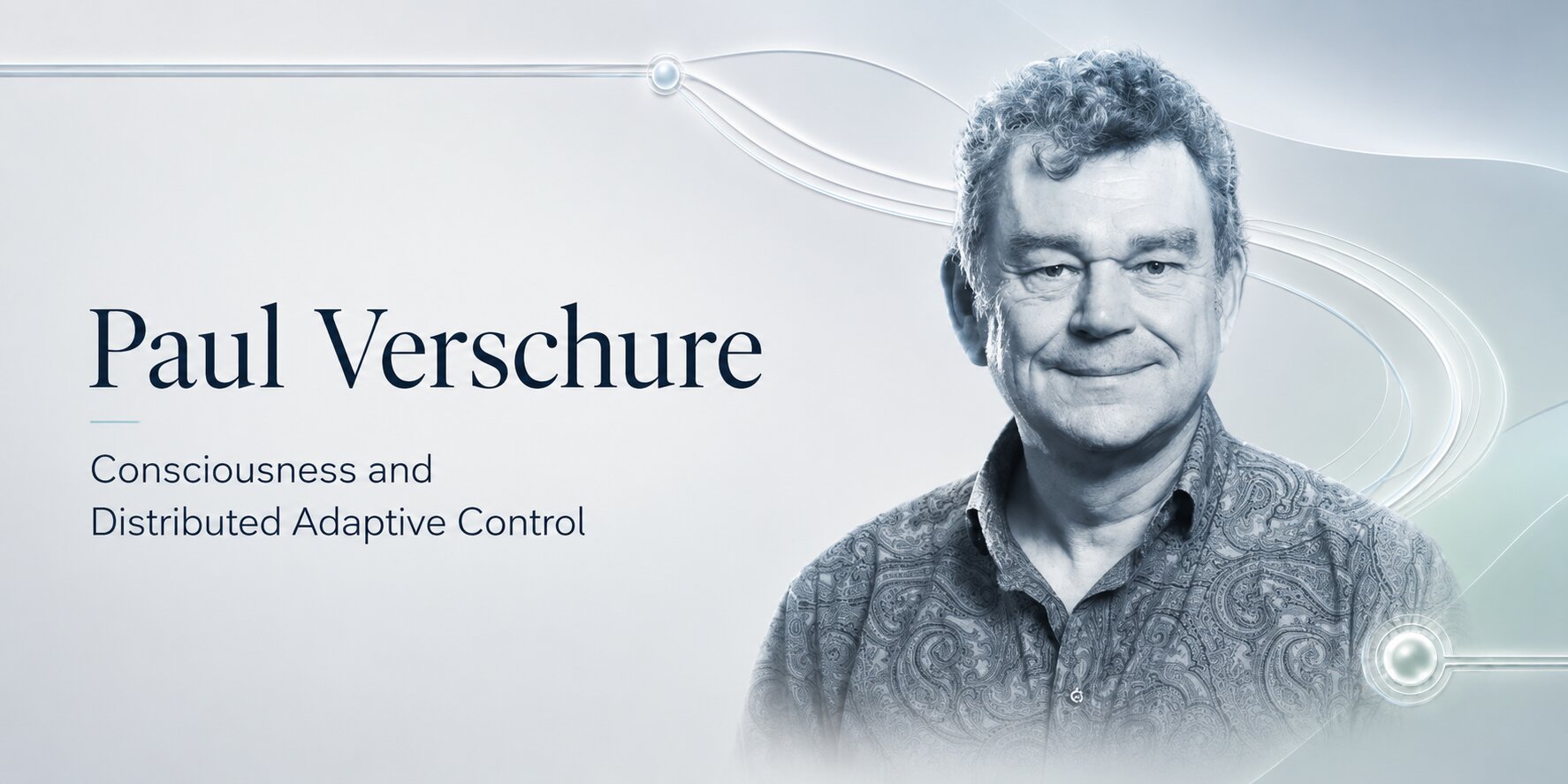
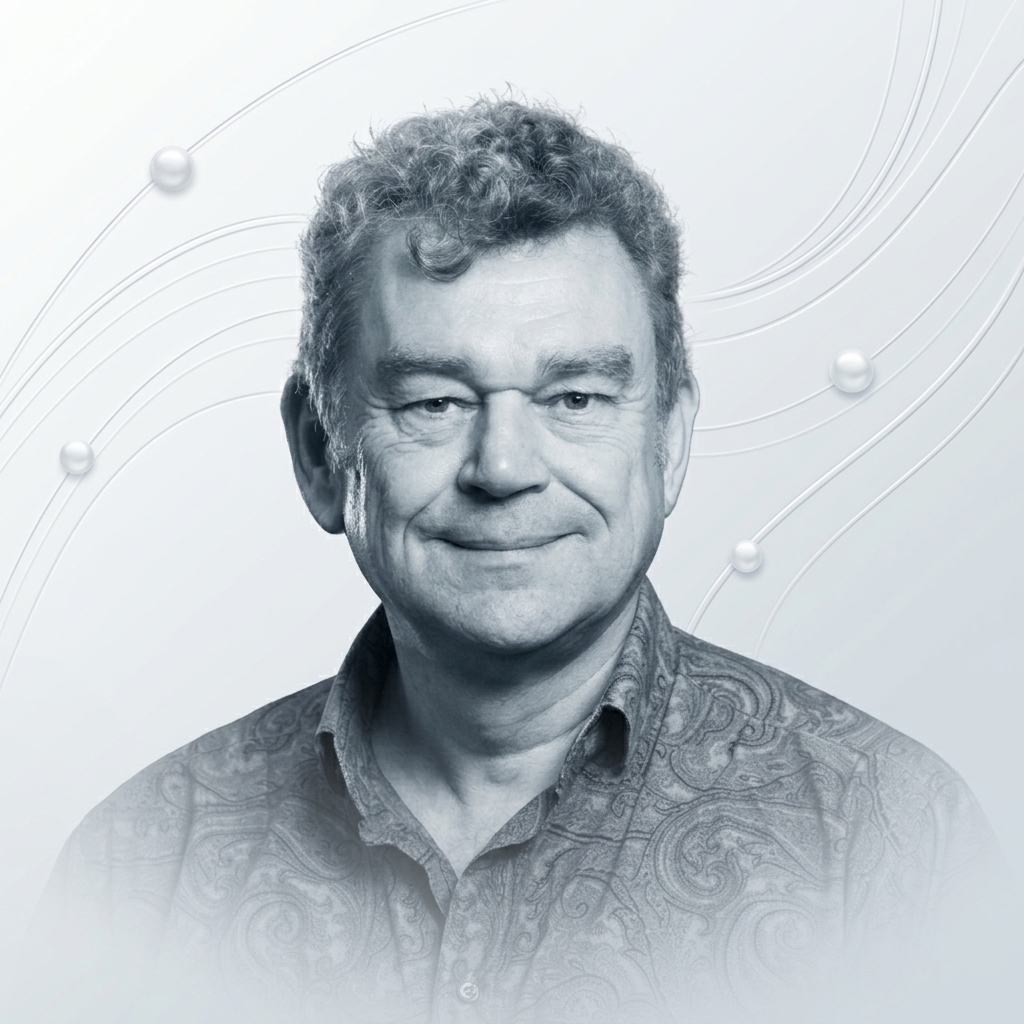
Paul Verschure on consciousness and distributed adaptive control
Episode 5 14.03.2013
-
play_arrow
PLAY EPISODE
Description arrow_drop_down

Description
What if consciousness evolved not to perceive the world but to survive in a world full of other minds? Paul Verschure proposes that the unified conscious scene solves a credit assignment problem created by parallel social simulations.
Subscribe for more from the Convergent Science Network podcast series.
In this episode, Paul Verschure is interviewed by Tony Prescott and Tim Pearce about his theory of consciousness and its relationship to his Distributed Adaptive Control (DAC) architecture. Verschure begins by surveying the landscape of consciousness research, identifying five families of necessary but insufficient conditions: embodied grounding (Metzinger, Damasio), sensorimotor coupling (O’Regan), predictive simulation (Hesslow), integration and differentiation (Tononi, Edelman), and global workspace dynamics (Baars, Dehaene). He argues that each captures a real feature of conscious processing but none alone is sufficient.
The DAC architecture provides the broader framework: a layered control system with reactive, adaptive, and contextual layers, crossed by columns processing world states, self states, and action. Verschure argues this architecture handles the H4W problem of interacting with the physical world (why, what, where, when) but does not require consciousness. The critical transition occurs during the Cambrian explosion when organisms suddenly faced a world populated by other agents whose internal states, goals, and strategies are hidden from surface observation.
Verschure’s central hypothesis is that consciousness evolved to solve the credit assignment problem created by running multiple parallel simulations of other agents’ intentions. Real-time behavior is controlled by these parallel loops, but their outputs may conflict. The unified conscious scene serves as a delayed but coherent compression of all simulations into a singular assessment of what is actually happening, collapsing the possible into the actual. This singular state can then propagate value signals back to the parallel controllers, optimizing their future performance. The conscious scene runs behind real time, consistent with Libet’s findings, but serves a genuine causal function rather than being epiphenomenal.
The episode includes a critical examination of Tononi’s integrated information theory, where Verschure argues that phi-like measures of neural variability fail to distinguish between pre-conscious states with multiple competing options and the unitary conscious scene that emerges after competitive selection.
Tagged as:
Conscious Scene consciousness Consciousness Evolved distributed adaptive control States Unified Conscious
About the author call_made
CSN Podcasts
Both the triumphs of humanity and its most evil deeds have resulted from collaboration. In a time where humanity is required to aspire to the former and minimize the latter, the question arises of how collaboration arises and why it fails. Surprisingly, this phenomenon, so central to who we are, is not well understood. Hence, a collaborative effort is required to understand collaboration in its full biological, psychological, sociological, cultural, and economic complexity and to translate this understanding into operational impact. This series of podcasts is one step toward achieving these complementary goals. The Collaboration Podcast presents interviews with people who are central orchestrators of collaboration in various domains including business, government, science, art, health, sustainability, and the military. The discussions were conducted by Prof. Dr. Paul F.M.J. Verschure and members of the Program Advisory Committee of the Ernst Strungmann Forum on Collaboration (https://www.esforum.de/forums/ESF32_Collaboration.html) during 2021 and had the goal to sketch a map of opportunities, challenges, and obstacles in human collaboration. The forum took place in May 2022, and now we would like to share this series of interviews with a broader audience. The full report of the Forum will be published in 2023 by MIT Press. The podcast was produced by the Convergent Science Network (https://www.convergentsciencenetwork.org/). Context: The stability of social systems depends critically on realizing sustainable methods of “collaboration,” yet how and by which means collaboration is achieved is not clearly understood; neither are the conditions or processes that lead to its breakdown or failure. Collaboration can be understood as cooperation between agents toward mutually constructed goals. Part of the reason for our lack of understanding is that the phenomenon of collaboration is, by nature, a highly multidisciplinary problem, and effective research into its complexities has been difficult to achieve across the broad range of scientific and technical disciplines involved. The need for a fundamental understanding of collaboration, however, has become increasingly important. Not only does humankind demand answers as it attempts to address critical challenges at multiple scales (e.g., climate change, migration, enhanced automation, social and economic inequality), but ever-increasing technological and economic means of interconnecting people and societies are disrupting long-established, familiar patterns of how we interact. Radical technological changes that are ongoing have the potential to reshape collaboration in ways that are currently hard to predict or influence (e.g., by altering configurations in interaction, information creation, and modes of communication). On one hand, such changes could disrupt hitherto stable forms of collaboration by affecting critical communication channels and traditional roles, as can be observed in the rapidly changing patterns in governance, commerce, and social interaction. Conversely, technology could lead to the emergence of novel, successful forms of collaboration that deviate from traditional “hierarchical” architectures. Evidence of this can be seen in areas as diverse as highly automated manufacturing plants, the open science movement, collaborative software repositories, user-centered services, and the sharing of economy-based modes of organization. Without a fundamental understanding of the mechanisms, processes, and boundary conditions of collaboration, it is not possible to evaluate or predict which of these possible scenarios are sustainable or even plausible. The Forum “How Collaboration Arises and Why it Fails” (May 8–13, 2022, Location: Frankfurt am Main, Germany) Chairs: Andreas Roepstorff and Paul Verschure Program Advisory Committee: Jenna Bednar, Julia R. Lupp, Bhavani R. Rao , Andreas Roepstorff, Ferdinand von Siemens, and Paul Verschure
Episodes

Timestamp
- fast_forward00:00:03 - This is the Convergent Science Network podcast. Leading researchers in the domain
- fast_forward00:00:10 - of neuroscience, brain theory and technology are interviewed by Paul Verschure and Tony Prescott.
- fast_forward00:00:26 - Hello this is tony prescott for the
- fast_forward00:00:28 - conversion science podcast series at barcelona summer school 2013 and i'm here
- fast_forward00:00:36 - with paul verschur who is the chair of the summer school but also this morning
- fast_forward00:00:40 - speaker where he was talking about consciousness and the machine and i'm also
- fast_forward00:00:45 - joined by Tim Pearce, who is on this occasion,
- fast_forward00:00:48 - Tim and I are going to be interviewing Paul.
- fast_forward00:00:51 - So Paul, in this morning's presentation, you began by talking about the importance
- fast_forward00:00:58 - of memory in consciousness.
- fast_forward00:01:01 - But as your talk evolved, memory seemed to go into the background.
- fast_forward00:01:05 - But let's begin with that and say how much of
- fast_forward00:01:09 - what we are now and what we're aware of when we think of
- fast_forward00:01:12 - ourselves is to do with our past history and how does it
- fast_forward00:01:14 - affect us right well so the
- fast_forward00:01:17 - idea would be there that if we think
- fast_forward00:01:20 - about the conscious content um that
- fast_forward00:01:24 - we might experience or the way we experience our
- fast_forward00:01:27 - interaction with the world this is very much predicated upon our
- fast_forward00:01:31 - memory of the past and it's also an idea of a
- fast_forward00:01:34 - book by uh by jerry edelman that he wrote in
- fast_forward00:01:37 - the late 80s called the remembered word present
- fast_forward00:01:40 - and actually at the time I wrote a
- fast_forward00:01:42 - review of this book because this also this book was about Edelman's theory of
- fast_forward00:01:48 - consciousness and even though there were a lot of really interesting and rich
- fast_forward00:01:53 - ideas in there I was still left after reading this book as with a lot of the
- fast_forward00:01:58 - literature I saw at the time about consciousness about well.
- fast_forward00:02:01 - Can we at this stage, are we really in a position to say anything meaningful
- fast_forward00:02:04 - about consciousness beyond this very basic observation that the experience of
- fast_forward00:02:10 - present is predicated on our past?
- fast_forward00:02:14 - So the experience of the present is predicated for you on something rather different
- fast_forward00:02:21 - than our memory of the past.
- fast_forward00:02:23 - It's something to do with creating an instantaneous idea of what you call the unified scene.
- fast_forward00:02:28 - And uh for you is
- fast_forward00:02:31 - is is that an adequate description of consciousness or are
- fast_forward00:02:34 - you picking out a particular aspect of consciousness there well traditionally
- fast_forward00:02:39 - so going back to william james um a characterizing feature of consciousness
- fast_forward00:02:45 - was this notion of a unified scene right so that even though we might find ourselves
- fast_forward00:02:49 - in a very confusing ambiguous and unpredictable world In our experience,
- fast_forward00:02:54 - there's always this unitary understanding of the world that we're in. So it's a unified scene.
- fast_forward00:03:01 - And the question then becomes a little bit like, well, okay,
- fast_forward00:03:05 - what is really the purpose of maintaining such a scene from a biological perspective?
- fast_forward00:03:11 - Perspective that doesn't mean that evolution has a purpose but
- fast_forward00:03:13 - it just means well what's the functional role of maintaining such
- fast_forward00:03:17 - a coherent integrated scene of the
- fast_forward00:03:20 - world we find ourselves in and often our interactions with
- fast_forward00:03:23 - this world and i was also then referring there to to the work by bjorn merker
- fast_forward00:03:27 - because bjorn um proposed this this notion that maybe we maintain this this
- fast_forward00:03:35 - integrated scene as a way to counteract uncertainties that we encounter in the world,
- fast_forward00:03:40 - that the unified scene helps us to disambiguate the states of the world.
- fast_forward00:03:45 - For instance, if we, example, burn would use is, okay, you move about in the
- fast_forward00:03:49 - world, your sensors take your eyes, they move in different ways that you cannot
- fast_forward00:03:54 - fully compensate through your psychotic system.
- fast_forward00:03:56 - So now this imposes noise and input signals. And by having a unified scene,
- fast_forward00:04:01 - I can sort of disambiguate and counteract this noise so that I actually can
- fast_forward00:04:06 - have a better understanding of the world I'm in.
- fast_forward00:04:08 - So consciousness is in a way a filter excluding stuff which is perhaps less
- fast_forward00:04:12 - important and bringing in the things which are really pertinent to acting now.
- fast_forward00:04:19 - Well, it depends how you look upon it. So if you look at the literature,
- fast_forward00:04:23 - all in all, you will not find many strong statements about the function of consciousness.
- fast_forward00:04:31 - So you might find statements on, let's say, the correlates of consciousness,
- fast_forward00:04:35 - like people might have found activity in certain parts of the brain and so on.
- fast_forward00:04:39 - And you will find people isolating certain contributing factors.
- fast_forward00:04:44 - And this I have summarized in what I call the grounded and active predictive experience model,
- fast_forward00:04:51 - which means that conscious content or qualia is on the one hand grounded in
- fast_forward00:05:00 - physical existence, right, in embodiment.
- fast_forward00:05:02 - This would be the first axiom that you see expressed in the work by people such as Thomas Metzinger,
- fast_forward00:05:08 - Bud Craig would pertain to that, or also Damasio or Thomas Nagel,
- fast_forward00:05:14 - where the core feature of conscious states is very much organized through notions of self.
- fast_forward00:05:24 - The inactive part is you will find more in the work by people such as Kevin O'Regan,
- fast_forward00:05:31 - O'Regan sorry who would say well qualia the content of conscious states is very
- fast_forward00:05:37 - much defined by our direct sensory motor coupling to the world right so I hold this cup.
- fast_forward00:05:43 - In some sense I'm able to hold this cup and I experience this cup because of
- fast_forward00:05:48 - law like relationships with this
- fast_forward00:05:49 - object and these laws are now defining my qualia, my conscious states.
- fast_forward00:05:55 - Then you would have a predictive component, which goes back to people like Gary Haslow,
- fast_forward00:06:01 - Barcelou, and others, who would emphasize very strongly that it's not only about
- fast_forward00:06:05 - immediate sensor motor coupling, but it's very strongly dependent on your ability
- fast_forward00:06:10 - to predict and simulate the world. So this is a predictive element.
- fast_forward00:06:13 - And then on top of that, we would have theories like friend by Jerry Edelman,
- fast_forward00:06:17 - Giulio Tononi, who would emphasize integration and differentiation which means
- fast_forward00:06:22 - conscious states are very rich,
- fast_forward00:06:25 - they come in many different forms so they're
- fast_forward00:06:28 - highly differentiated from each other but within every scene every specific
- fast_forward00:06:34 - conscious scene is in itself highly integrated and coherent and this then maps
- fast_forward00:06:39 - to a last set of proposals on the neural substrate which emphasize a notion
- fast_forward00:06:45 - of what's called global workspace advanced by
- fast_forward00:06:48 - Barnett-Barrs and further now elaborated by Jean-Pierre Jangeu and Stanislav Dahan.
- fast_forward00:06:56 - Where this notion of integration and differentiation is more mapped onto a neural
- fast_forward00:07:01 - substrate in terms of the ability of neural states to enter a global workspace,
- fast_forward00:07:08 - which would then be the neural substrate of this conscious scene.
- fast_forward00:07:11 - So actually, there are different perspectives on this.
- fast_forward00:07:13 - And one objective I have in my approach is to not necessarily say,
- fast_forward00:07:18 - well, now we have to choose among these different alternatives.
- fast_forward00:07:21 - But I think we actually can find a compromise where we can see that actually
- fast_forward00:07:25 - each of these elements are necessary conditions of conscious states,
- fast_forward00:07:30 - but they're not sufficient.
- fast_forward00:07:31 - There's something missing. So there are certain prerequisites here,
- fast_forward00:07:34 - and quite a few of them are attached to having a brain.
- fast_forward00:07:38 - But in your talk, you also were quite critical of, if you like,
- fast_forward00:07:43 - the search for the neural or brain correlates of consciousness.
- fast_forward00:07:47 - Do you have an issue about levels of explanation here, or what's your concern about that?
- fast_forward00:07:53 - Yeah, so that's a bit the difference you see in approaches of on the one hand,
- fast_forward00:07:58 - Gerald Edelman, who in the late 80s had this idea of, okay, a theory-based research
- fast_forward00:08:05 - program of consciousness,
- fast_forward00:08:07 - also tying it to what he called real-world artifacts or robots,
- fast_forward00:08:12 - versus the approach more advocated by Francis Crick, who coined this notion
- fast_forward00:08:18 - of the neural correlate of consciousness,
- fast_forward00:08:19 - where you would say, well, we don't need a theoretical framework on the basis
- fast_forward00:08:25 - of which we make specific predictions.
- fast_forward00:08:27 - We should basically search for different correlations between functional operationalizations
- fast_forward00:08:32 - of consciousness and neural response patterns to say,
- fast_forward00:08:35 - well, we might find activity in areas X, Y, and Z correlate with varying levels of conscious states.
- fast_forward00:08:45 - So this is the discrepancy. And I feel from a more general methodological perspective,
- fast_forward00:08:49 - the search for correlations, I think, is a very unfortunate way to try to gain
- fast_forward00:08:56 - insight in reality because the universe is filled with correlations and most
- fast_forward00:09:00 - of these aren't very informative.
- fast_forward00:09:02 - So I think science is tied to theory and constrained predictions and validation of prediction.
- fast_forward00:09:08 - But do you think it's possible to have one instantiation, either a physical
- fast_forward00:09:16 - instantiation or a theory that can somehow take into account all of these different
- fast_forward00:09:20 - diverse views of consciousness?
- fast_forward00:09:23 - Yeah, I do. I do. So one thing that I have been developing and tried to show
- fast_forward00:09:29 - this morning is that over the last 20 years or so, I've developed a theory of mind and brain.
- fast_forward00:09:35 - It's called distributed adaptive control. And roughly it says,
- fast_forward00:09:38 - look, the brain can be seen as a layered control structure where we have a reactive component.
- fast_forward00:09:45 - Roughly, we could map this on brainstem and midbrain structures where you have
- fast_forward00:09:48 - strongly predefined behavioral programs.
- fast_forward00:09:51 - Think about the central gray controlling very complex stereotype behaviors in
- fast_forward00:09:57 - a very predefined fashion.
- fast_forward00:10:00 - Then on top of that layer, you have an adaptive layer, as I call it,
- fast_forward00:10:03 - which I see more as a substrate of classical conditioning.
- fast_forward00:10:08 - And essentially, you can see, look at this layer as developing a state space,
- fast_forward00:10:11 - right? It helps you to label the world, to say, well, these are the objects in the world.
- fast_forward00:10:15 - This is the relative importance of these objects to my existence.
- fast_forward00:10:19 - And then parallel to that, you learn the state space of your own actions.
- fast_forward00:10:23 - The next layer is contextual, where you actually use these states now to develop
- fast_forward00:10:28 - plans for action and policies.
- fast_forward00:10:30 - But across these layers of the architecture, you can see columns that on the
- fast_forward00:10:35 - one hand deal with just processing states of the world. We have reflexes that
- fast_forward00:10:40 - pick up, let's say, loud noises. There's a loud noise. You freeze.
- fast_forward00:10:44 - It's a predefined processing system with one component completely focusing on the world.
- fast_forward00:10:51 - But similarly, at these adaptive and contextual layers, we process states of
- fast_forward00:10:55 - the world up to the level of having a map of the city and making predictions where you want to go.
- fast_forward00:11:00 - The next column is pure self. These are all states of self, maybe going from
- fast_forward00:11:04 - your hypothalamus that tells you that, you know, your body has certain deficits
- fast_forward00:11:08 - you have to work on and replenish to self.
- fast_forward00:11:12 - Very abstract notions of, let's say, your professional career,
- fast_forward00:11:15 - sort of the self notion, the self column.
- fast_forward00:11:18 - And the third column is then all about action and interaction,
- fast_forward00:11:22 - motor systems that you can find at spinal cord levels to frontal areas.
- fast_forward00:11:27 - So in this matrix, I think we can disambiguate a lot of neural processing and neural structures.
- fast_forward00:11:32 - So you have levels of self, but to what extent is it really fair to talk about this as consciousness?
- fast_forward00:11:38 - Because um and you look for instance at
- fast_forward00:11:40 - the classic experiments on blind sight and so you
- fast_forward00:11:43 - can get uh the ability to orient
- fast_forward00:11:46 - to visual cues without having any
- fast_forward00:11:50 - consciousness that those visual cues are out
- fast_forward00:11:52 - there and driving your your movements because your visual cortex isn't operating
- fast_forward00:11:57 - properly but your midbrain your visual midbrain is able to detect them so i
- fast_forward00:12:02 - mean isn't that a clear evidence of a dissociation between what we talk about
- fast_forward00:12:06 - generally as consciousness and these lower-level systems you've been discussing. Absolutely.
- fast_forward00:12:10 - So I completely agree with you, and this is also an important point.
- fast_forward00:12:13 - The theory I just sketched out for you very rapidly, distributed depth of control
- fast_forward00:12:19 - in these components has not that much to say on consciousness.
- fast_forward00:12:23 - However, it does pertain rather directly to this GP framework of the grounded
- fast_forward00:12:30 - and active predictive experience model, which is summarized in the current state of the art.
- fast_forward00:12:35 - And what I show there is, for instance, if you emphasize self and embodiment
- fast_forward00:12:38 - as defining qualia, I can show you how it fits in this overall deck theory that
- fast_forward00:12:44 - it's strongly grounded.
- fast_forward00:12:46 - I mean, our knowledge of the world is strongly grounded in our embodiment,
- fast_forward00:12:50 - but it doesn't say anything about whether it's conscious or not.
- fast_forward00:12:54 - It's neutral to that issue. So what I want to show there is the theoretical
- fast_forward00:12:58 - framework, the theory we have, that we have tested the many robots and the many
- fast_forward00:13:03 - theoretical studies and so on, and also in the clinic.
- fast_forward00:13:07 - That theory maps very well on this summary of the state of the art.
- fast_forward00:13:12 - To illustrate and emphasize that I believe the state of the art is essentially
- fast_forward00:13:15 - highlighting necessary features of consciousness and not sufficient ones.
- fast_forward00:13:20 - So there's something missing in this picture, that's exactly the point,
- fast_forward00:13:22 - and it also means there's something missing in the theory as I summarized it
- fast_forward00:13:26 - so far. So in terms of DAC then, it sounds like a good description of what a whole brain is doing.
- fast_forward00:13:34 - I mean, it's almost like a complete description of the different requirements for a brain.
- fast_forward00:13:39 - So if that were the case, how would we define which subsets of that behavior
- fast_forward00:13:44 - may relate to consciousness or not?
- fast_forward00:13:46 - Or is something else required or is it all there?
- fast_forward00:13:50 - If it is, do certain parts of it at different points in time relevant and not
- fast_forward00:13:55 - relevant? What is the relationship?
- fast_forward00:13:59 - Well, so I see this as a transition in your interactions with the world.
- fast_forward00:14:06 - So on the one hand, the deck structure that I just described that also captures
- fast_forward00:14:10 - these key components of the state of the art in consciousness research deals
- fast_forward00:14:15 - essentially with interactions with the physical world.
- fast_forward00:14:17 - And I summarize that in what I call the H4W problem, where you say,
- fast_forward00:14:22 - well, to interact with the world, so to generate action, to know how I interact
- fast_forward00:14:28 - with the world to the age, I have to answer four questions.
- fast_forward00:14:31 - It is why, what are my motivations and goals to act, what are the objects in
- fast_forward00:14:36 - the world that pertain to these goals, where are these objects in the world,
- fast_forward00:14:41 - where am I located in the world, what's the spatial layout of this whole configuration,
- fast_forward00:14:45 - and lastly, it's when, right?
- fast_forward00:14:47 - How do I time and sequence my behavior to be adapted to this world?
- fast_forward00:14:51 - And my claim is, the starting point of the whole story is that this might be
- fast_forward00:14:57 - nice for interactions with the physical world, but it doesn't require consciousness.
- fast_forward00:15:01 - Because interactions with the physical world are often of a fairly unitary character.
- fast_forward00:15:06 - That means you interact with rocks and then dirt and whatever,
- fast_forward00:15:10 - non-agents, right? Dead matter.
- fast_forward00:15:13 - And interaction with dead matter is fairly straightforward. And I think consciousness
- fast_forward00:15:18 - really comes into the story.
- fast_forward00:15:20 - When you start to interact with other agents, that's really the transition point.
- fast_forward00:15:25 - That's a very specific transition point that I think allows us now to hypothesize
- fast_forward00:15:32 - that certain aspects of the theory are incomplete.
- fast_forward00:15:35 - And that if you want those during evolution, very specific aspects of brains
- fast_forward00:15:40 - were invented to really deal with and solve that specific problem of dealing with other agents.
- fast_forward00:15:48 - So dealing with other agents though is is part of
- fast_forward00:15:51 - this uh larger problem so the you identify
- fast_forward00:15:54 - these components that people have suggested are important
- fast_forward00:15:57 - and you say that they're necessary but not sufficient and the
- fast_forward00:16:01 - extra ingredient is that what you're calling the unified scene or is it more
- fast_forward00:16:05 - than that no it's more than that so the extra ingredient so we have to backtrack
- fast_forward00:16:10 - a little bit because the unified scene we know um i mean as a concept it's around
- fast_forward00:16:15 - for a long time okay so there's There's not that much controversy on it.
- fast_forward00:16:21 - We know we can manipulate this scene if we use drugs, for instance,
- fast_forward00:16:27 - like drugs like LSD or ketamine and so on really can lead to changes to this
- fast_forward00:16:31 - unified scene as you experience it.
- fast_forward00:16:34 - And also when I myself was a subject in these experiments on psychosis,
- fast_forward00:16:42 - essentially this is done by giving you ketamine and if you're lucky,
- fast_forward00:16:45 - you get psychotic or unlucky.
- fast_forward00:16:48 - This leads to a very severe distortion of the conscious scene.
- fast_forward00:16:51 - You lose a sense of space and time for instance.
- fast_forward00:16:54 - That means the conscious scene is maintained by a brain and this is what it suggests to me.
- fast_forward00:16:59 - But the other remarkable observation came from the 80s experiments by Libet
- fast_forward00:17:06 - where he shows that the conscious scene essentially is not operating in real time.
- fast_forward00:17:12 - The conscious scene is a very nice well-defined experiments,
- fast_forward00:17:17 - basically he showed the dissociation between brain states that relate to our
- fast_forward00:17:21 - actions and conscious experience, and that the conscious experience is delayed,
- fast_forward00:17:27 - relative to the brain states that relate to actions, suggesting if you want,
- fast_forward00:17:31 - the brain already knows what to do before you experience that.
- fast_forward00:17:34 - So now that led to this strange conundrum, because it means like,
- fast_forward00:17:38 - okay, here we have all this metabolic power and compute power of the brain dedicated
- fast_forward00:17:44 - to building a conscious scene and maintaining it, but it's running behind in time.
- fast_forward00:17:50 - So it's not causing your ongoing behavior.
- fast_forward00:17:53 - And it led some like Dan Dana to say, well, it therefore might be an epiphenomenon.
- fast_forward00:17:57 - Maybe consciousness therefore is not causing and cannot cause behavior.
- fast_forward00:18:02 - And I think this is where our paths start to diverge, where I think people have
- fast_forward00:18:06 - overlooked some important contributions
- fast_forward00:18:08 - that consciousness can make in the control of real-time behavior.
- fast_forward00:18:14 - Could you elaborate a bit more on what you think that unconsciousness is adding?
- fast_forward00:18:18 - Right, exactly. So, well, I think first of H4W, I interact with the world with bricks, right?
- fast_forward00:18:23 - Well, a brick, I can look at it on the basis of its surface features.
- fast_forward00:18:27 - I can make a pretty accurate prediction what it will do, probably nothing.
- fast_forward00:18:31 - So, now imagine that brick is not a brick, but it's an agent, it's SpongeBob.
- fast_forward00:18:36 - And SpongeBob has goals and wishes and intentions and strategies.
- fast_forward00:18:41 - Now have a whole new problem because SpongeBob doesn't show at its surface essentially
- fast_forward00:18:49 - what these internal states are.
- fast_forward00:18:51 - This is a very fundamental problem of estimating the intentional states of others
- fast_forward00:18:57 - that they're not advertised at the outside.
- fast_forward00:19:01 - This is a fundamental problem and also well recognized already since Hume at
- fast_forward00:19:06 - least, the inference of intentional states.
- fast_forward00:19:09 - So what I'm saying, well, during the Cambrian explosion 500 million years ago
- fast_forward00:19:15 - about, I think something really unique happened in evolution that suddenly agents,
- fast_forward00:19:21 - animals found themselves in a world filled with other agents that could predate
- fast_forward00:19:28 - on them or they could predate on and they would have conspecifics maybe in different social structures.
- fast_forward00:19:34 - This is not so clear but now we move from living in a world of bricks of living
- fast_forward00:19:38 - in a world filled with other agents and these agents have hidden states that
- fast_forward00:19:41 - we cannot easily assess and now where consciousness comes in in my mind as the hypothesis,
- fast_forward00:19:48 - it allows you to actually run massive parallel simulations on the world that
- fast_forward00:19:55 - means if I want to successfully exist in a world with other agents I have to
- fast_forward00:19:59 - run simulations on their internal states to make predictions,
- fast_forward00:20:03 - I have to do this in parallel because I have to operate in real time.
- fast_forward00:20:07 - But the problem of parallel operation is, of course, that you have parallel
- fast_forward00:20:11 - control systems that are not necessarily all coherent.
- fast_forward00:20:14 - So they might actually make opposite contradictory decisions.
- fast_forward00:20:20 - So now, being a single agent, I have a big optimization problem because it means,
- fast_forward00:20:25 - well, if I have all these parallel loops performing their own simulations,
- fast_forward00:20:30 - controlling my real-time performance, how do I optimize them?
- fast_forward00:20:33 - How do I know whether I made a mistake or I did it right, and how do I translate
- fast_forward00:20:37 - that singular observation to parallel control loops? That's where the conscious scene comes in.
- fast_forward00:20:42 - So how I see this is, real-time operation is performed by these parallel control
- fast_forward00:20:47 - loops, so I can keep track of my social environment, make predictions on what might occur, now.
- fast_forward00:20:56 - With some delay, I maintain a coherent conscious scene that is really like a
- fast_forward00:21:00 - compressed state where I go from the possible that is pursued in these simulations
- fast_forward00:21:05 - to the actual that is really the collapse across all these simulations of what
- fast_forward00:21:11 - I believe is really out there.
- fast_forward00:21:13 - This is the world in which I operate and work and the world that gives me feedback.
- fast_forward00:21:17 - This is by necessity intentional. I can now make statements on value,
- fast_forward00:21:23 - and they can percolate those value statements, if you want, back into my parallel controller.
- fast_forward00:21:28 - So real-time operation is parallel.
- fast_forward00:21:31 - This automatically leads to a credit assignment problem that I solve by having
- fast_forward00:21:35 - a singular integrated conscious state.
- fast_forward00:21:39 - But it sounds like a good way of explaining interactions. But is there really,
- fast_forward00:21:51 - is it so unique with interactions between agents?
- fast_forward00:21:54 - For instance, any interaction with the world has all sorts of indeterminisms,
- fast_forward00:21:59 - right? That we can't necessarily predict.
- fast_forward00:22:02 - So don't we have to compute all of those? And didn't we have to do all of that,
- fast_forward00:22:06 - say, before the Cambrian explosion or whatever?
- fast_forward00:22:10 - Well, I would claim that... So the most complex organisms, apparently,
- fast_forward00:22:16 - really early Cambrian, before Cambrian, maybe was a worm-like creature.
- fast_forward00:22:21 - So if you are a worm, I would believe that H4W is not a big deal for you.
- fast_forward00:22:26 - You crawl around in the dirt, you follow some gradients, that's it.
- fast_forward00:22:31 - After they came you know suddenly we have these 30 body
- fast_forward00:22:35 - plants that now can define again many
- fast_forward00:22:38 - variations on these body plants defining many different kinds
- fast_forward00:22:41 - of animals that now exist in complex ecological systems i think that's a real
- fast_forward00:22:47 - qualitative change from being the worm in the dirt so so from having a simulation
- fast_forward00:22:53 - in my brain which helps me make predictions about the future so i can make better choices.
- fast_forward00:22:59 - And part of that simulation in my brain is a simulation of other beings,
- fast_forward00:23:04 - including conspecifics.
- fast_forward00:23:06 - And I guess at one point in the simulation I also have a model of myself.
- fast_forward00:23:11 - But does that model of myself somehow have some privileged status that then
- fast_forward00:23:16 - it becomes part of my consciousness in some way?
- fast_forward00:23:21 - Well, yeah, I mean, in some sense, your model of self has access to other sensor
- fast_forward00:23:26 - states than your model of others.
- fast_forward00:23:28 - And so, for instance, you do have direct feedback from your own body,
- fast_forward00:23:32 - from your own organs and so on, that can all feed into some sort of self model.
- fast_forward00:23:39 - So, yes, the self model is definitely privileged.
- fast_forward00:23:41 - And that's why also in the deck architecture, self is really one of the,
- fast_forward00:23:45 - is the central organizing column in this whole system.
- fast_forward00:23:48 - And also believe that indeed for subjective states, in the end,
- fast_forward00:23:52 - it is, of course, a unified scene that tells you how the self,
- fast_forward00:23:55 - the I, is really placed in the world.
- fast_forward00:23:58 - And maybe that self-model is the basis for building models of others,
- fast_forward00:24:02 - particularly in my own species, so I can say, well, if I was that person,
- fast_forward00:24:06 - what would I be doing? Sure.
- fast_forward00:24:07 - No, look, I agree with this. So this is, of course, also a fairly well-recognized
- fast_forward00:24:13 - mechanism of social perception,
- fast_forward00:24:14 - going back to Merleau-Ponty, right, among others, that you interpret states
- fast_forward00:24:21 - of others in terms of self.
- fast_forward00:24:22 - And this is also where I think this whole discussion on the mirror mechanisms
- fast_forward00:24:26 - have become very relevant, but a lot of this can play out at a subconscious level.
- fast_forward00:24:31 - Level so so a lot of people uh try to explain consciousness in terms of cortex right or.
- fast_forward00:24:39 - Thalamaco cortical interactions and loops and presumably
- fast_forward00:24:42 - the cortex came quite a while after this process right of cambrin explosions
- fast_forward00:24:47 - so it's an interesting question do you need a cortex for this or how come they
- fast_forward00:24:52 - didn't kind of occur co-occur at the same time if you if you if you need some
- fast_forward00:24:57 - loops with a cortical structure?
- fast_forward00:25:00 - How do we reconcile these two different very significant developments in brain architecture? Well.
- fast_forward00:25:09 - So this is a good question, but it also raises important issues on brain evolution, right?
- fast_forward00:25:14 - And so you have this traditional McLean notion of a tree on the brain where,
- fast_forward00:25:18 - let's say, first you have, let's say, your lizard brain, and then after a few
- fast_forward00:25:21 - million years, you add a new layer and so on, right? They're like modules that you stack together.
- fast_forward00:25:26 - I'm not sure that's really a reasonable way to think about it.
- fast_forward00:25:28 - And I would believe, actually, we had another beautiful talk here with Stan
- fast_forward00:25:33 - Grillner, who takes the lamprey as his model animal.
- fast_forward00:25:36 - And he basically shows that the lamprey that evolved, emerged very early in
- fast_forward00:25:42 - the Cambrian, so we're talking 500 million years ago, basically has all the
- fast_forward00:25:47 - ingredients of a vertebrate nervous system, right?
- fast_forward00:25:50 - In a minimally a prototypical state.
- fast_forward00:25:53 - So all structures are there. But then I would believe consciousness is a transient memory system.
- fast_forward00:25:59 - This is why I think the thalamocortical system, that depends very much strongly
- fast_forward00:26:03 - on its dynamics, is a very good candidate to at least be part of that substrate.
- fast_forward00:26:09 - But I have absolutely no problems with suggestions like Bjorn Merker,
- fast_forward00:26:13 - who says, well, maybe there are also already structures more focusing on zona
- fast_forward00:26:18 - inserta superior colliculus that already have rudimentary forms of such a transient
- fast_forward00:26:25 - memory system that we might also attribute some minimal conscious states to.
- fast_forward00:26:30 - For me, I don't see a too categorical distinction there.
- fast_forward00:26:34 - The key thing for me is that we're talking about transient memory systems.
- fast_forward00:26:38 - But then doesn't it become a bit strange why the cortex then developed?
- fast_forward00:26:43 - I mean, if these things were sufficient to have these requirements for consciousness?
- fast_forward00:26:48 - Or are there other reasons for cortex that are independent? Well,
- fast_forward00:26:53 - cortex, I look at cortex more as a big memory system.
- fast_forward00:26:57 - So you can think about primary sensory areas with their receptive fields expressing
- fast_forward00:27:02 - a form of memory of states of the world.
- fast_forward00:27:04 - You can think about more frontal areas.
- fast_forward00:27:07 - You might find states that relate more to strategies and monitoring goals and so on.
- fast_forward00:27:13 - So here we have this massive memory system. So I think the contribution of cortex
- fast_forward00:27:18 - is more memory, allowing you sort of more complex representations and so on.
- fast_forward00:27:23 - But as such as an isolated substrate I
- fast_forward00:27:26 - think it won't help you much in being conscious or not
- fast_forward00:27:29 - because I believe that really strongly depends on the
- fast_forward00:27:32 - dynamics you will find between cortical areas and subcortical areas such as
- fast_forward00:27:36 - the thalamus right that in that interaction conscious states would be residing
- fast_forward00:27:42 - and this also would of course be consistent with these the literature that would
- fast_forward00:27:45 - show that different kinds of anesthetics that really modulate states of the thalamus indeed
- fast_forward00:27:52 - directly modulate levels of consciousness.
- fast_forward00:27:55 - So I think it would be naive to localize this too much in cortex.
- fast_forward00:28:01 - And we should never forget that, of course, we're all strongly biased by cortex
- fast_forward00:28:05 - because it's so easy to measure from it relative to other areas.
- fast_forward00:28:11 - So um one of the uh topics
- fast_forward00:28:15 - you touched on at some depth was uh what's uh
- fast_forward00:28:18 - uh been known as ternoni's phi theory of
- fast_forward00:28:22 - uh consciousness which is uh currently fairly popular and that is a theory that
- fast_forward00:28:27 - makes a very specific prediction about uh properties of the brain and how those
- fast_forward00:28:33 - might be linked to consciousness i mean can you quickly summarize the theory
- fast_forward00:28:36 - for us and perhaps say where you see the problems with that are.
- fast_forward00:28:40 - Well, so this integration information theory, which Giulio Tononi also developed
- fast_forward00:28:45 - already working with Jerry Edelman many years ago, essentially tries to give
- fast_forward00:28:50 - a quantification of brain states that pertain to consciousness.
- fast_forward00:28:55 - So the question could be, look, I'm asleep, the brain is in a certain state.
- fast_forward00:29:00 - I'm awake and conscious, and the brain is in another state.
- fast_forward00:29:02 - How can I have a quantification of that difference?
- fast_forward00:29:05 - So it's a neural correlate that we're talking about. Definitely a neural correlate
- fast_forward00:29:08 - version of this. And so it's a neural correlate approach.
- fast_forward00:29:12 - And the measure essentially tells you something about, let's say,
- fast_forward00:29:15 - the variability of neural states.
- fast_forward00:29:16 - Essentially, Julio conceptualizes this as a reflection of the idea of a unified scene.
- fast_forward00:29:23 - A unified scene would be an undividable whole of information, right?
- fast_forward00:29:29 - So that means how can I identify now these indivisible wholes of information
- fast_forward00:29:35 - information, or these partitions of information.
- fast_forward00:29:38 - And your ability to then… the complexity of these partitions would tell you
- fast_forward00:29:43 - something about the conscious state.
- fast_forward00:29:45 - So essentially it's like an entropy measure, you could say, but with some bells
- fast_forward00:29:50 - and whistles added to it, it tells you something about the variability of neural states.
- fast_forward00:29:53 - And then what they have shown, what Julia has shown, I think very nicely,
- fast_forward00:29:58 - is then how that measure indeed correlates in some way with different levels
- fast_forward00:30:02 - of consciousness, such such as sleep, wakefulness, or different perturbations
- fast_forward00:30:06 - of brain states, and so on.
- fast_forward00:30:08 - But of course, the questions are here now have a quantification.
- fast_forward00:30:11 - I mean, it started out as a mutual information measure, and now it has evolved in different forms.
- fast_forward00:30:16 - But in the end, it's an approximation of some entropy. And...
- fast_forward00:30:22 - Um the point is of course yeah but what does
- fast_forward00:30:25 - it really tell me about let's say the function of consciousness in
- fast_forward00:30:28 - this case or what does it really tell me about the underlying uh dynamic
- fast_forward00:30:31 - organization of it that's not so much but is
- fast_forward00:30:34 - it not a nice to have a marker if indeed that is what it could be of course
- fast_forward00:30:38 - but then so to test that what what we have done is we we have looked at other
- fast_forward00:30:43 - markers of brain activity we have looked at neural responses in the macaque
- fast_forward00:30:49 - dorsal premotor Cortex that we have analyzed and published recently,
- fast_forward00:30:53 - a paper with Stefano Ferreira in Rome and Carnie Marcos, his first author in
- fast_forward00:30:59 - Nuren, where we looked at the role of the inter-trial variability in decision-making in the monkey.
- fast_forward00:31:06 - And basically, you can show that the variability between trials is predictive
- fast_forward00:31:11 - of performance if you manipulate, let's say, the certainty of the animal.
- fast_forward00:31:16 - So then we thought, well, here we have a more generic measure of neural variability.
- fast_forward00:31:21 - We know it relates to performance.
- fast_forward00:31:23 - So let's compare this now to what this phi measure would do on the same data.
- fast_forward00:31:29 - So it is unreasonable to believe that the monkey throughout this trial would
- fast_forward00:31:35 - be conscious of these states of its premotor area for the following reason.
- fast_forward00:31:40 - And what you see is that when the stimulus comes on that informs the monkey
- fast_forward00:31:46 - about the kinds of action it has to execute, different action options are active in this area.
- fast_forward00:31:54 - And slowly, through competition, one will be chosen.
- fast_forward00:31:58 - One will be selected. The conscious scene is unitary.
- fast_forward00:32:02 - So that means the plurality of actions that is represented in this area early
- fast_forward00:32:07 - on in the trial cannot be part of your measure of consciousness because that's not the unitary scene.
- fast_forward00:32:12 - So the only part that can possibly be a contribution to the unitary conscious
- fast_forward00:32:17 - scene is once the system has converged to a single response through a competitive process.
- fast_forward00:32:25 - So you would expect, and if I have a measure that is really specific to consciousness,
- fast_forward00:32:29 - then it would tell you nothing about this pre-conscious state in this area where
- fast_forward00:32:35 - you have a plurality of options open because the conscious scene is unitary.
- fast_forward00:32:39 - And it would give you a lot of information when you have the choice made because
- fast_forward00:32:43 - that's when you have the content for a future conscious state.
- fast_forward00:32:46 - However, what we see is that this phi measure basically is exactly the inverse
- fast_forward00:32:51 - of our intertrial variability.
- fast_forward00:32:53 - So that means in this very specific and restricted element example that I only
- fast_forward00:32:59 - used to sort of illustrate a bit the problem, the measure as such indeed tells
- fast_forward00:33:04 - you something about the variability,
- fast_forward00:33:06 - the entropy in a neural response, but it's completely unspecific to a pre-conscious
- fast_forward00:33:11 - or post-conscious or conscious phase,
- fast_forward00:33:14 - because it happily gives you a measure when you have many options open,
- fast_forward00:33:18 - which cannot be part of the conscious scene because it has to be unitary,
- fast_forward00:33:21 - and where you have a single option open, which can be part of a conscious scene.
- fast_forward00:33:24 - So I think the measure is really not sensitive enough to give you specific information on consciousness.
- fast_forward00:33:30 - So this particular measure may have some problems with it, but I think what may be interesting is.
- fast_forward00:33:37 - From the point of view of studying consciousness is at
- fast_forward00:33:39 - least it's a hypothesis about how
- fast_forward00:33:42 - you could measure objectively conscious states in another mind and you can even
- fast_forward00:33:48 - go as far since this information measure and say well let's take minds that
- fast_forward00:33:53 - may not be instantiated in brains they might be instantiated in computers or
- fast_forward00:33:56 - robots and we can apply that measure to those other minds and so So,
- fast_forward00:34:02 - if we could find a measure, maybe IIT isn't the best one,
- fast_forward00:34:05 - but if we could do that, if we could really see a clear marker for which you
- fast_forward00:34:09 - have an objective definition, this would be useful.
- fast_forward00:34:12 - And your own program of building robots would benefit from that.
- fast_forward00:34:16 - I mean, how would you plan to measure consciousness in robots? parts.
- fast_forward00:34:22 - Look, I agree. Of course, if we have tools to quantify our measurements and
- fast_forward00:34:28 - these quantifications are specific to phenomena we want to explain,
- fast_forward00:34:32 - this is key, right? This is essential.
- fast_forward00:34:34 - But it's a little bit like the discussion around the IQ, right?
- fast_forward00:34:37 - I mean, at some point, now we have these IQ tests, we get scores,
- fast_forward00:34:42 - but in the end we don't really know what we're measuring.
- fast_forward00:34:44 - And so this whole issue of specificity, right?
- fast_forward00:34:47 - So if you say, look, I have a measure here of the The variability of neural
- fast_forward00:34:51 - states or the ability of a system to maintain indivisible informational subdomains
- fast_forward00:34:59 - or something of this kind, that's all fine.
- fast_forward00:35:02 - But it's all about the specificity. If you say, look, it's a specific measure
- fast_forward00:35:05 - to consciousness, then you have to show that specificity.
- fast_forward00:35:09 - If it's not specific, of course, it leads to confusion.
- fast_forward00:35:12 - But I do agree with you that it is absolutely essential to develop these kinds
- fast_forward00:35:16 - of measures. And what I expect, though, is that we have to constrain them more
- fast_forward00:35:20 - by at least a theoretical understanding of the substrate that generates conscious state.
- fast_forward00:35:26 - So I would suggest these kinds of measures might be an interesting starting point.
- fast_forward00:35:32 - But maybe we have to make sure we really apply them to the right subsystems,
- fast_forward00:35:35 - as opposed to in a rather indiscriminate fashion to the whole of the brain.
- fast_forward00:35:38 - But just to push on this, your own program of research includes a very ambitious
- fast_forward00:35:44 - target of building a robot with consciousness.
- fast_forward00:35:48 - But unless you're prepared to commit in advance to some particular measure of
- fast_forward00:35:53 - consciousness, how will you know you've succeeded?
- fast_forward00:35:55 - Did and and uh you know without that commitment you
- fast_forward00:35:59 - could easily as you build your robot uh you
- fast_forward00:36:02 - know modify your goals in order to fit where you
- fast_forward00:36:05 - get to and i think this is the risk with with these
- fast_forward00:36:08 - kinds of programs absolutely but the point is i'm committed i think i'm doing
- fast_forward00:36:12 - better than a neural correlate approach because i'm committing myself to very
- fast_forward00:36:15 - specific theoretical constructs so given the theory what i'm saying so i move
- fast_forward00:36:20 - from h4w to h5w because now i have to deal with who, to deal with who, I have to simulate.
- fast_forward00:36:26 - In order to optimize these internal simulations, I must serialize again and
- fast_forward00:36:31 - solve my credit assignment problem.
- fast_forward00:36:33 - So I'm making very specific predictions, and the core of this is all going in
- fast_forward00:36:38 - the direction of conscious states.
- fast_forward00:36:40 - That means my current task description, biased by my self-model,
- fast_forward00:36:48 - resides in a transient memory.
- fast_forward00:36:49 - That means it's not expressed in a structural memory. It's really in a memory
- fast_forward00:36:53 - that is transient in neural activity.
- fast_forward00:36:56 - So it can very flexibly be changed.
- fast_forward00:36:59 - And I believe that we might find possibilities.
- fast_forward00:37:01 - Echoes of this in the thalamocortical system. So that now means that I have to say,
- fast_forward00:37:06 - okay, in my robot, what I expect to see is, one,
- fast_forward00:37:10 - I have an understanding of the task the robot is in, I have an understanding
- fast_forward00:37:13 - of the memories the robot has formed in the past about this task,
- fast_forward00:37:16 - and now I can find echoes of these states in this transient memory system.
- fast_forward00:37:22 - So I think these are very specific predictions that we can address with the
- fast_forward00:37:25 - kinds of quantifications we already have.
- fast_forward00:37:27 - So we can, can we tie you down on this to say that, you know,
- fast_forward00:37:31 - in 10 years you've built your robot and it solves the H5W problem in some way
- fast_forward00:37:37 - that we've agreed is appropriate and similar to perhaps the human H5W problem.
- fast_forward00:37:44 - Then you would make the strong claim that that robot was conscious because it
- fast_forward00:37:49 - had solved that problem in a demonstrable way. Absolutely.
- fast_forward00:37:52 - Yeah. Okay. We'll come back and check out. No, you should. Good.
- fast_forward00:37:57 - Moreover, I will have found corollaries of this also in the human brain.
- fast_forward00:38:03 - Because, for instance, I believe that this transient memory system we're dealing
- fast_forward00:38:08 - with has to also go through very specific update cycles, certain persistence.
- fast_forward00:38:14 - Also, we know now a certain delay with respect to real-time operation.
- fast_forward00:38:18 - So there are very specific testable predictions coming out of this that we can
- fast_forward00:38:22 - then bring back to also humans and other animals.
- fast_forward00:38:26 - So if we had a system like that that was able to compute these possible intentional
- fast_forward00:38:33 - stances and then select one, bind it to the current system,
- fast_forward00:38:38 - uh the present moment um but what uh what would we uh be able to account for
- fast_forward00:38:45 - in terms of going back to the original gate with these different criteria of
- fast_forward00:38:50 - different theories for consciousness.
- fast_forward00:38:53 - Would it be able to kind of account for all of those and include them and if
- fast_forward00:38:59 - so in what way or what features of that system would then uh basically account
- fast_forward00:39:03 - for the different aspects of how people have been thinking about consciousness.
- fast_forward00:39:07 - Well, so my claim is that already in the theory, we are accounting for these elements, right?
- fast_forward00:39:13 - So for instance, we spend a lot of time looking at predictive systems in the
- fast_forward00:39:18 - cerebellum, in the cortex, subcortical areas, also like basal ganglia.
- fast_forward00:39:23 - So you see, prediction occurs in many of these systems.
- fast_forward00:39:27 - Now, this is one of the axioms of this GP model, going back to people like,
- fast_forward00:39:32 - I mentioned earlier, Jerry Haslow, Barcelou, and so on, and also Bjorn Merker,
- fast_forward00:39:37 - that qualia are defined through prediction.
- fast_forward00:39:40 - So prediction is an organizing principle of the whole theory expressed at many
- fast_forward00:39:48 - different levels of organization.
- fast_forward00:39:49 - So this already shows you that to say, well, qualia are prediction is not specific enough.
- fast_forward00:39:54 - It occurs at all these levels. So what I am aiming for is that we can give this
- fast_forward00:39:59 - now more specificity. that we can say, well, actually it is one subset of predictions
- fast_forward00:40:03 - generated by a very specific system that are pertaining to conscious states.
- fast_forward00:40:09 - For instance, it's an open question, do the cerebellum, which is 15 million
- fast_forward00:40:13 - loops in the human brain,
- fast_forward00:40:16 - making up more than 65% of the neural populations of the central nervous system,
- fast_forward00:40:20 - each of these loops is independently generating a prediction all the time, and.
- fast_forward00:40:27 - When predictions are met or not met, dependent on the outcome of that,
- fast_forward00:40:30 - it might generate event triggers.
- fast_forward00:40:33 - Well, right now it's really unclear whether violations of predictions in the
- fast_forward00:40:38 - cerebellum that will be conveyed through the inferior olive,
- fast_forward00:40:41 - the inferior olive, by the way, is again under feedback control by the cerebellum
- fast_forward00:40:46 - on a prediction-based level, do violations of predictions in the cerebellum
- fast_forward00:40:51 - in any way percolate into conscious states?
- fast_forward00:40:54 - I don't think so. So, but now we can try to evaluate that more specifically,
- fast_forward00:40:59 - okay, that we can really delineate a subset of predictions the brain generates
- fast_forward00:41:03 - at many levels of its organization to say, well, it's only this subset that
- fast_forward00:41:07 - in a very specific way gets gated into a conscious scene.
- fast_forward00:41:12 - I do expect very specific gating mechanisms there at work.
- fast_forward00:41:15 - But if it's the cerebellum that's computing all these possibilities,
- fast_forward00:41:18 - and then the fact that when we remove it, we still have a sense of consciousness.
- fast_forward00:41:25 - How do we reconcile those two facts together?
- fast_forward00:41:29 - Well, I think it's important to distinguish levels of consciousness,
- fast_forward00:41:32 - like Steve Lowery has been writing quite a bit on this, that for instance, I can be asleep,
- fast_forward00:41:40 - I can be anesthetized, I can be in coma, I can be minimally conscious, I can be awake and alert.
- fast_forward00:41:44 - These are all different levels of consciousness, right?
- fast_forward00:41:47 - But then orthogonal to that, if you want, you have content of consciousness, right?
- fast_forward00:41:52 - I can be aware of the interview we're having right now.
- fast_forward00:41:56 - I can be fantasizing while talking to you about sailing or other things I could be doing as well.
- fast_forward00:42:05 - So this is content of consciousness. And I see the cerebellum,
- fast_forward00:42:11 - your question is very much pertaining to this content of consciousness issues.
- fast_forward00:42:16 - If you remove a cerebellum, suddenly you might be ataxic, you might have difficulties
- fast_forward00:42:20 - controlling motor, you might have some difficulties with timing issues.
- fast_forward00:42:24 - There are also suggestions about cognitive deficits you might suffer from with cerebellar lesions.
- fast_forward00:42:30 - So these, of course, will all pertain to a change of conscious state because
- fast_forward00:42:35 - suddenly I cannot play tennis anymore. And yes, this will restrict my potential
- fast_forward00:42:40 - space of experiences, but it doesn't
- fast_forward00:42:42 - tell you anything specific about the organization of consciousness.
- fast_forward00:42:46 - But this just sounds like a whole description of behavior and the brain.
- fast_forward00:42:52 - I mean, the fact that this content of consciousness seems to be directly...
- fast_forward00:42:58 - Uh related to just what
- fast_forward00:43:01 - the brain does and no i don't
- fast_forward00:43:05 - think so look it's an architectural theory of
- fast_forward00:43:08 - consciousness and a functional theory absolutely but i mean a lot of the time
- fast_forward00:43:11 - when people are when we think about what it means to be conscious it's the experience
- fast_forward00:43:17 - of standing on the beach and watching the sunset and that unique set of feelings
- fast_forward00:43:22 - that that evokes in you that's That's what we often mean by the experience of consciousness.
- fast_forward00:43:27 - And that's all about content. But we only spend a very small fraction of our
- fast_forward00:43:32 - life standing on the beach looking at the sunset, though.
- fast_forward00:43:35 - But I can be looking at the color of this microphone cover, which is yellow,
- fast_forward00:43:38 - and thinking that reminds me of the sunset on the beach. So it's evoking.
- fast_forward00:43:44 - Memory is not an input channel, right? But it's evoking those feelings in me.
- fast_forward00:43:49 - So it's about feeling. so it's i find it
- fast_forward00:43:52 - hard to separate the the content and the
- fast_forward00:43:54 - vehicle aspects of okay of consciousness in the way you want to do yeah but
- fast_forward00:43:58 - for me so how i see the feeling which for me comes out of this whole self column
- fast_forward00:44:03 - of the of the architecture starting really very low down and really embodiment
- fast_forward00:44:09 - and very primitive sensations to the notion of a career.
- fast_forward00:44:15 - This is the information channel if
- fast_forward00:44:18 - you want that feeds then into the feeling
- fast_forward00:44:21 - aspects of of a conscious state and also it's a strong ground it also grounds
- fast_forward00:44:27 - very much constant experience in self right so there's this feeling undertone
- fast_forward00:44:32 - if you want of the conscious state but i don't really see this as being problematic
- fast_forward00:44:36 - i mean my i have structures in my
- fast_forward00:44:39 - brain that assess my interaction with the world, right?
- fast_forward00:44:45 - So, and this can be expressed in a different, in an emotional undertone,
- fast_forward00:44:50 - like I can feel relaxed, I can feel stressed now talking to you or aroused and so on.
- fast_forward00:44:56 - And this defines, if you want, an emotional foundation.
- fast_forward00:45:03 - Upon which other information channels are integrated in my inner conscious scene.
- fast_forward00:45:07 - But I don't see this as problematic, really. What would be problematic about that?
- fast_forward00:45:11 - Well, this is what people have talked about being the hard problem.
- fast_forward00:45:15 - What is it like to be Paul Vachon?
- fast_forward00:45:18 - It is a lot down to what is the specific set of feelings that you experience
- fast_forward00:45:22 - as you go through your life, when you're sailing on your boat,
- fast_forward00:45:25 - when you're talking to us.
- fast_forward00:45:27 - But I get the impression that you're wanting to
- fast_forward00:45:30 - orthogonalize maybe that aspect of consciousness
- fast_forward00:45:33 - and what you see as the functional functional architecture of
- fast_forward00:45:36 - consciousness well so for
- fast_forward00:45:39 - the heart problem the so-called heart problem which is indeed how
- fast_forward00:45:42 - do we give a third person description of a first person experience um
- fast_forward00:45:46 - i think it's a little bit of fake problem it's a
- fast_forward00:45:48 - little bit of a red herring right i mean if we study
- fast_forward00:45:51 - memory let's say and we say like what's really what's the
- fast_forward00:45:54 - engram of a certain association where is it located we
- fast_forward00:45:58 - don't really pose this question like what's it what's it really like to be that
- fast_forward00:46:02 - engram to really have that information right it doesn't seem to be a real issue
- fast_forward00:46:05 - or we don't challenge a physicist with explaining to us what it's really like
- fast_forward00:46:11 - to be a chair from from a quantum physical perspective.
- fast_forward00:46:17 - Um quantum mechanical perspective this is it seems a question that but suddenly
- fast_forward00:46:22 - with with consciousness we all get a little bit flippy about the whole thing
- fast_forward00:46:26 - and suddenly we have to to know what it's really, really like to be that one
- fast_forward00:46:29 - specific bat in the world.
- fast_forward00:46:31 - Well, maybe we could also, well, but that's not really our problem.
- fast_forward00:46:34 - This is not really what we need to explain.
- fast_forward00:46:36 - Look, we have to also be clear about the scientific theory is all about,
- fast_forward00:46:39 - right? We have to explain, predict, and control.
- fast_forward00:46:41 - Do we have to explain human experience at the level of millisecond to millisecond
- fast_forward00:46:47 - record and explanation of single individuals?
- fast_forward00:46:50 - And I don't think that's true because for many reasons, we don't commit ourselves
- fast_forward00:46:56 - to that level of explanation from any other phenomena, attention,
- fast_forward00:46:59 - memory, and so on. And I think...
- fast_forward00:47:01 - There's a way to deal with this problem. So I have to be, I must explain how
- fast_forward00:47:06 - a conscious being can experience just anything.
- fast_forward00:47:11 - I don't have to explain why it must experience hanging off the ceiling or something like this.
- fast_forward00:47:17 - So that means I have to explain the potentiality of experience and the mechanisms
- fast_forward00:47:23 - underlying this potentiality.
- fast_forward00:47:25 - It's not our our responsibility i
- fast_forward00:47:28 - think to really be able to to take a single subjective state
- fast_forward00:47:31 - and explain it but now the way we can make progress here i think is indeed by
- fast_forward00:47:36 - bringing in the robots i think this is this is important issue here because
- fast_forward00:47:40 - essentially the problem with with the third person perspective on subjective
- fast_forward00:47:45 - experience is that we cannot control time right if if you go back to indeed psychoanalysis,
- fast_forward00:47:51 - then there you would say, well, I have subconscious factors that sort of feed
- fast_forward00:47:55 - into my behavior and my experience, and I have to gain access into these.
- fast_forward00:48:01 - I have to sort of get to catharsis to improve myself.
- fast_forward00:48:04 - And for that, I have to delve into my memory in a very complex process to relive
- fast_forward00:48:09 - my whole life to find catharsis.
- fast_forward00:48:11 - So it illustrates, if we could just control time, if you would have a time machine,
- fast_forward00:48:15 - you You could go back in time and see, okay, did my mother really beat me so
- fast_forward00:48:17 - much when I was young, as an example.
- fast_forward00:48:20 - So with the robot, I have this potential.
- fast_forward00:48:24 - With the robot, I can control time because I can measure all the states of this
- fast_forward00:48:29 - machine as it evolves over time.
- fast_forward00:48:31 - So now if the robot at the age of 20 suddenly looks at the yellow microphone
- fast_forward00:48:37 - and thinks of the sunset, I can actually enter that system and parse.
- fast_forward00:48:42 - I can interpret its subjective state. and I can also explain where this content
- fast_forward00:48:47 - came from. And I think this is the best we can do.
- fast_forward00:48:52 - Well, I think we've had some strong predictions from Paul so far,
- fast_forward00:48:56 - and we've already tied him down to saying when we'll have met the goal of creating a conscious robot.
- fast_forward00:49:03 - I think as we do in all of these interviews, there are certain questions at
- fast_forward00:49:08 - the end, and Paul's had a long time to think about and prepare these,
- fast_forward00:49:11 - so we're expecting great answers.
- fast_forward00:49:13 - So the first question uh paul is
- fast_forward00:49:16 - uh a lot of what we do here in
- fast_forward00:49:19 - bcbt is about trying to inspire next generation
- fast_forward00:49:22 - of scientists and uh by
- fast_forward00:49:25 - polling uh experienced scientists about their experience about how how to progress
- fast_forward00:49:30 - the field so from your own uh history and experience what is your advice to
- fast_forward00:49:36 - more junior colleagues what is paul's law about how we're going to make progress
- fast_forward00:49:41 - in the science of the brain.
- fast_forward00:49:43 - Well Paul's law would be to commit yourself to the real world.
- fast_forward00:49:47 - So you know a lot of science we see is theoretical science like recreating nice
- fast_forward00:49:54 - pictures in some piece of software that look like a picture you found in a journal
- fast_forward00:49:58 - and say ah this is my model of the brain.
- fast_forward00:50:00 - It's not good enough. We have to. It's all about performing the experiment of
- fast_forward00:50:04 - submitting your ideas to reality and there are different ways to do that.
- fast_forward00:50:08 - We can do experiments, test our predictions there. We can build robots.
- fast_forward00:50:12 - The robot works or it doesn't. It's a very simple test of a theory to start with.
- fast_forward00:50:17 - But the third way to be real and test ideas is in the clinic.
- fast_forward00:50:23 - If we claim that we know how the brain works, you must be able to fix that brain as well.
- fast_forward00:50:28 - So I think these are the kinds of challenges we can face to benchmark our understanding
- fast_forward00:50:33 - and submit it to reality as opposed to submit it only to social factors of the
- fast_forward00:50:37 - appreciation of our colleagues and so on.
- fast_forward00:50:41 - Okay. And the second question, which we've also already tied you down to some
- fast_forward00:50:46 - predictions, but let's see if we can make something slightly shorter term and really concrete.
- fast_forward00:50:52 - So in five years time, we'll be here for BCBT again, funding allowed.
- fast_forward00:50:56 - So, and we will be able to come and see your iCub robot.
- fast_forward00:51:01 - What do you predict that it will be doing? And what will that tell us about consciousness? Okay.
- fast_forward00:51:07 - So I predict that I can engage in fairly complex dyadic, so one-on-one interactions
- fast_forward00:51:14 - with humans in unpredictable environments.
- fast_forward00:51:16 - But the most specific prediction is that in five years' time,
- fast_forward00:51:19 - we will be able to parse or to interpret the subjective states of this machine
- fast_forward00:51:23 - that are comparable to the subjective states we might find in other animals such as ourselves.
- fast_forward00:51:29 - We'll be able to ask iCub if it's conscious or not? Absolutely.
- fast_forward00:51:33 - You can ask it today already. And maybe it'll say no. Exactly.
- fast_forward00:51:38 - Exactly right. No. Well, you know how it is, right? People can say whatever
- fast_forward00:51:43 - they want, but why would you believe them?
- fast_forward00:51:45 - So, but the same with robots. So I think we will have better methods to do that.
- fast_forward00:51:50 - Okay. Thank you very much, Paul. You're welcome. Thanks. Thanks a lot.
- fast_forward00:51:53 - Music.
- fast_forward00:51:59 - The CSN podcast was produced by the Convergent Science Network of Biometrics
- fast_forward00:52:05 - and Biohybrid Systems, a project funded by the European 7th Research Framework Program.
- fast_forward00:52:13 - For more interviews, recorded lectures, or upcoming conferences in the field
- fast_forward00:52:18 - of biometrics and biohybrid systems, go to csnnetwork.eu.
- fast_forward00:52:25 - Music.
Tags
Brain brain evolution Cerebellar cerebellum collaboration consciousness Cortex Cortical decision making disorders of consciousness Framework grid cells Memory mirror neurons Motor motor cortex neocortex Neural Neurons place cells Populations prediction prefrontal cortex Robots scientific collaboration Spatial

Exploring the convergence of neuroscience, robotics, and AI through conversations with leading researchers since 2010.
A project of the Convergent Science Network Foundation.
Follow us on
© CSN Podcasts. Developed by IMCreative & WEBC
Be the first to leave a comment