


play_arrow
Listeners:
Top listeners:
00:00
00:00
volume_up
chevron_left
-
 play_arrow
Paul Verschure on consciousness and distributed adaptive control CSN Podcasts
-
 play_arrow
Edvard Moser on grid cells and entorhinal cortex CSN Podcasts
-
 play_arrow
Giacomo Rizzolatti on mirror neurons and action understanding CSN Podcasts
-
 play_arrow
Robert Axelrod on game theory and prisoner's dilemma CSN Podcasts
-
 play_arrow
Adrian Owen on disorders of consciousness and vegetative state CSN Podcasts
-
 play_arrow
Jonathan Whitlock on markerless motion capture and posterior parietal cortex CSN Podcasts
-
 play_arrow
Luis Puelles on neuroanatomy and prosomeric model CSN Podcasts
-
 play_arrow
Zoltan Molnar on subplate neurons and cortical development CSN Podcasts
- arrow_back Home
- keyboard_arrow_right Podcast
- keyboard_arrow_right Season 2010
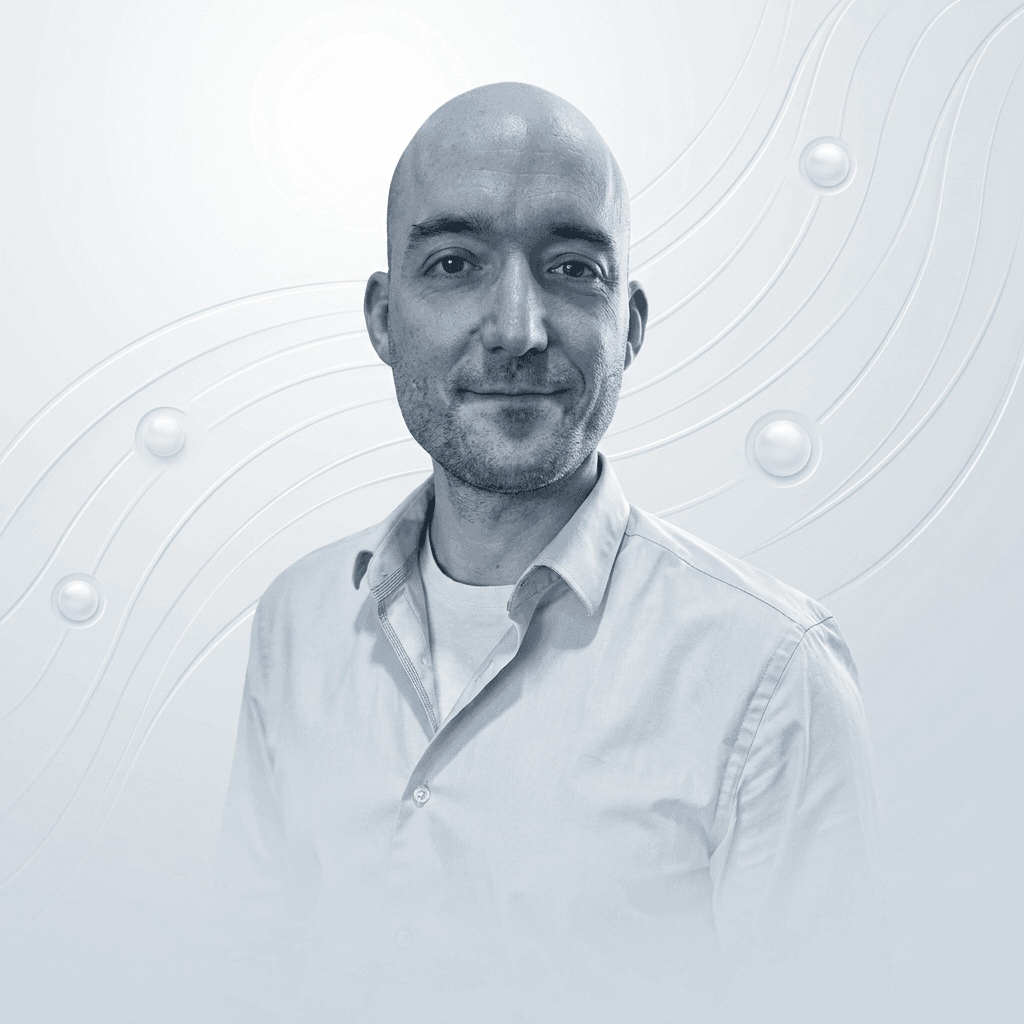
Alard Roebroeck on neuroimaging and fmri analysis
Episode 8 08.03.2010
-
 play_arrow
PLAY EPISODE
Description arrow_drop_down

Description
How do we move beyond “this brain region lights up” to genuinely understanding how neural circuits compute? Alard Roebroeck argues that the future lies in merging bottom-up computational models with top-down neuroimaging analysis , and that neither community can succeed alone. Subscribe for more from the Convergent Science Network podcast series. Alard Roebroeck tackles a fundamental tension in neuroimaging: the field generates gigabytes of whole-brain data per minute, yet most analyses reduce this richness to statements about which regions activate during which tasks. He distinguishes two modeling traditions that have developed largely in isolation. Bottom-up modelers build biophysically inspired simulations of neural circuits, from spiking networks to hemodynamic coupling, but face a crippling indeterminacy problem: infinitely many models can reproduce the same behavioral data. Top-down modelers invert observation models to go from fMRI or EEG signals back to inferred neural activity, but typically work with only a handful of pre-selected brain regions and stop at causal connectivity without asking what computations those regions perform. Roebroeck’s vision is to unite these approaches. He advocates for models that simultaneously perform the task (as bottom-up models do), are biophysically grounded, and are accountable to whole-brain neuroimaging data (as top-down models aspire to be). This triple requirement has not yet been achieved, but he argues it is the only path toward models that are both computationally meaningful and empirically constrained. The whole-brain coverage of fMRI provides a unique advantage over electrophysiology , not in spatial or temporal resolution, but in the ability to observe the entire system at once without invasive intervention. The interview engages seriously with criticisms of this program. Can correlation-based neuroimaging data really constrain causal models? Roebroeck acknowledges that causality requires assumptions beyond correlation, but argues that computational models themselves provide exactly those assumptions , transforming observed dependencies into mechanistic explanations. He also confronts the common practice of restricting analyses to regions of interest, which discards the very whole-brain information that makes neuroimaging valuable, and calls for models that encompass at least all cortical regions plausibly involved in a given task.
Tagged as:
Computational Models fmri analysis Neural Circuits neuroimaging Regions Whole-brain
About the author call_made
CSN Podcasts
Both the triumphs of humanity and its most evil deeds have resulted from collaboration. In a time where humanity is required to aspire to the former and minimize the latter, the question arises of how collaboration arises and why it fails. Surprisingly, this phenomenon, so central to who we are, is not well understood. Hence, a collaborative effort is required to understand collaboration in its full biological, psychological, sociological, cultural, and economic complexity and to translate this understanding into operational impact. This series of podcasts is one step toward achieving these complementary goals. The Collaboration Podcast presents interviews with people who are central orchestrators of collaboration in various domains including business, government, science, art, health, sustainability, and the military. The discussions were conducted by Prof. Dr. Paul F.M.J. Verschure and members of the Program Advisory Committee of the Ernst Strungmann Forum on Collaboration (https://www.esforum.de/forums/ESF32_Collaboration.html) during 2021 and had the goal to sketch a map of opportunities, challenges, and obstacles in human collaboration. The forum took place in May 2022, and now we would like to share this series of interviews with a broader audience. The full report of the Forum will be published in 2023 by MIT Press. The podcast was produced by the Convergent Science Network (https://www.convergentsciencenetwork.org/). Context: The stability of social systems depends critically on realizing sustainable methods of “collaboration,” yet how and by which means collaboration is achieved is not clearly understood; neither are the conditions or processes that lead to its breakdown or failure. Collaboration can be understood as cooperation between agents toward mutually constructed goals. Part of the reason for our lack of understanding is that the phenomenon of collaboration is, by nature, a highly multidisciplinary problem, and effective research into its complexities has been difficult to achieve across the broad range of scientific and technical disciplines involved. The need for a fundamental understanding of collaboration, however, has become increasingly important. Not only does humankind demand answers as it attempts to address critical challenges at multiple scales (e.g., climate change, migration, enhanced automation, social and economic inequality), but ever-increasing technological and economic means of interconnecting people and societies are disrupting long-established, familiar patterns of how we interact. Radical technological changes that are ongoing have the potential to reshape collaboration in ways that are currently hard to predict or influence (e.g., by altering configurations in interaction, information creation, and modes of communication). On one hand, such changes could disrupt hitherto stable forms of collaboration by affecting critical communication channels and traditional roles, as can be observed in the rapidly changing patterns in governance, commerce, and social interaction. Conversely, technology could lead to the emergence of novel, successful forms of collaboration that deviate from traditional “hierarchical” architectures. Evidence of this can be seen in areas as diverse as highly automated manufacturing plants, the open science movement, collaborative software repositories, user-centered services, and the sharing of economy-based modes of organization. Without a fundamental understanding of the mechanisms, processes, and boundary conditions of collaboration, it is not possible to evaluate or predict which of these possible scenarios are sustainable or even plausible. The Forum “How Collaboration Arises and Why it Fails” (May 8–13, 2022, Location: Frankfurt am Main, Germany) Chairs: Andreas Roepstorff and Paul Verschure Program Advisory Committee: Jenna Bednar, Julia R. Lupp, Bhavani R. Rao , Andreas Roepstorff, Ferdinand von Siemens, and Paul Verschure
Episodes
play_arrow

play_arrow

play_arrow

play_arrow
Timestamp
- fast_forward00:00:00 - This is all for sure with Allard Roebroek, who was one of the speakers at our summer school.
- fast_forward00:00:07 - And Allard gave this summary of an incredible development,
- fast_forward00:00:13 - actually, in the deployment of new and also pretty advanced tools in understanding
- fast_forward00:00:19 - these large-scale data sets that are becoming available in particular for different forms of imaging.
- fast_forward00:00:25 - So why is this important? Why should we be doing this?
- fast_forward00:00:30 - So there's two levels to that so I think why
- fast_forward00:00:34 - should we be doing neuroimaging is what we can say first
- fast_forward00:00:37 - is that because it gives us an unprecedented view in vivo on the brain with
- fast_forward00:00:43 - whole brain coverage and high spatial resolution especially with fMRI and with
- fast_forward00:00:47 - very high temporal resolution with EEG and MEG so neuroimaging I think might
- fast_forward00:00:52 - be clear to some of the listeners to the podcast.
- fast_forward00:00:55 - But what we've also been learning with neuroimaging is that this huge amount,
- fast_forward00:01:00 - this huge bandwidth of data that comes our way out of the MRI machines,
- fast_forward00:01:04 - like gigabytes per minute, basically,
- fast_forward00:01:08 - many, many voxels, tens, hundreds of thousands of voxel time series come out of it.
- fast_forward00:01:13 - We need a good way to understand that. We need a good way to model it.
- fast_forward00:01:17 - And just doing what some people have accusingly called the new phrenology,
- fast_forward00:01:23 - just saying like, oh, neuroimaging tells us that this region lights up when
- fast_forward00:01:26 - you see faces and this region lights up when you do that isn't good enough anymore.
- fast_forward00:01:30 - We need to understand this data in terms of network models, in terms of models that tell us.
- fast_forward00:01:36 - Which region does what, but also how it sends information on to other regions.
- fast_forward00:01:40 - And so that necessitates these complex models, that necessitates that you have
- fast_forward00:01:46 - a network model of what a task might do, how it's coupled to the neuroimaging
- fast_forward00:01:49 - data, because there is your neural network model at one level that might have
- fast_forward00:01:53 - an explanation of how the task works.
- fast_forward00:01:55 - You need to couple that to your data, which is not mere normal neural network activity.
- fast_forward00:02:01 - It's usually some kind of form of
- fast_forward00:02:03 - metabolics and fMRI and some form of synchronized activity in EEG and MEG.
- fast_forward00:02:09 - So you need to model all of that and then try to go in the reverse direction
- fast_forward00:02:12 - from the data to the neural activity to do useful things, even more useful things
- fast_forward00:02:18 - with neuroimaging data than we have been doing. Right.
- fast_forward00:02:21 - Now, in this, what you call modeling, you distinguish two approaches, right?
- fast_forward00:02:26 - So on the one, you have forward models or you have bottom-up models and you
- fast_forward00:02:30 - have these top-down models. So what's exactly the distinction there?
- fast_forward00:02:33 - Right. So it's important to say that this terminology is used and not used in many fields.
- fast_forward00:02:38 - So what I tried to do in the talk is to make clear that my definition is as follows.
- fast_forward00:02:42 - And it's used a bit wider in cognitive neuroscience and computational neuroscience.
- fast_forward00:02:47 - So bottom-up models are first principle models, often biophysically inspired,
- fast_forward00:02:53 - of how a task is performed,
- fast_forward00:02:55 - how neurons fire, for instance, or how whole groups of neurons summarized in
- fast_forward00:03:01 - neuronal mass models generate their activity and pass activity on to other neural masses.
- fast_forward00:03:07 - And then, for instance, how cerebral blood flow, cerebral blood volume,
- fast_forward00:03:13 - deoxygenation levels, hemoglobin levels change because of that.
- fast_forward00:03:18 - All of that you can simulate in the normal causal direction.
- fast_forward00:03:20 - So from neural activity to the
- fast_forward00:03:23 - changes in blood flow, blood volume and oxygenation to the fMRI signal.
- fast_forward00:03:27 - That would be bottom-up modeling or forward modeling. And that would be what
- fast_forward00:03:31 - normal computational neuroscience does a lot, except maybe for also simulating
- fast_forward00:03:35 - the fMRI model, the fMRI data, initially at least, but also lately,
- fast_forward00:03:40 - people got very interested in that.
- fast_forward00:03:41 - So the other type of modeling, top-down modeling, is inverse modeling,
- fast_forward00:03:46 - in the normal sense of the word, is that because we go anti-causal,
- fast_forward00:03:50 - we go in the reverse direction,
- fast_forward00:03:51 - we go from the data that we have to what we're actually interested in,
- fast_forward00:03:55 - which is the neural activity in the brain.
- fast_forward00:03:57 - And of course, for that, we need to go in the inverse direction,
- fast_forward00:04:00 - in the anti-causal direction, which means we have to invert all of those forward
- fast_forward00:04:04 - models that we have built up from how our signal is generated.
- fast_forward00:04:08 - So that's the two types of modeling that I distinguished in that way.
- fast_forward00:04:12 - And I do realize that top-down and bottom-up is used differently in different fields.
- fast_forward00:04:17 - Sure. But now, would you recommend either of these two methods?
- fast_forward00:04:21 - Would you say, look, top-down is more effective than bottom-up? No, no.
- fast_forward00:04:27 - What I would advocate in saying is that, whereas nowadays still,
- fast_forward00:04:32 - these are two largely disjoint fields.
- fast_forward00:04:35 - The computational neuroscientists do their bottom-up modeling,
- fast_forward00:04:39 - and the cognitive neuroscientists and the neuroimagers are doing their top-down modeling.
- fast_forward00:04:43 - Modeling, roughly independently, what we need to do is to join these fields,
- fast_forward00:04:48 - to break the barrier between them, and basically to work with models.
- fast_forward00:04:54 - To work with bottom-up models, which we can also invert. So the big challenge
- fast_forward00:04:58 - that we have ahead of us is to have basically models which can do a few things.
- fast_forward00:05:07 - One is that they're biophysically inspired, so that's number one.
- fast_forward00:05:10 - That was always true for bottom-up models.
- fast_forward00:05:13 - The second one is that they can actually perform the task in the sense that
- fast_forward00:05:18 - they have a real computational implementation, a real computational hypothesis
- fast_forward00:05:22 - about how a human or an animal performs a task.
- fast_forward00:05:26 - This was, both was often true for bottom-up models.
- fast_forward00:05:29 - On the other hand, you had the top-down models, which were largely able to invert
- fast_forward00:05:35 - observation models, like I've just explained, but they largely were aimed at
- fast_forward00:05:39 - explaining neuroimaging data.
- fast_forward00:05:40 - So for instance, when you do this top-down modeling, when you go from your fMRI
- fast_forward00:05:45 - data down to the hypothesized neuronal activity that you can see to decide which
- fast_forward00:05:52 - of several competing hypotheses,
- fast_forward00:05:54 - which of several competing models was the best.
- fast_forward00:05:56 - The ultimate measure for top-down modelers is often how well does it fit my data?
- fast_forward00:06:00 - And of course, fit is not everything. I mean, fit with a lot more parameters is not good.
- fast_forward00:06:06 - So often you would also add a complexity penalty there and look at something like model evidence.
- fast_forward00:06:09 - But still, in the end, what you're looking at is the fit to the neuroimaging data.
- fast_forward00:06:12 - So what I would like to see us do, and I think many people with me,
- fast_forward00:06:17 - is to join this and to work with models.
- fast_forward00:06:20 - Not only fit the data as top-down modelers do, but also perform the task as bottom-up modelers do.
- fast_forward00:06:27 - So I would like to work with bottom-up computational models of tasks,
- fast_forward00:06:30 - which we can also invert and therefore make accountable to neuroimaging data.
- fast_forward00:06:35 - And that's an ultimate combination of three things, which has not been achieved
- fast_forward00:06:39 - yet. That's a big challenge.
- fast_forward00:06:41 - But the way you describe this, doesn't this sound a bit like that you say,
- fast_forward00:06:45 - look, we have all these tools, and now we have these amazing methods to try
- fast_forward00:06:50 - to interpret the data in new ways.
- fast_forward00:06:53 - But now we need to find an interpretation. So now I have to find the bottom-up
- fast_forward00:06:58 - modelers who look more to biophysics, anatomy, and so on, to help me interpret
- fast_forward00:07:03 - this abstract description that I'm trying to disentangle.
- fast_forward00:07:06 - So it's clear. It will be clear what your motivation is to find that link because
- fast_forward00:07:10 - you need that translation step to work your way towards the neural substrate.
- fast_forward00:07:13 - But the modeler themselves might say, well, what's the leverage I get?
- fast_forward00:07:19 - Adding this layer of complexity, inventing some sort of approximation of an
- fast_forward00:07:25 - fMRI signal, so I have to model some hemodynamical system that is,
- fast_forward00:07:29 - again, linked to my neural simulation just to make Allard happy.
- fast_forward00:07:33 - So why would I do that? He's not doing it to make me happy.
- fast_forward00:07:38 - He's doing it to make himself happy because the basic problem that any bottom-up
- fast_forward00:07:42 - modeler has is that his approach is completely undetermined.
- fast_forward00:07:46 - So it's a well-known fact that given some type of high-level behavioral data,
- fast_forward00:07:53 - let's say change blindness, or even some high level of behavior,
- fast_forward00:07:58 - let's say exploration behavior, you can find an infinite set of models which
- fast_forward00:08:04 - could all generate that behavior.
- fast_forward00:08:05 - Behavior, how to then decide which of those infinite sets of models is the true model.
- fast_forward00:08:10 - And supposedly that would be our motivation here, to find how a human or how
- fast_forward00:08:13 - a rat or how a monkey performs a certain task and to understand therefore how
- fast_forward00:08:18 - the brain of the human or the animal works.
- fast_forward00:08:21 - So in other words, if the bottom-up modeler works with very high-level behavioral
- fast_forward00:08:26 - data, he will always be under constraint.
- fast_forward00:08:28 - He can come up with any type of model. I can always say, see, my model fits behavior.
- fast_forward00:08:32 - Yeah, sure, there's an infinite amount of other models that would also fit behavior,
- fast_forward00:08:34 - but mine happens to fit behavior. What else do you want from me?
- fast_forward00:08:37 - Well, that's not good enough, obviously. We need more data to constrain these
- fast_forward00:08:42 - models in order to decide not only does it fit the behavioral data or the task itself,
- fast_forward00:08:47 - can it perform the task, but also does it perform it in the way that the human
- fast_forward00:08:52 - brain or the mammal brain performs it.
- fast_forward00:08:54 - And there you need the extra data at the level of the actual neuronal activity.
- fast_forward00:08:57 - And that's the data that neuroimaging can provide us with.
- fast_forward00:09:01 - That's what the bottom-up modeler gets from it. Well, the promise is great.
- fast_forward00:09:05 - So I agree with that. And indeed, this problem of determinancy or the indeterminacy
- fast_forward00:09:10 - of many models is very fundamental.
- fast_forward00:09:11 - And indeed, we have to find ways to add constraints to models to make them meaningful.
- fast_forward00:09:15 - And the neuroimaging data is that constraint, the extra constraint.
- fast_forward00:09:18 - Well, this is the issue we should inspect, right? Because you are then,
- fast_forward00:09:21 - in some sense, promising that the neuroimaging data is of some special quality
- fast_forward00:09:26 - because it's not just yet another data source. It seems the way you describe
- fast_forward00:09:30 - it that you say it's a decisive data source.
- fast_forward00:09:32 - It's a data source of a very special quality. So what's that special quality?
- fast_forward00:09:36 - Why is it not yet another source of information like possibly gene expression
- fast_forward00:09:41 - or some second messenger system or behavior or what have you?
- fast_forward00:09:46 - What makes it special? Good question. It's more gradual.
- fast_forward00:09:49 - I understand your question, but it's more gradual. I am not promising that it's the decisive data set.
- fast_forward00:09:54 - What I am convinced of and I would like to convince the listeners of or my fellow
- fast_forward00:09:59 - modelers of is that it's a set of data which contains a lot of very important
- fast_forward00:10:05 - information that can constrain our model better.
- fast_forward00:10:08 - For the mere fact that what neuroimaging does, and that has always been its
- fast_forward00:10:12 - promise and that is actually true, it does allow us to look inside the brain,
- fast_forward00:10:16 - which we weren't previously able to do with in vivo functioning humans without
- fast_forward00:10:20 - actually intervening into the system.
- fast_forward00:10:22 - That has been the promise of neuroimaging and
- fast_forward00:10:25 - fMRI in particular for 15 years now and that is really
- fast_forward00:10:27 - true yes we can look into the brain at some level
- fast_forward00:10:30 - of this section of course it's it's hemodynamics it's metabolics but
- fast_forward00:10:34 - still it's the metabolics which is much closer to the brain activity than the
- fast_forward00:10:38 - eye movements or the behavior which we would otherwise be observing and we're
- fast_forward00:10:41 - still also observing that so it gives us a very important extra constraint which
- fast_forward00:10:45 - is much closer to the brain to the actual neural activity than what we had before
- fast_forward00:10:49 - and that's the privileged status of that data.
- fast_forward00:10:52 - It's not perfect, but it's a lot better than what we had.
- fast_forward00:10:55 - That isn't true under certain circumstances. No, if I, for instance,
- fast_forward00:11:00 - if you would restrict your argument to, let's say, the human brain,
- fast_forward00:11:04 - it's fairly clear. No, because we don't have many alternative methods.
- fast_forward00:11:07 - But however, if we go to macaque or rodent or cat and so on,
- fast_forward00:11:11 - I could argue, look, but then I have alternative physiological methods I can deploy. Such as?
- fast_forward00:11:16 - Let's name them. I can do my electrophysiology. Exactly. I can do much more
- fast_forward00:11:20 - detailed anatomical studies.
- fast_forward00:11:22 - I can do much more controlled behavioral studies. However, the paradigms I can
- fast_forward00:11:26 - deploy will, of course, be more restricted.
- fast_forward00:11:29 - There's another very important restriction there, Paul, and that is that none
- fast_forward00:11:32 - of those methods that you mentioned now have whole brain coverage in an in vivo
- fast_forward00:11:38 - animal without doing any damage and therefore have repeatability.
- fast_forward00:11:41 - Electrophysiology is brilliant. I'm not against it. But even having a very dense
- fast_forward00:11:46 - multi-electrode array, which you can do nowadays, you only have a very sparse
- fast_forward00:11:51 - sampling of a couple of populations of neurons.
- fast_forward00:11:55 - And those neurons you can observe very well with nice spike sorting algorithms.
- fast_forward00:11:58 - You can get at every electrode a couple of tens or maybe even hundreds of neurons,
- fast_forward00:12:02 - but only tens of hundreds of neurons.
- fast_forward00:12:05 - And then you have maybe 100 or 200 of those spots. But is that enough?
- fast_forward00:12:09 - I mean, we have millions, billions of neurons in the brain.
- fast_forward00:12:12 - So what electrophysiology is, what it's great at, is that it's one or even ten
- fast_forward00:12:18 - or a hundred huge magnifying glasses onto the activity of a few neurons that
- fast_forward00:12:23 - you can observe and you're ignorant about what happens in the rest of the brain.
- fast_forward00:12:27 - And the beautiful complementary aspect of something like fMRI,
- fast_forward00:12:30 - which I would also perform on a monkey, is that it's the whole brain and all of the brain.
- fast_forward00:12:34 - And of course then what we have is the whole brain and all of the brain at a
- fast_forward00:12:39 - certain spatial resolution, which is much coarser than electrophysiology Although
- fast_forward00:12:43 - with increasing field size and increasing MR technology, it's getting better and better and better.
- fast_forward00:12:47 - We're going towards the 100 micron level now for fMRI, but it's the whole brain.
- fast_forward00:12:52 - And that is something unique that we didn't have before in any of the methods
- fast_forward00:12:55 - that you just mentioned.
- fast_forward00:12:56 - Granted, this is all very acceptable. However, the weakness of one method is
- fast_forward00:13:02 - not the strength of another method.
- fast_forward00:13:03 - So, for instance, in your case, you can say, well, I have a whole brain.
- fast_forward00:13:08 - And granted, in principle, you extract data from the whole brain.
- fast_forward00:13:11 - But very often in the analysis, you see people suddenly starting to jump into
- fast_forward00:13:15 - what they call regions of interest because they will otherwise I cannot extract
- fast_forward00:13:18 - any meaningful correlations from my data. So then, to what extent do I actually
- fast_forward00:13:22 - really exploit still being this bottom-up modeler looking for constraints?
- fast_forward00:13:26 - To what extent am I then actually really exploiting this advantage?
- fast_forward00:13:29 - Because here I go, I have neat whole-brain data at a fairly coarse spatial temporal resolution.
- fast_forward00:13:34 - But now, in order to make sense of this very noisy signal, I start to impose
- fast_forward00:13:38 - more restrictive analysis windows, so I throw away the whole-brain information.
- fast_forward00:13:42 - So, what am I left with? What's my advantage? Very good question, Paul.
- fast_forward00:13:45 - I actually recognized some of my slides in my talk this morning where I actually
- fast_forward00:13:48 - implicitly complained about this approach where, although we have whole brain data,
- fast_forward00:13:53 - what top-down modelers tend to do with their neuroimaging data nowadays is to
- fast_forward00:13:58 - select a few selected regions within it and only model the interactions between those regions.
- fast_forward00:14:04 - I am strongly advocating that, yes, we should use the whole brain data.
- fast_forward00:14:08 - Not only should our models contain a computational model of the task,
- fast_forward00:14:12 - but also they should be accountable to the entire data set.
- fast_forward00:14:16 - They should preferably be models of the entire brain.
- fast_forward00:14:19 - So, yes, I fully agree there that sub-selecting data from this very rich whole
- fast_forward00:14:25 - brain data set that we have is not the right approach because it's actually
- fast_forward00:14:27 - not using the strength of the method. it.
- fast_forward00:14:30 - So top-down models of neuroimaging data,
- fast_forward00:14:34 - and this is something I've been advocating in the last couple of years and I'm
- fast_forward00:14:37 - currently working on, should be models of the whole brain, at least of the whole
- fast_forward00:14:40 - cortex, preferably of the whole brain, and take into account at,
- fast_forward00:14:44 - of course, the level where we are with.
- fast_forward00:14:47 - Particular modality, it should take into account all of the neuronal activity that it's sampling.
- fast_forward00:14:53 - Okay, but then if I would follow your advice, then I would impose this Allard-Rabruck
- fast_forward00:14:59 - filter of the literature.
- fast_forward00:15:00 - There are not very many papers I'm left with to constrain my model. Is that correct?
- fast_forward00:15:04 - No, but I'm giving you a vision onto a future.
- fast_forward00:15:08 - I'm giving you what I feel that we should be working on.
- fast_forward00:15:11 - And I think quite a few people agree with me that we are working on this and
- fast_forward00:15:15 - trying to get there. Okay, so that means that we actually agree that today,
- fast_forward00:15:19 - as the bottom-up modeler, I'm sort of a bit left alone.
- fast_forward00:15:22 - I will not be able to find these constraints that I actually would need.
- fast_forward00:15:27 - No, they are there, and I would invite any bottom-up modeler to join this research
- fast_forward00:15:32 - program and help us in achieving this and finding ways in which your bottom-up
- fast_forward00:15:36 - models can be made accountable to neuroimaging data.
- fast_forward00:15:40 - Yeah, but that would help you. It would still not necessarily help the bottom-up
- fast_forward00:15:43 - model, right? Yes, it would help you because of the reason I said earlier.
- fast_forward00:15:45 - Because without it, you would have less constraint on your bottom-up model.
- fast_forward00:15:48 - Sure. I got that. Yeah. I got that point, but I was making a different point.
- fast_forward00:15:52 - Because your whole brain requirement is excluding, as far as I understand this
- fast_forward00:15:58 - literature, a large chunk of literature.
- fast_forward00:16:00 - So now as bottom-up modeler of phenomenon X and structure Y,
- fast_forward00:16:04 - there are not that many studies I could look at today to help me constrain my model.
- fast_forward00:16:09 - Because it's not a model of the whole brain. Exactly, yeah. Right,
- fast_forward00:16:12 - yeah. You would agree with that contention?
- fast_forward00:16:15 - I would agree. I mean, yes, where, of course, the issue gets more subtle,
- fast_forward00:16:19 - and this is an issue you always have in modeling, and that will remain there
- fast_forward00:16:23 - also in this new program of doing things, of combining things,
- fast_forward00:16:28 - is that a model always needs to be a model at a certain level of abstraction.
- fast_forward00:16:32 - Often they say all models are wrong, but some are useful. It's a famous, famous thing to say.
- fast_forward00:16:37 - And some of the ones that are useful are the ones that take a suitable abstraction
- fast_forward00:16:41 - level and a suitable set of the data to model and to try and understand that
- fast_forward00:16:47 - part. And that will always remain true.
- fast_forward00:16:48 - A useful model is one that includes all the relevant areas for your task and
- fast_forward00:16:53 - has a nice computational model for those areas.
- fast_forward00:16:56 - And of course, although I would advocate that you would not forget Forget any
- fast_forward00:17:00 - of the important areas for your task that you would not constrain your model a priori to be,
- fast_forward00:17:05 - to contain two or three regions in the brain where you know or expect or are
- fast_forward00:17:10 - afraid that there might be two or three or four or five other regions in the
- fast_forward00:17:13 - brain that it contains only those two or three that you a priori started with.
- fast_forward00:17:18 - Once you do have all the regions which you reasonably believe to be involved
- fast_forward00:17:22 - in the task, the six or seven, let's say, then of course, sure,
- fast_forward00:17:26 - focus on the six or seven that are relevant.
- fast_forward00:17:27 - If the rest of the brain really isn't relevant, I won't force you to model it
- fast_forward00:17:30 - because that's not a useful abstraction. That's not a useful model then. Right.
- fast_forward00:17:35 - Okay, so here we go. So we're looking to this future where we have this whole
- fast_forward00:17:39 - brain fMRI data interpreted in some, let's say, connectivity scheme, I guess.
- fast_forward00:17:48 - But now from the modeling perspective, what I'm actually trying to replicate
- fast_forward00:17:53 - is the causal structure of the phenomenon. I really try to think about how neurons
- fast_forward00:17:58 - interact with each other and A causing B and so on, leading to some macroscopic
- fast_forward00:18:02 - phenomenon I could call behavior.
- fast_forward00:18:04 - But in some sense, if I look at the methods you're developing with your colleagues,
- fast_forward00:18:09 - we very quickly end up not talking about connectivity, but about a special kind
- fast_forward00:18:14 - of connectivity, which is functional connectivity,
- fast_forward00:18:16 - which in some sense is related to a correlation structure.
- fast_forward00:18:21 - And as we all know, going back to Hume and before, correlation is only a necessary
- fast_forward00:18:26 - condition of causation.
- fast_forward00:18:28 - And as a constraint, I would like to have access to causal information.
- fast_forward00:18:33 - So how are we going to solve this conundrum? So that means on the one hand,
- fast_forward00:18:36 - the whole brain data I still don't have.
- fast_forward00:18:38 - But now if we have it, imagine we have it, then I want to know I want to have causal information.
- fast_forward00:18:43 - But actually, if I understand what you were telling us, today,
- fast_forward00:18:47 - this is really difficult to get your hands on.
- fast_forward00:18:49 - So what's our problem there? But first, we're missing something.
- fast_forward00:18:53 - We don't only want causal information.
- fast_forward00:18:55 - We also want computational information. Let me explain what I mean here.
- fast_forward00:18:58 - We know that activity in V2 is caused by activity in V1. And that's an important fact to know.
- fast_forward00:19:06 - But that doesn't actually explain to us or give us any understanding about what
- fast_forward00:19:11 - V1 and V2 do exactly. Do we really know that?
- fast_forward00:19:14 - Let's assume for now that we know that. Okay.
- fast_forward00:19:17 - Right? I tried to give an example. Sure. Yes. I was not facetious. I was serious.
- fast_forward00:19:22 - Yeah. So actually, we actually believe that there might also be recurrent information. For instance.
- fast_forward00:19:27 - But that already goes towards a more computational model of what they're doing.
- fast_forward00:19:31 - So a causal model, which I agree many of the top-down models of neuroimaging
- fast_forward00:19:36 - data have focused on, are perfectly content in saying that, okay,
- fast_forward00:19:39 - if I can get with my top-down modeling, with my inversion of complex observation
- fast_forward00:19:44 - models to a model which says that
- fast_forward00:19:46 - information is going from V1 to V2, and also, by the way, from V2 back to V1,
- fast_forward00:19:52 - and then on to V3, V4, and so on,
- fast_forward00:19:55 - then they're happy to stop there and say, okay, I have just distinguished by
- fast_forward00:20:01 - fitting to my data the model where there's a recurrent information flow, V1 and V2,
- fast_forward00:20:07 - and just a feed-forward V1 to V2, but nothing else.
- fast_forward00:20:11 - That would be a causal inference that you just spoke about. On top of that,
- fast_forward00:20:14 - we also need a computational inference.
- fast_forward00:20:16 - We actually want to know what is it that V1 does with its input.
- fast_forward00:20:19 - What is it computing, right?
- fast_forward00:20:21 - And then what is it computing that it sends on to V2, and what would V2 supposedly
- fast_forward00:20:27 - be computing, which it either exclusively sent on to V3, V4,
- fast_forward00:20:32 - or which it would actually recurrently feed back to V1.
- fast_forward00:20:35 - So that's on top of the causal inference of saying that some type of information
- fast_forward00:20:40 - and we don't know what moves from V1 to V2 is actually having a computational
- fast_forward00:20:44 - model of direction-specific cells, of, you know, columns, orientation columns,
- fast_forward00:20:50 - color blobs, things like that, gives us a much finer understanding.
- fast_forward00:20:54 - So that's what I mean when I say that computational bottom-up models have to
- fast_forward00:20:57 - be integrated and made accountable to neuroimaging data.
- fast_forward00:21:02 - But now I'm confused in some sense because I feel that – So I think we had a
- fast_forward00:21:07 - good agreement on imposing constraints on these models.
- fast_forward00:21:09 - And that whatever set of constraints we can find, we should use them.
- fast_forward00:21:15 - In that sense, in the imaging data. So you now agree that you'll use newer imaging
- fast_forward00:21:19 - data not for Allard but actually for yourself?
- fast_forward00:21:20 - No, I don't agree to the imaging data yet. All right. I agree to the general
- fast_forward00:21:24 - principle. All right. Which we already adhere to for many years.
- fast_forward00:21:28 - All right. But, and then we, then your argument was to say, and fMRI data is
- fast_forward00:21:34 - one of the sources of information constraints that you can impose in your model.
- fast_forward00:21:39 - And then I made this argument about actually modeling causal structures, right?
- fast_forward00:21:42 - And I said, but the way you guys analyze this imaging data doesn't give me access to causal structure.
- fast_forward00:21:48 - So how then can it be a constraint that is in any way decisive for me?
- fast_forward00:21:53 - Because what I want to understand is the causal, the causal links in this network.
- fast_forward00:21:59 - But then in answering – so I had expected it would say something like,
- fast_forward00:22:03 - oh, but actually we do have access to causality.
- fast_forward00:22:05 - We have methods to try to infer causal structure so we can strengthen it.
- fast_forward00:22:10 - But then actually you made a jump and you went to something that's called computation,
- fast_forward00:22:13 - which is not necessarily well-defined. True.
- fast_forward00:22:18 - And then suddenly that was as if the imaging data would give me a sense of some
- fast_forward00:22:24 - functional property that I could then use as my constraint. So you seem to sidestep
- fast_forward00:22:28 - that issue of causality.
- fast_forward00:22:30 - All right. And now you seem to tell me that actually it's not about causality,
- fast_forward00:22:33 - but I can tell you something about the functional operations that happen in that structure.
- fast_forward00:22:37 - So now I'm confused because what are you offering to me, really?
- fast_forward00:22:41 - All right, right. So let's take it in a few steps. And it is about causality. It is about causality.
- fast_forward00:22:46 - And maybe I jumped over that too fast because I'm eager to move on,
- fast_forward00:22:49 - but causality is important. So it is important to know before we know anything
- fast_forward00:22:54 - that there might be causality, which is, by the way, also notoriously ill-defined
- fast_forward00:22:58 - just like computation is.
- fast_forward00:22:59 - But let's suppose we have some relevant intuitive understanding of what it means.
- fast_forward00:23:03 - It is relevant to know that there is causality from V1 to V2.
- fast_forward00:23:08 - Supposedly, we didn't know anything about the brain. Knowing that teaches us
- fast_forward00:23:11 - something, and it teaches us something useful.
- fast_forward00:23:13 - I then quickly moved on to say, but we want to know more. But let's actually,
- fast_forward00:23:17 - right, and that was my argument just now, but I understand your question like,
- fast_forward00:23:20 - oh, you're moving too fast. Let's look at causality first.
- fast_forward00:23:22 - So, yes, okay, since Hume and since, you know, what many first-year psychology
- fast_forward00:23:28 - students know is that from correlations alone, which is in principle what we
- fast_forward00:23:33 - have and what we can observe and compute from our neuroimaging data,
- fast_forward00:23:36 - we don't have causality.
- fast_forward00:23:37 - Causality is basically correlations plus additional assumptions.
- fast_forward00:23:42 - And the question is, of course, what are those assumptions? And if those assumptions
- fast_forward00:23:45 - are good assumptions, we might actually get to causality, to some form of causality.
- fast_forward00:23:51 - Causality derived from correlations to some observational causality rather than
- fast_forward00:23:56 - a perturbational causality which would be actually intervening to the system.
- fast_forward00:23:59 - I'm just leaving that aside for now but a useful form of causality but those
- fast_forward00:24:03 - assumptions are really important.
- fast_forward00:24:04 - Which assumptions do we put into our models which allow us to go from correlations
- fast_forward00:24:09 - and also higher forms of dependence to causality?
- fast_forward00:24:14 - Well that's where we actually also get back to computation in the end because
- fast_forward00:24:18 - computational models would be one of the forms of very fine,
- fast_forward00:24:21 - very detailed assumptions that would have us go from correlations to causations.
- fast_forward00:24:28 - But already before that, once again, that's the next step.
- fast_forward00:24:31 - I don't want to overstep the point of causality that you were making.
- fast_forward00:24:34 - Yes, already when we're doing pure top-down modeling as it's applied today,
- fast_forward00:24:39 - going from our neuroimaging data to causality, to influence at the neuronal
- fast_forward00:24:43 - level, it's all the assumptions which are in the model the assumptions which
- fast_forward00:24:47 - are in what we call the neurodynamic model.
- fast_forward00:24:49 - How do we actually model interacting neuronal populations? What does that look like?
- fast_forward00:24:54 - And in the observation model that takes our neuronal population activity to
- fast_forward00:24:58 - our observations which would be a model of hemodynamics for fMRI and the models
- fast_forward00:25:02 - of leak fields and gain matrices in EEG or MEG that contains all of those assumptions
- fast_forward00:25:07 - which combined with our data can tell us something about gazellon.
- fast_forward00:25:11 - Yes, so one reason why I like to stick a little bit to this causality issue
- fast_forward00:25:15 - is also if you jump to what we could call computation, it's also an excuse in
- fast_forward00:25:20 - some sense to start to discard constraints.
- fast_forward00:25:23 - Because if you say, oh, let's just worry about the computation,
- fast_forward00:25:26 - in some sense anything that happens in space and time you're going to discard.
- fast_forward00:25:29 - Because you say, no, now I move from a physical space to a functional space.
- fast_forward00:25:34 - And before we make that jump, I think it would be useful to understand And what
- fast_forward00:25:38 - possibilities do you have right now in your toolbox to make statements about
- fast_forward00:25:43 - causal interactions in this kind of imaging data that you have access to? How is this really done?
- fast_forward00:25:49 - All right. Okay.
- fast_forward00:25:52 - So, there's a couple of ways in which you can operationally define causality.
- fast_forward00:25:57 - And that's actually where we now have to press for a definition of causality,
- fast_forward00:25:59 - which, as I said, is notoriously ill-defined.
- fast_forward00:26:02 - So, there's a couple of possible definitions. I just mentioned the perturbational approach.
- fast_forward00:26:06 - Some philosophers would insist, actually, that the only way to get to causality
- fast_forward00:26:11 - is to perform experiments where you actively disturb the system and see what
- fast_forward00:26:15 - the consequences are. I can agree with that.
- fast_forward00:26:17 - It's the foundation of empirical science. Exactly, yes. Yes,
- fast_forward00:26:20 - but also immediately with an interactive functioning system and a complex system
- fast_forward00:26:26 - like the brain, it also presents you with problems,
- fast_forward00:26:28 - which you could actually, at a quite abstract, vague level, compare to the uncertainty principle.
- fast_forward00:26:35 - By observing the system and by perturbing the system, you are disturbing the
- fast_forward00:26:39 - system. So by perturbing the system, you're actually looking at an unnaturally functioning system.
- fast_forward00:26:44 - By using, for instance, something like transcranial magnetic stimulation,
- fast_forward00:26:47 - where you give quite a blast of magnetic pulse into the brain,
- fast_forward00:26:52 - which then induces electric currents in the brain tissue,
- fast_forward00:26:56 - you're doing something completely unnatural to the brain because that are not
- fast_forward00:26:59 - the usual microvolt currents, which are functionally normal to run in the brain.
- fast_forward00:27:05 - Basically, what you're doing is, a nice analogy is, if an alien would come from
- fast_forward00:27:09 - outer space and we're trying to understand what our cars are like,
- fast_forward00:27:13 - supposedly, if they came from outer space, they have much more advanced technology than that.
- fast_forward00:27:16 - But still, let's suppose that they see one of our cars and want to make sense of it.
- fast_forward00:27:20 - The correlational approach that I was advocating before would be to have the
- fast_forward00:27:24 - engine run and measure temperatures here and there and actually seeing that
- fast_forward00:27:27 - when the temperature goes up in one place, it also tends to go up in the other place.
- fast_forward00:27:30 - So actually, these things might have something to do with each other. but we
- fast_forward00:27:33 - need more assumptions to understand what it is that they do to each other which
- fast_forward00:27:36 - is what we were discussing before the perturbational approach here would be
- fast_forward00:27:41 - and to drive my point home taking a big sledgehammer giving a big knock onto
- fast_forward00:27:45 - one part of the engine seeing what shakes basically and deciding that what shakes
- fast_forward00:27:50 - must be functionally connected to where i knocked the engine.
- fast_forward00:27:54 - Now this point drives the point home that this might not actually be how an
- fast_forward00:27:57 - engine works and that if I knock an engine, I perturb the engine in such a way
- fast_forward00:28:05 - that the shaking that goes on then,
- fast_forward00:28:07 - the perturbations, the consequences of it, yes,
- fast_forward00:28:10 - they are most definitely and utterly causal.
- fast_forward00:28:13 - But are they actually the important causal things that make the engine work? I don't think so.
- fast_forward00:28:20 - I understand the distinction. I could argue, though, that in some ways you're
- fast_forward00:28:24 - setting up a straw man, no?
- fast_forward00:28:26 - Because I could argue, well, to understand how this engine works,
- fast_forward00:28:28 - I could do a more subtle perturbation. I could just, let's say,
- fast_forward00:28:31 - take out one of the spark plugs and see what happens to the power output.
- fast_forward00:28:34 - And once again, it wouldn't be the normal function of the engine to start with,
- fast_forward00:28:37 - in a subtle way, but it's still the same argument.
- fast_forward00:28:41 - But I could have more subtle perturbations on the system. Even more subtle.
- fast_forward00:28:45 - And then how subtle would they have to be? I change the air mixture and the
- fast_forward00:28:48 - carburent I'm injecting and so on.
- fast_forward00:28:52 - But I'm not sure if this is completely fair because effectively on your human
- fast_forward00:28:59 - subject that you try to decompose functionally, you also perform small perturbations.
- fast_forward00:29:03 - That's your experimental protocol.
- fast_forward00:29:05 - Exactly. Right? And importantly, these are natural perturbations.
- fast_forward00:29:08 - These are the perturbations that I would advocate using are to provide you as
- fast_forward00:29:13 - a subject with a perturbation into your visual field,
- fast_forward00:29:15 - for instance, flashing a face picture at you, which you would then have to perceive
- fast_forward00:29:19 - as being a face and to decide whether this is the face of your neighbor or not.
- fast_forward00:29:23 - Of course, that then causes things to happen in your brain, but natural things
- fast_forward00:29:26 - as you would naturally function. And that's the important distinction.
- fast_forward00:29:30 - Indeed. But as you know, also the first year psychology student will be told
- fast_forward00:29:34 - about the problem of ecological validity.
- fast_forward00:29:36 - And your subject in the scanner looking at all sorts of pictures is also not
- fast_forward00:29:41 - necessarily exposed to a natural situation. So it seems that you're saying,
- fast_forward00:29:44 - well, some perturbations are more natural than others.
- fast_forward00:29:49 - And that's what I'm saying. I'm saying it's a continuity. It's a continuity.
- fast_forward00:29:52 - So I would say that an active perturbation in the form of TMS is highly non-natural.
- fast_forward00:30:00 - I would also say that flashing a face picture for 100 milliseconds to one of
- fast_forward00:30:04 - my subjects is more natural because it's the natural channel of input into my
- fast_forward00:30:09 - brain. That's at least better than what I did with TMS.
- fast_forward00:30:11 - By the way, I'm sounding negative about TMS. I think TMS is a great method.
- fast_forward00:30:15 - I think the podcast listeners should know that.
- fast_forward00:30:18 - I'm just trying to contrast two concepts here, and that's why I'm beating at TMS here.
- fast_forward00:30:23 - No, I don't understand. So at least the perturbation is coming in through the
- fast_forward00:30:27 - natural channels that my brain is used to receive information through.
- fast_forward00:30:31 - But of course, in the natural world, I'm not having faces flash to me.
- fast_forward00:30:36 - Rather, I have a dynamic stimulus array that is continually changing.
- fast_forward00:30:40 - So an already more natural stimulus would be to look at a movie and being able to fixate around.
- fast_forward00:30:44 - And an even more natural stimulus after that might be actually to actively explore my environment.
- fast_forward00:30:49 - And there's a whole continuous array which indeed explores the trade-off between
- fast_forward00:30:54 - having ecologically valid and natural stimuli on one side and having controllability upon the other.
- fast_forward00:31:00 - We're a controllable stimulus where we keep everything constant and have no
- fast_forward00:31:04 - confounds and vary one thing so that we know what we're actually doing is often
- fast_forward00:31:08 - highly unnatural and highly non-ecological.
- fast_forward00:31:10 - But very ecological experiments showing movies active exploration are highly
- fast_forward00:31:15 - non-controlled, so there are many things changing at the same time.
- fast_forward00:31:19 - So anything we observe, what is it really due to?
- fast_forward00:31:21 - And in designing experiments on this continuum and finding places in the middle,
- fast_forward00:31:26 - useful places in the middle, is actually where we might learn a lot.
- fast_forward00:31:30 - So, if I got it right, that means that this contrast you seem to sketch between
- fast_forward00:31:35 - associative methods and perturbation-based methods is less of a contrast.
- fast_forward00:31:39 - Because in some sense, you're saying we might want to do both,
- fast_forward00:31:41 - but you just want to be careful with the perturbations we consider.
- fast_forward00:31:44 - Absolutely. So, this is the bottom line of it. It's not necessarily one or the other.
- fast_forward00:31:48 - That's a beautiful conclusion, Paul, because that shows that I'm definitely
- fast_forward00:31:51 - not against TMS. I'm just seeing that… You just didn't know it yet.
- fast_forward00:31:55 - Oh, I definitely… I'm getting a new view onto it within our discussion.
- fast_forward00:31:59 - But no, that's exactly what I would like to stress, is that these are very complementary
- fast_forward00:32:03 - methods, which are not only black and white, but they are a whole gradation
- fast_forward00:32:08 - from white to gray to black that we should explore and use in a complementary
- fast_forward00:32:12 - way, and also especially in the in-between levels. Right.
- fast_forward00:32:15 - Very good. So there's one thing that worries me a bit.
- fast_forward00:32:19 - So it's clear that you master these methods and techniques, right?
- fast_forward00:32:26 - So you know what you're doing. But in some sense, a lot of these tools are also
- fast_forward00:32:30 - used by people who have not spent all this time training on the details of them.
- fast_forward00:32:34 - And, you know, you provide it with a data set and some numbers will come out.
- fast_forward00:32:39 - How can we make sure that the tool is not overpowering the users, that we can really...
- fast_forward00:32:46 - Of course, it's important that the large community of users can make use of
- fast_forward00:32:50 - these tools, but you don't want them all to call you all the time to ask you
- fast_forward00:32:55 - for advice what they really should be doing.
- fast_forward00:32:56 - So how can we make sure that while the complexity of the tools is increasing,
- fast_forward00:33:00 - we can still, as a community, make effective use of them?
- fast_forward00:33:04 - That's a complex question because essentially, yes, so with increasing power
- fast_forward00:33:10 - of the tools, often they need to become increasingly complex and they are increasingly
- fast_forward00:33:13 - more difficult to understand.
- fast_forward00:33:15 - They become often increasingly more statistically and mathematically technical.
- fast_forward00:33:20 - And a cognitive psychologist or a cognitive neuroscientist, of course,
- fast_forward00:33:25 - has a legitimate claim to want to use these methods because they were actually designed for her.
- fast_forward00:33:29 - But then we're, of course, presented with the conundrum that you just sketched,
- fast_forward00:33:36 - that a researcher has to understand things about mathematics and things about
- fast_forward00:33:42 - statistics and things about dynamic systems and system identification that she wasn't trained to do.
- fast_forward00:33:47 - So yes, the conundrum here is that obviously the responsibility always lies with the researcher.
- fast_forward00:33:51 - You as a researcher are always responsible for the experiments that you do.
- fast_forward00:33:55 - And you as a researcher are always responsible for understanding the methods
- fast_forward00:34:00 - that you use to such a degree that you wouldn't do anything foolish.
- fast_forward00:34:04 - And to such a degree is where it gets subtle.
- fast_forward00:34:06 - It's your responsibility that if you feel kind of iffy about some part of your
- fast_forward00:34:11 - analysis where you weren't actually sure that this actually is the right thing to do.
- fast_forward00:34:16 - But it gave you beautiful data that you would actually like to
- fast_forward00:34:19 - submit to nurture neuroscience that you would call me then
- fast_forward00:34:21 - at that moment and ask me or anyone else that's that's
- fast_forward00:34:24 - much smarter still and ask them like i use your method can
- fast_forward00:34:27 - i really do this because i'm getting beautiful data but is this actually allowed
- fast_forward00:34:30 - should i do it this way that's your own responsibility that's what you should
- fast_forward00:34:33 - do um and then of course even though uh you're responsible for understanding
- fast_forward00:34:41 - the methods that you use it's also perfectly natural that you can only understand
- fast_forward00:34:44 - them to such a level With the increasing complexity,
- fast_forward00:34:47 - especially in neuroimaging, where physics is involved for the MRI machine,
- fast_forward00:34:51 - which is a highly physically theoretic machine, has to do with static fields,
- fast_forward00:34:55 - gradient fields, RF fields, where then statistics is involved,
- fast_forward00:35:00 - mathematics is involved,
- fast_forward00:35:01 - neuroanatomy is involved, psychology is involved.
- fast_forward00:35:03 - It's a very multidimensional field.
- fast_forward00:35:09 - There's many expertises involved.
- fast_forward00:35:11 - And naturally, you would only be an expert in one or two of those.
- fast_forward00:35:14 - And you would only want to know the necessary thing about the other fields.
- fast_forward00:35:18 - Yes, that's definitely true. And that's an increasing challenge,
- fast_forward00:35:20 - actually, for neuroimaging, neuroscience, and also neuromodelers to try and
- fast_forward00:35:24 - figure that out, to form consortiums, in fact, of researchers,
- fast_forward00:35:27 - which can maybe help each other doing that in the right way.
- fast_forward00:35:30 - Correct. So, but then would you claim that 100% of the users of these tools
- fast_forward00:35:34 - satisfy these constraints you just spelled out?
- fast_forward00:35:38 - I wouldn't know. I wouldn't claim to have insight into who is using these tools.
- fast_forward00:35:42 - I don't have control over that.
- fast_forward00:35:43 - But you see the papers that are being written with them, no?
- fast_forward00:35:46 - Yeah, and there are many fantastic papers, which I admire and love.
- fast_forward00:35:49 - And there are some papers that I'm highly skeptical about and that I think shouldn't
- fast_forward00:35:52 - have been performed in that way.
- fast_forward00:35:54 - So should we improve our standards, do you think?
- fast_forward00:35:57 - Or you feel that things are... Improving standards is always better.
- fast_forward00:36:00 - The question is how to do that.
- fast_forward00:36:02 - I'm completely for improving standards. So the question then would become one,
- fast_forward00:36:06 - which is highly interesting, by the way, with the exploding amounts of journals
- fast_forward00:36:12 - in fields of neuroscience,
- fast_forward00:36:14 - computational neuroscience, cognitive neuroscience, neuroimaging,
- fast_forward00:36:18 - and the exponential explosion of papers appearing in these journals every week.
- fast_forward00:36:22 - Actually, Partha Mithra was discussing this today in his talk. How daunting that is.
- fast_forward00:36:27 - How do we control that? Yeah, how do we keep up a standard like that?
- fast_forward00:36:31 - That's something that it's a nice side issue that we could discuss for three
- fast_forward00:36:35 - quarters of an hour more. Maybe we do that in another podcast.
- fast_forward00:36:38 - But yeah, that's one of the challenges of science in general.
- fast_forward00:36:42 - Certainly a field like neuroscience that has exploded in volume over the last 20 to 30 years.
- fast_forward00:36:48 - Correct. So now if you had to convince people to use your method,
- fast_forward00:36:54 - what is this convincing test case that you would put forward?
- fast_forward00:37:01 - Where you say, look, there was this problem, this question that we could not answer before.
- fast_forward00:37:05 - But now we really gained fundamental insight in how the brain operates because
- fast_forward00:37:10 - of the data that we have access to, the imaging data, and the tools that we
- fast_forward00:37:15 - have developed to analyze it.
- fast_forward00:37:16 - What would be the... This would be hypothetical or already happened?
- fast_forward00:37:19 - No, no. It should have been published now.
- fast_forward00:37:21 - It should have been published now. Yeah, it should have already been in the
- fast_forward00:37:24 - literature. What's the key thing you would point to? All right. Good question.
- fast_forward00:37:28 - There's a few very good studies. Just give me one. I'm going to try not to name
- fast_forward00:37:31 - my own. That's very self-indulgent. So let's not do that.
- fast_forward00:37:35 - Let's not do that. Okay.
- fast_forward00:37:40 - There were a couple of interesting things discussed, so let's actually take
- fast_forward00:37:43 - another talk in the symposium over here.
- fast_forward00:37:45 - Maybe you've done a podcast with Melanie Bolli, who showed very interestingly,
- fast_forward00:37:52 - using the dynamic causal modeling framework,
- fast_forward00:37:54 - how she could distinguish between
- fast_forward00:37:56 - models where certain merely feed-forward processing was taking place,
- fast_forward00:38:04 - or fully recurrent processing was taking place, which supposedly can be one
- fast_forward00:38:08 - of the substrates of consciousness in the brain,
- fast_forward00:38:10 - and therefore could test these models against each other.
- fast_forward00:38:13 - One model where there's merely feed-forward processing going on and leading
- fast_forward00:38:17 - to some fit to the MEG data, in that case, EEG data.
- fast_forward00:38:22 - And the one where there is recurrent processing taking place.
- fast_forward00:38:26 - And the models that I advocate, the top-down models alone, could already distinguish
- fast_forward00:38:30 - between these two models and tell you that one fits the data much better than the other.
- fast_forward00:38:34 - And that therefore, supposedly, we can answer questions about consciousness.
- fast_forward00:38:37 - Is one of the most, you know, the biggest challenges that we have to face.
- fast_forward00:38:41 - So that already, I think, is convincing.
- fast_forward00:38:44 - And when we can take these models even further, like we've been discussing here,
- fast_forward00:38:47 - then maybe we can do even more than that. It's going to be fantastic.
- fast_forward00:38:50 - It's going to be fantastic.
- fast_forward00:38:52 - Very good. So now to conclude.
- fast_forward00:38:56 - So you're sort of coming up in this field. You're one of the rising stars,
- fast_forward00:39:00 - clearly in charge of what you do.
- fast_forward00:39:04 - You know what you're doing. So what's the law of Allard Raubruch that we should
- fast_forward00:39:07 - follow in order to make advances in our science?
- fast_forward00:39:11 - What's the law that you want to put out there for us to adhere to? Yeah, the law of Allard.
- fast_forward00:39:16 - Allard's law. I need a law. I didn't have a law yet. What will it be?
- fast_forward00:39:19 - So I have to make up a law now? Yep. Oh, wow.
- fast_forward00:39:23 - Oh, wow. But it can be one about the brain.
- fast_forward00:39:27 - It can be one of the methods we follow, the rules of behavior we adhere to as
- fast_forward00:39:33 - scientists. You're free.
- fast_forward00:39:35 - All right. There's one law, which in my own studies, my master science studies
- fast_forward00:39:40 - and my PhD studies, I've always loved.
- fast_forward00:39:43 - And it's not a law about the brain, but let me state that law and see if we
- fast_forward00:39:46 - can make it into another. The law that I've always loved is Hofstadter's law.
- fast_forward00:39:50 - And Hofstadter's law is about how painful it can be to program something,
- fast_forward00:39:55 - how precise you have to be, how meticulous you have to be, and how you should
- fast_forward00:40:00 - not think at any point that you are actually already done. So Hofstadter's law
- fast_forward00:40:04 - is actually a recurrent law.
- fast_forward00:40:06 - You know, Douglas Hofstadter always had a fond thing for recurrence. And it goes thus.
- fast_forward00:40:13 - A program is never done.
- fast_forward00:40:19 - Even when you take into account Hofstadter's law and your expectations about
- fast_forward00:40:23 - when the program will be done.
- fast_forward00:40:24 - So that kind of tells you that, okay, so if you think you're going to be done,
- fast_forward00:40:29 - you're not going to be done yet.
- fast_forward00:40:31 - So maybe I could paraphrase that into a law about.
- fast_forward00:40:37 - Neuronal modeling and modeling of the brain, which is that even though we think
- fast_forward00:40:40 - we'd be done with our models today,
- fast_forward00:40:42 - because for instance, we had causality from top-down models,
- fast_forward00:40:45 - we're not nearly done yet because there's always a higher level and also a higher
- fast_forward00:40:51 - level of abstraction and a lower level of biophysical detail that we can put
- fast_forward00:40:54 - into our models and learn to understand more.
- fast_forward00:40:56 - So we're never done with modeling the brain, even if you take into account Hofstadter's
- fast_forward00:41:01 - law for the brain, let's call it that. I couldn't honestly take credit for that myself.
- fast_forward00:41:05 - Okay. So, so Ehlers' law would be something like the analysis of effective connectivity is never done.
- fast_forward00:41:11 - Could always be better, yes. Very good. So then, if I would go and visit you
- fast_forward00:41:17 - five years from now, and say, look, Allard, in this podcast interview,
- fast_forward00:41:22 - you gave me this prediction, and now I want to know whether you were right or wrong.
- fast_forward00:41:26 - What's this one prediction you would really want to stick your neck out today,
- fast_forward00:41:29 - so that I can check five years from now?
- fast_forward00:41:32 - Oh, that's a nice one, especially when you've got it on a record.
- fast_forward00:41:35 - Are you doing stuff like this? Are you going to make a prediction that I can
- fast_forward00:41:39 - come and validate in five years in your lab? Sure. Yeah?
- fast_forward00:41:42 - Okay, you make yours only, Mark.
- fast_forward00:41:45 - My prediction is that we would have an integrated biophysically and anatomically
- fast_forward00:41:50 - constrained model of the core structures of the brain, including cerebellum,
- fast_forward00:41:57 - amygdala, hippocampus, thalamus, cortex,
- fast_forward00:42:00 - and components of the basal ganglia. At which level of detail?
- fast_forward00:42:06 - Including biophysical detail. So, there will be multi-compartmental models,
- fast_forward00:42:11 - we will have anatomical detail, connectivity,
- fast_forward00:42:15 - and we will be able to account for all aspects of classical and operant conditioning
- fast_forward00:42:19 - with these models. All right, perfect. So, now mine.
- fast_forward00:42:23 - My prediction would be that in five years, we've been able to push fMRI,
- fast_forward00:42:28 - Functional Magnetic Resonance Imaging, especially at ultra-high fields,
- fast_forward00:42:32 - 7 Tesla and beyond, to such a degree that we can validate models such as which
- fast_forward00:42:39 - you are talking about in your prediction
- fast_forward00:42:41 - at the level of cortical columnar structures and cortical layers,
- fast_forward00:42:47 - which is something that we can only dream about today, even with modern 3D machines.
- fast_forward00:42:51 - My prediction would be in five years, we're going to be very close to that.
- fast_forward00:42:54 - And that is actually going to be the convincing reason why to to use this type
- fast_forward00:42:59 - of data as your added constraints onto those bottom-up models.
- fast_forward00:43:03 - Great. Alan Raubrook, thank you very much. Pleasure.
Tags
Brain brain evolution Cerebellar cerebellum collaboration consciousness Cortex Cortical decision making disorders of consciousness Framework grid cells Memory mirror neurons Motor motor cortex neocortex Neural Neurons place cells Populations prediction prefrontal cortex Robots scientific collaboration Spatial

Exploring the convergence of neuroscience, robotics, and AI through conversations with leading researchers since 2010.
A project of the Convergent Science Network Foundation.
Follow us on
© CSN Podcasts. Developed by IMCreative & WEBC
Be the first to leave a comment