


play_arrow
Listeners:
Top listeners:
00:00
00:00
volume_up
chevron_left
-
 play_arrow
Paul Verschure on consciousness and distributed adaptive control CSN Podcasts
-
 play_arrow
Edvard Moser on grid cells and entorhinal cortex CSN Podcasts
-
 play_arrow
Giacomo Rizzolatti on mirror neurons and action understanding CSN Podcasts
-
 play_arrow
Robert Axelrod on game theory and prisoner's dilemma CSN Podcasts
-
 play_arrow
Adrian Owen on disorders of consciousness and vegetative state CSN Podcasts
-
 play_arrow
Jonathan Whitlock on markerless motion capture and posterior parietal cortex CSN Podcasts
-
 play_arrow
Luis Puelles on neuroanatomy and prosomeric model CSN Podcasts
-
 play_arrow
Zoltan Molnar on subplate neurons and cortical development CSN Podcasts

- arrow_back Home
- keyboard_arrow_right Podcast
- keyboard_arrow_right Season 2013
Sten Grillner on lamprey and central pattern generator
Episode 1 14.03.2013
-
 play_arrow
PLAY EPISODE
Description arrow_drop_down

Description
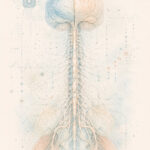
How does a 560-million-year-old fish illuminate the control architecture behind all vertebrate movement? Sten Grillner traces the neural circuits of locomotion from lamprey spinal cord to human basal ganglia.
Subscribe for more from the Convergent Science Network podcast series.
Sten Grillner presents decades of work on the lamprey, a jawless fish that emerged during the Cambrian explosion, as a model for understanding the conserved control systems underlying vertebrate motor behavior. He explains how the lamprey’s spinal cord contains approximately 100 central pattern generators (CPGs) that produce rhythmic swimming through the interplay of excitatory premotor interneurons, inhibitory coordination neurons, and critical membrane properties including NMDA receptors, voltage-dependent calcium channels, and calcium-activated potassium channels. Even without sensory feedback, the isolated spinal cord generates well-coordinated locomotor patterns, though stretch receptors provide essential compensation for environmental perturbations.
The conversation reveals how detailed computational models of the lamprey spinal cord, incorporating biological variability in cellular properties across neuron populations, demonstrated that this variability is not noise but a design feature essential for stable motor output. A striking finding from large-scale simulations with 10,000 neurons showed that modifying just 5-10 percent of the network could entirely transform the pattern of activity, enabling transitions between forward and backward swimming.
Grillner then ascends the neural hierarchy to describe how basal ganglia circuits control behavior through a layered architecture. The substantia nigra reticulata and globus pallidus project directly to brainstem locomotor command centers and the tectum, providing powerful inhibitory gating of motor programs. The striatum receives cortical input and interfaces with the thalamus in recurrent loops. He presents this as a four-layered control structure: CPGs at the base, brainstem motor nuclei, the nigra-pallidus output layer, and the cortex-striatum input layer, with the thalamus providing modulatory feedback across the upper layers.
The discussion explores how this basic architecture has been elaborated through vertebrate evolution, from the emergence of paired fins in elasmobranchs to the development of limbs in tetrapods, while the fundamental circuit principles remain remarkably conserved. Grillner argues that new motor capabilities arise not from qualitative changes in spinal circuitry but from the parceling out of interneuron populations to independently control new appendages.
Tagged as:
Architecture Basal Ganglia central pattern generator Lamprey Spinal Motor Spinal Cord
About the author call_made
CSN Podcasts
Both the triumphs of humanity and its most evil deeds have resulted from collaboration. In a time where humanity is required to aspire to the former and minimize the latter, the question arises of how collaboration arises and why it fails. Surprisingly, this phenomenon, so central to who we are, is not well understood. Hence, a collaborative effort is required to understand collaboration in its full biological, psychological, sociological, cultural, and economic complexity and to translate this understanding into operational impact. This series of podcasts is one step toward achieving these complementary goals. The Collaboration Podcast presents interviews with people who are central orchestrators of collaboration in various domains including business, government, science, art, health, sustainability, and the military. The discussions were conducted by Prof. Dr. Paul F.M.J. Verschure and members of the Program Advisory Committee of the Ernst Strungmann Forum on Collaboration (https://www.esforum.de/forums/ESF32_Collaboration.html) during 2021 and had the goal to sketch a map of opportunities, challenges, and obstacles in human collaboration. The forum took place in May 2022, and now we would like to share this series of interviews with a broader audience. The full report of the Forum will be published in 2023 by MIT Press. The podcast was produced by the Convergent Science Network (https://www.convergentsciencenetwork.org/). Context: The stability of social systems depends critically on realizing sustainable methods of “collaboration,” yet how and by which means collaboration is achieved is not clearly understood; neither are the conditions or processes that lead to its breakdown or failure. Collaboration can be understood as cooperation between agents toward mutually constructed goals. Part of the reason for our lack of understanding is that the phenomenon of collaboration is, by nature, a highly multidisciplinary problem, and effective research into its complexities has been difficult to achieve across the broad range of scientific and technical disciplines involved. The need for a fundamental understanding of collaboration, however, has become increasingly important. Not only does humankind demand answers as it attempts to address critical challenges at multiple scales (e.g., climate change, migration, enhanced automation, social and economic inequality), but ever-increasing technological and economic means of interconnecting people and societies are disrupting long-established, familiar patterns of how we interact. Radical technological changes that are ongoing have the potential to reshape collaboration in ways that are currently hard to predict or influence (e.g., by altering configurations in interaction, information creation, and modes of communication). On one hand, such changes could disrupt hitherto stable forms of collaboration by affecting critical communication channels and traditional roles, as can be observed in the rapidly changing patterns in governance, commerce, and social interaction. Conversely, technology could lead to the emergence of novel, successful forms of collaboration that deviate from traditional “hierarchical” architectures. Evidence of this can be seen in areas as diverse as highly automated manufacturing plants, the open science movement, collaborative software repositories, user-centered services, and the sharing of economy-based modes of organization. Without a fundamental understanding of the mechanisms, processes, and boundary conditions of collaboration, it is not possible to evaluate or predict which of these possible scenarios are sustainable or even plausible. The Forum “How Collaboration Arises and Why it Fails” (May 8–13, 2022, Location: Frankfurt am Main, Germany) Chairs: Andreas Roepstorff and Paul Verschure Program Advisory Committee: Jenna Bednar, Julia R. Lupp, Bhavani R. Rao , Andreas Roepstorff, Ferdinand von Siemens, and Paul Verschure
Episodes



Timestamp
- fast_forward00:00:03 - This is the Convergent Science Network podcast. Leading researchers in the domain
- fast_forward00:00:10 - of neuroscience, brain theory and technology are interviewed by Paul Verschoor and Tony Prescott.
- fast_forward00:00:25 - This is Paul Verschoor with the Convergent Science Network And I'm here with
- fast_forward00:00:29 - Tony Prescott and our guest, Stan Grillner.
- fast_forward00:00:33 - Stan is a neurophysiologist, and Stan was speaking this morning about the control
- fast_forward00:00:38 - of motor behavior of action, in particular in the lamprey.
- fast_forward00:00:42 - And Stan, the starting point of your presentation was the observation that there
- fast_forward00:00:51 - are lots of similarities in how motor patterns are organized across different species,
- fast_forward00:00:56 - right, from fish to humans.
- fast_forward00:00:58 - So what's really the invariance there that you see? I mean, the invariance is in the control systems.
- fast_forward00:01:07 - From the brainstem, you have command centers that activate spinal locomotor circuits.
- fast_forward00:01:13 - Of course, you have then different species, of course, of different forms of locomotion.
- fast_forward00:01:23 - And fish locomotion and human locomotion is not identical, but it's built up
- fast_forward00:01:29 - in the same way with central networks, with sensory control on these networks.
- fast_forward00:01:35 - And so there is, with the control structure, it's very clear similarities.
- fast_forward00:01:41 - Okay, but that runs across the whole nervous system?
- fast_forward00:01:45 - Or are they adding divergent patterns there?
- fast_forward00:01:49 - Or for you, that really goes from, let's say, spinal cord, where you directly
- fast_forward00:01:52 - interface the periphery all the way to frontal areas?
- fast_forward00:01:57 - Essentially, we have the execution of different behaviors like locomotion,
- fast_forward00:02:05 - posture, control, eye movements, etc.
- fast_forward00:02:08 - Is controlled at the brainstem, spinal cord level.
- fast_forward00:02:13 - But then in addition, you have control circuits in the forebrain that decide
- fast_forward00:02:21 - or helps to decide when a given motor program should be turned on or turned off.
- fast_forward00:02:30 - Okay. But now, you very early on, so we're talking quite some decades now ago,
- fast_forward00:02:37 - decided to really focus on one species in particular, which is the lamprey,
- fast_forward00:02:43 - which you believe is really, let's say, the prototypical brain of all vertebrates.
- fast_forward00:02:50 - So, what's the power of this lamprey model? Why did you zoom in on that one so strongly?
- fast_forward00:02:55 - Well, I mean, the history before that is that we were interested in the mammals,
- fast_forward00:03:01 - in the basic design of the locomotor control system.
- fast_forward00:03:06 - And there we showed that you can activate the spinal cord motor centers from
- fast_forward00:03:14 - the brainstem in a well-conserved command center.
- fast_forward00:03:17 - Center in the spinal cord, we have the networks that coordinate the different
- fast_forward00:03:22 - movements, and they can do so without any sensory input.
- fast_forward00:03:29 - On the other hand, we show that when the sensory input is present,
- fast_forward00:03:33 - it can help regulate the locomotor movement in a very good way.
- fast_forward00:03:40 - So that was the starting point when I like to go further and understand not
- fast_forward00:03:47 - only that that we have a network in the spinal cord,
- fast_forward00:03:49 - but the intrinsic mechanism that is responsible for this.
- fast_forward00:03:57 - And I did not think that was reachable in the mammal at the time,
- fast_forward00:04:06 - so that's why I selected to go to as simple a vertebrate as possible,
- fast_forward00:04:12 - but still a vertebrate with the same basic design of the nervous system.
- fast_forward00:04:18 - So that's when we opted for the lamprey for several reasons.
- fast_forward00:04:22 - What other options did you have at the time?
- fast_forward00:04:25 - I was thinking about the amphioxus as one possibility.
- fast_forward00:04:29 - I actually started and we did some work on elasmobranchs, the dogfish,
- fast_forward00:04:35 - and showed that you have sensory generation there and you have sensory feedback and so forth.
- fast_forward00:04:43 - But also the elastomer branch spinal cord was not very useful,
- fast_forward00:04:48 - so that's why we opted for the lamprey.
- fast_forward00:04:53 - I looked on the amphioxus also, but the amphioxus is,
- fast_forward00:04:59 - the spinal cord is only 50 microns in dimension, And at the time,
- fast_forward00:05:04 - I didn't think this was possible to use experimentally.
- fast_forward00:05:10 - Would you consider going back to Amphioxus now and seeing how many of the conserved
- fast_forward00:05:15 - traits that you see in the jawless fish are also present?
- fast_forward00:05:19 - Are there techniques there now to do that? Well, in my next life, I would like to do that.
- fast_forward00:05:26 - But now, did you ever regret that early choice for Lamprey? Did you ever think,
- fast_forward00:05:31 - oh no, this was actually a mistake?
- fast_forward00:05:33 - No, I have always thought it was a very good choice at the time.
- fast_forward00:05:38 - If I would have had to do it today with all the tools that there are in the
- fast_forward00:05:45 - zebrafish, I mean, the zebrafish would have been...
- fast_forward00:05:50 - Been probably a choice to make because
- fast_forward00:05:53 - i mean you have all the different tools with the
- fast_forward00:05:56 - gdf marked subtypes on neurons etc on the other hand the zebrafish brain is
- fast_forward00:06:01 - much much smaller i'm not sure that we would have done been able to do the things
- fast_forward00:06:05 - that we did have done in the lamprey so right so the lamprey uh appears in evolution
- fast_forward00:06:13 - about 560 million years ago,
- fast_forward00:06:17 - so at the beginning of the Cambrian explosion.
- fast_forward00:06:20 - So how firm is that understanding of the lamprey really, let's say,
- fast_forward00:06:25 - anchoring this phylogenetic expansion of vertebrate?
- fast_forward00:06:30 - Well, it's the jawless fish, really, isn't it? So we don't know exactly what
- fast_forward00:06:34 - the ancestral jawless fish would have been like.
- fast_forward00:06:36 - Well, that's really what I'm fishing for, right? Yeah, yeah, yeah.
- fast_forward00:06:39 - I mean, one has fossil records, And the claim is that it is quite conserved,
- fast_forward00:06:46 - but of course, over 560 million years, a few things may have happened.
- fast_forward00:06:53 - So now we have the lamprey, and then in some sense,
- fast_forward00:06:57 - a significant amount of time you really spend on understanding how the spinal
- fast_forward00:07:02 - cord of this fish works, and how the physiology of that spinal cord and also
- fast_forward00:07:07 - its anatomy in the end translate into locomotion.
- fast_forward00:07:11 - So, what are now the basic design principles of that spinal cord of the lamprey?
- fast_forward00:07:18 - The original goal of taking up the lamprey was to understand a CPG,
- fast_forward00:07:25 - a central path generator network.
- fast_forward00:07:28 - And I think what is the basic tenet is that we have excitatory premotor interneurons
- fast_forward00:07:38 - that are also interacting.
- fast_forward00:07:40 - Interacting and together as a collective generating the burst pattern.
- fast_forward00:07:46 - And then in addition, we have inhibitory interneurons that coordinate the different burst generators.
- fast_forward00:07:52 - So, I mean, that's, so essentially, membrane properties are critical,
- fast_forward00:07:56 - synaptic interaction is critical, and the types of synaptic interaction that you have.
- fast_forward00:08:03 - But which key parameters of, at a cellular level? are really key here.
- fast_forward00:08:12 - With regard to the membrane properties,
- fast_forward00:08:17 - the calcium NMDA receptors, voltage-dependent calcium channels,
- fast_forward00:08:24 - low-voltage activated calcium channels are quite important for regulating the
- fast_forward00:08:32 - calcium levels in the neurons.
- fast_forward00:08:35 - And then we have the related calcium-activated potassium channels and also at
- fast_forward00:08:44 - higher level of activity,
- fast_forward00:08:45 - sodium-activated potassium channels that pull the membrane potential down and
- fast_forward00:08:51 - helps to terminate the burst and then also to close the voltage-dependent NMDA receptors.
- fast_forward00:08:57 - So function basically means you need a bursting unit that is asymmetrically
- fast_forward00:09:02 - coupled to an opponent bursting unit, so you have your oscillation.
- fast_forward00:09:08 - Yeah, but I mean even without the reciprocal coupling, you still have oscillation. Of course. Yeah.
- fast_forward00:09:14 - But you need opponent coupling if you want to translate this into movement. Yeah, yeah, sure. Okay.
- fast_forward00:09:20 - So, but now what you also showed is that basic central pattern generator network
- fast_forward00:09:26 - about which which we have about 100 making up the spinal cord of a lamprey, if I'm correct,
- fast_forward00:09:33 - is also, again, under a lot of additional control, descending control,
- fast_forward00:09:38 - coming out of higher brain areas, right?
- fast_forward00:09:41 - So what are the key features of that kind of control?
- fast_forward00:09:46 - The key features and what can drive the network is a tonic drive from the brainstem.
- fast_forward00:09:54 - Them, and the Locomotor Command Centers in turn can activate the reticulus behind the new wounds.
- fast_forward00:10:03 - So that is sufficient. So you elevate the excitability of the spinal cord via
- fast_forward00:10:09 - rather unspecific activation of excitatory and inhibitory interneurons.
- fast_forward00:10:15 - The same reticulospinal can activate both excitatory and inhibitory and motor
- fast_forward00:10:19 - neurons, but the overall excitation increases.
- fast_forward00:10:24 - So that's answer one. Answer two is that in addition,
- fast_forward00:10:31 - we actually have a feedback from the head wards, the segments that are rather
- fast_forward00:10:38 - close to the head, which feeds into the reticulospinal neurons.
- fast_forward00:10:43 - So they are actually, even though they may be tonically activated from command
- fast_forward00:10:49 - centers, they get rhythmically active.
- fast_forward00:10:52 - And it turns out that the fact that the reticulospinins are rhythmically active
- fast_forward00:10:57 - provides a stronger excitation of the more rostral segments and more tonic of
- fast_forward00:11:05 - the remaining, but it also provides,
- fast_forward00:11:09 - gating signals, so that if you have steering signals from the,
- fast_forward00:11:14 - for instance, tectum or or spherical iclos-like, then these signals need not be very precise.
- fast_forward00:11:24 - The command signal that lasts for one cycle will then be gated by the reticulospinal actin.
- fast_forward00:11:32 - So that's an added feature that I didn't speak about. Right.
- fast_forward00:11:37 - Another added feature that you did speak about, though, is also the role of,
- fast_forward00:11:42 - if you want the embodiment itself of the spinal cord, right?
- fast_forward00:11:45 - There's also a dense coupling with the periphery through the stretch receptors
- fast_forward00:11:49 - in the body of the spinal, of the lamprey.
- fast_forward00:11:52 - So how does that body itself contribute to, in the end, the very smooth sinusoidal
- fast_forward00:12:00 - movements that you have to generate to get swimming?
- fast_forward00:12:04 - Yeah, and you can have well-coordinated swimming movements without any sensory feedback.
- fast_forward00:12:15 - But with the sensory feedback you get a
- fast_forward00:12:18 - compensation for any perturbation
- fast_forward00:12:24 - which helps then the animal to handle unexpected perturbations like when swimming
- fast_forward00:12:34 - in a brook and being moved in different directions.
- fast_forward00:12:40 - There are also additional, actually, the mid-cells have somewhat different power
- fast_forward00:12:48 - in different parts of the body.
- fast_forward00:12:50 - But if you would take a spinal cord out of the body and you would activate it, would it also swim?
- fast_forward00:12:59 - Only the spinal cord. I mean, the spinal cord would generate rhythmic activity.
- fast_forward00:13:05 - The spinal cord itself would not swim.
- fast_forward00:13:08 - Right, but what are the minimum components of the muscles that you have to retain
- fast_forward00:13:12 - to get swimming movement of this body?
- fast_forward00:13:15 - Okay, so you're asking how much muscle should be retained in order to have movement. I don't know.
- fast_forward00:13:27 - I mean, essentially, I cannot answer that directly, but I can say that during
- fast_forward00:13:35 - slow swimming, you have primarily the slow motor units activated,
- fast_forward00:13:41 - and that's sufficient to activate the locomotive movement.
- fast_forward00:13:47 - Okay. Now, what is interesting is that, for instance, if you look at the modeling of behavior,
- fast_forward00:13:53 - there's quite a discussion now on the very intricate coupling of nervous system
- fast_forward00:13:58 - control and the specific biomechanics that are effectuating.
- fast_forward00:14:02 - And that's also, if you take the body of this lamprey, it's not that this spinal
- fast_forward00:14:07 - cord is really deciding exactly on the positions of different body segments.
- fast_forward00:14:12 - It just depends, again, on the bending and the forces that this body is exposed
- fast_forward00:14:17 - to generate the movement. Sure.
- fast_forward00:14:20 - It was for that reason I was asking about a more decomposed lamprey and how
- fast_forward00:14:25 - well that would still function.
- fast_forward00:14:27 - So, Stan, you mentioned slow swimming, and I guess the lamprey can swim at different speeds.
- fast_forward00:14:33 - Can it locomote in different modes, or is everything a variant on the basic pattern?
- fast_forward00:14:41 - I mean, when it swims forward, it's essentially the same pattern.
- fast_forward00:14:48 - But the frequency of oscillations, the burst frequency, can go from 0.3, 0.4 Hz up to 10 Hz.
- fast_forward00:15:00 - It's a considerable range. And what happens then is that you recruit more and
- fast_forward00:15:07 - more motor neurons in order to achieve these alternating movements.
- fast_forward00:15:11 - So in terms of vertebrate locomotion pattern generation, it's almost the simplest
- fast_forward00:15:18 - kind because whereas land mammals will have different gates,
- fast_forward00:15:21 - the lamprey will have a basic swimming pattern and then it can do that at different
- fast_forward00:15:28 - speeds and I guess it can turn by different amounts.
- fast_forward00:15:31 - It can turn and it can swim backwards. Right, okay.
- fast_forward00:15:35 - Can it roll? Would it do that?
- fast_forward00:15:39 - Yes, it is rolling, particularly if you leach in one vestibular apparatus. Okay.
- fast_forward00:15:47 - But I mean, what is interesting, I mean, we haven't talked at all about the
- fast_forward00:15:52 - control of body orientation,
- fast_forward00:15:54 - but we've done an experiment quite some time ago where we, I mean,
- fast_forward00:16:01 - the The lamprey corrects itself, and we have looked in detail on that connectivity,
- fast_forward00:16:07 - but then you have the different reticulospinal nuclei,
- fast_forward00:16:12 - the anterior, the middle, and the posterior,
- fast_forward00:16:15 - and the mesencephalic, and they are activated, maximally activated at different
- fast_forward00:16:23 - angles, one one at 45 degree, another at 90 degree.
- fast_forward00:16:28 - The anterior rhombocephalic reticular nucleus is activated maximally when the lamprey is upside down.
- fast_forward00:16:36 - So, I mean, there's a selective control of body orientation.
- fast_forward00:16:43 - And you also have that bias under conditions when the lamprey likes to orient
- fast_forward00:16:53 - itself towards the light,
- fast_forward00:16:57 - when the light is coming in from the side.
- fast_forward00:17:00 - Right. So now you've analyzed in great detail the spinal cord,
- fast_forward00:17:05 - and now we know roughly how this animal can swim.
- fast_forward00:17:08 - And it's a very robust system.
- fast_forward00:17:11 - And now in order to validate your understanding, you also build a very detailed
- fast_forward00:17:16 - model of this lamprey spinal cord.
- fast_forward00:17:18 - Yeah. Right, so was it really like a one-to-one copy of a biological spinal cord?
- fast_forward00:17:25 - I mean, what we have done, probably not a one-to-one copy, but we have simulated
- fast_forward00:17:32 - in this later large simulation from 2009,
- fast_forward00:17:36 - we have simulated the excitatory interneurons with the variability in cellular
- fast_forward00:17:43 - properties and size that you have.
- fast_forward00:17:46 - So in each segment we have that variability introduced.
- fast_forward00:17:52 - So I mean it's a fairly close copy.
- fast_forward00:17:56 - And the ambition is that each group, each population of cells should be as close
- fast_forward00:18:02 - as possible to the natural counterpart.
- fast_forward00:18:05 - And it turns out that it's very important that we have the variability in each pool of interneurons,
- fast_forward00:18:15 - because that makes for a much more stable motor pattern.
- fast_forward00:18:26 - Because with a different sensitivity of the neurons, some neurons in the population
- fast_forward00:18:34 - are recruited first, and then you have a progressive recruitment and a progressive de-recruitment.
- fast_forward00:18:40 - And that makes for a much more stable activity. So, the variability is not an
- fast_forward00:18:45 - accident, it's built into the system.
- fast_forward00:18:47 - So, in what properties, what cellular properties do you find this variability?
- fast_forward00:18:53 - I mean, it's overall size, so the input resistance, but it is also the size of the,
- fast_forward00:19:03 - sort of the calcium dependent potassium channels, we also vary different cellular
- fast_forward00:19:10 - properties it is plus or minus 15% or so.
- fast_forward00:19:13 - So that is roughly the range in which you will find this variability.
- fast_forward00:19:16 - And you identified it first in these simulations, or you already had seen that
- fast_forward00:19:21 - in your biological preparation?
- fast_forward00:19:23 - In that case, we had seen that in the biological preparation,
- fast_forward00:19:26 - and we introduced that, but we could also then show that without that,
- fast_forward00:19:31 - the system didn't perform well.
- fast_forward00:19:33 - With a variability, you have a much more stable matter activity. Okay.
- fast_forward00:19:40 - So then what were the main lessons that you extracted from the system level
- fast_forward00:19:44 - model and this highly detailed and then constraint model?
- fast_forward00:19:50 - One thing was clear, the variability, and we could also explore things that if we modified.
- fast_forward00:19:59 - Particularly the spike frequency adaptations through calcium-dependent potassium
- fast_forward00:20:02 - channels, it's important.
- fast_forward00:20:04 - We could also simulate the effect of FADGT on the network.
- fast_forward00:20:16 - But it seems that the model sort of like confirmed your understanding of the
- fast_forward00:20:21 - system, but it didn't necessarily generate a new insight, did it?
- fast_forward00:20:26 - I think, I mean, the simulations,
- fast_forward00:20:30 - the segmental simulations that we did quite a quite a long time ago,
- fast_forward00:20:36 - that certainly gave a lot of insights to new experiments and so forth.
- fast_forward00:20:43 - So, I mean, there we had a close interaction.
- fast_forward00:20:47 - The insights that we got with these larger system simulations were also related
- fast_forward00:20:54 - to the control and forward and backward.
- fast_forward00:20:57 - I spoke a little bit about that. The fact that if you have this huge network
- fast_forward00:21:01 - with 10,000 neurons, and it's
- fast_forward00:21:04 - sufficient that you tinker a little bit with about 5-10% of the network,
- fast_forward00:21:09 - and then you can modify the pattern of activity entirely in the entire network,
- fast_forward00:21:14 - it was something that we had not predicted.
- fast_forward00:21:16 - Right. So now here we have, so you've done, I mean, how many years did it take
- fast_forward00:21:22 - you to sort of work your way through the spinal cord, finish the simulations?
- fast_forward00:21:26 - You could say, okay, now we understand really how this thing works.
- fast_forward00:21:28 - How many years of work is that?
- fast_forward00:21:34 - Well, too many.
- fast_forward00:21:41 - But would 20 years be a reasonable guess?
- fast_forward00:21:45 - I mean, of course, during this period, we have, I mean, the first was that you
- fast_forward00:21:51 - had rhythmic activity and then the definition of the local excitatory interneurons,
- fast_forward00:21:57 - and we could approximately understand that.
- fast_forward00:22:00 - And then we had the intersegmental and in parallel, we have had the work on
- fast_forward00:22:06 - the brainstem and the control of body orientation.
- fast_forward00:22:10 - So, we have added on things that we did not think about before.
- fast_forward00:22:16 - If you take the basics of the first question that I had,
- fast_forward00:22:23 - what in the hell, I mean, how does a birth generation occur in the spinal cord,
- fast_forward00:22:31 - which was the reason why I went from from mammals to the lamprey.
- fast_forward00:22:38 - That took probably five years or something like that.
- fast_forward00:22:42 - Since we had a reasonable understanding on that, we have perfected on that.
- fast_forward00:22:46 - But then you have the intersegmental, forward-backward sensory control,
- fast_forward00:22:52 - how that is integrated in the posterior control at the brainstem level and now
- fast_forward00:22:59 - with the basic anglia addition and tactile and eye movement.
- fast_forward00:23:04 - And it keeps on going right yeah there's
- fast_forward00:23:07 - a few things left to do yeah so having got
- fast_forward00:23:10 - this detailed understanding of lamprey spinal cord can
- fast_forward00:23:14 - you now look across the other vertebrate groups
- fast_forward00:23:18 - and say something about how spinal cord has evolved because when people talk
- fast_forward00:23:23 - about brain evolution they often say spinal cord is is pretty much conserved
- fast_forward00:23:27 - but there must be important things that have changed and what what would you
- fast_forward00:23:31 - say are the are the main ones and what does that say about about neural evolution more generally.
- fast_forward00:23:37 - I mean, essentially, of course, what has happened.
- fast_forward00:23:42 - The lamprey does not have paired fins, so it's essentially the trunk.
- fast_forward00:23:46 - Then you have the evolution of paired fins, first in elasmobranchs,
- fast_forward00:23:52 - where the fins are used mostly for posture control and steering.
- fast_forward00:23:58 - And then you have the further elaboration on the pectoral fins in teleosts, ray-finned fish,
- fast_forward00:24:07 - where the fins can actually be used for positioning the mouse quite accurately and so forth.
- fast_forward00:24:16 - It can also be used for slow locomotion, whereas with fast locomotion the fins are not used.
- fast_forward00:24:23 - So then again, it is trunk movements, and then you have the elaboration of the
- fast_forward00:24:30 - pectoral fins to forelimbs in frogs and other higher vertebrates,
- fast_forward00:24:39 - and there again,
- fast_forward00:24:41 - rather little is known about the exact pattern.
- fast_forward00:24:47 - But in a salamander, it swims in a lamprey-like way, and that has been done simulations also.
- fast_forward00:25:01 - It walks however with the limbs coordinated with the trunk.
- fast_forward00:25:10 - So you have the trunk movements there, but then of course the limb movements take over,
- fast_forward00:25:20 - and we have the, at least for the hind limbs, the foreface movements maybe slightly
- fast_forward00:25:30 - different from the forelegs.
- fast_forward00:25:34 - And what happens during evolution then is that for posterior stability,
- fast_forward00:25:40 - the limbs point out laterally and with a support,
- fast_forward00:25:45 - and then progressively in some lizards and then mammals, the limbs move in under
- fast_forward00:25:52 - the body, which makes for more efficient locomotion, but much greater posture
- fast_forward00:25:57 - problems or balance problems.
- fast_forward00:26:02 - So you have a huge amount of change in the periphery, and does that induce fundamental
- fast_forward00:26:08 - changes in the circuits that generate patterns, or are they really the same circuits,
- fast_forward00:26:14 - but maybe with some new add-ons to cope with these extra appendages like limbs?
- fast_forward00:26:21 - I mean, one knows rather little about the exact relation, but in the tadpole
- fast_forward00:26:29 - and the frog tadpole that then develops limbs, in the period where they just develop limbs,
- fast_forward00:26:35 - work by Combs and Kieselar, then you have a period where you have the rhythmic
- fast_forward00:26:43 - activity of the limbs going in phase with the locomotive movements of the truck.
- fast_forward00:26:49 - And then you get the phase where they sometimes are in phase and sometimes are
- fast_forward00:26:55 - independent, and then they become independent.
- fast_forward00:26:58 - And it has been argued that it's probably a group of interneurons that are gradually
- fast_forward00:27:05 - parceled out to control the limb that are maybe initially part of that.
- fast_forward00:27:12 - And it's also a possibility that you have the dorsal and the ventral part of
- fast_forward00:27:17 - the myotome related to extensors and flexors.
- fast_forward00:27:21 - But Sten, the consequence of this seems to be that you're saying,
- fast_forward00:27:24 - well, the periphery shows many changes, but in this local organization,
- fast_forward00:27:29 - the spinal cord, not many modifications are found.
- fast_forward00:27:33 - No, I mean, if you have new populations that are singled out from the older
- fast_forward00:27:39 - population that become independent, or at least independent.
- fast_forward00:27:44 - Correlated with the other. It tells you possibly that it's the same, well,
- fast_forward00:27:52 - it seems to be the same group of interneuron genetically, the B2A interneurons,
- fast_forward00:27:57 - but that they are singled out.
- fast_forward00:28:03 - So you have a large population and then you single out some that become independent
- fast_forward00:28:09 - and And we have essentially four different patterns of motor activity, at least for the hind.
- fast_forward00:28:17 - But there isn't a qualitative change, right?
- fast_forward00:28:20 - If we go from lamprey, salamander to, let's say, humans, in our case,
- fast_forward00:28:27 - it's much more transient control, right?
- fast_forward00:28:29 - You can change posture and then you fix it. It's static.
- fast_forward00:28:35 - Well, if you're a lamprey, okay, either you do nothing or you're oscillating.
- fast_forward00:28:40 - I mean, you correct body orientation very actively also. Okay, fine.
- fast_forward00:28:46 - But still, everything you do is in oscillatory mode.
- fast_forward00:28:49 - And also, how it transduces to the periphery is in an oscillatory fashion.
- fast_forward00:28:54 - Within our case, we would have an oscillatory substrate, our spinal cord,
- fast_forward00:28:57 - while my movement control is much more transient.
- fast_forward00:29:01 - Right? I have change and then I fix my posture. It would be very annoying if
- fast_forward00:29:05 - I would be oscillating here with my arms around you while we're speaking.
- fast_forward00:29:09 - So wouldn't that suggest that there must be an additional layer of control superimposed
- fast_forward00:29:15 - on that design template of the lamp break?
- fast_forward00:29:20 - I'm not, I mean, as humans, of course, we are walking around,
- fast_forward00:29:28 - we are stopping, and we can stand and we can lie and we can stand on our head.
- fast_forward00:29:36 - So we have a flexibility, and even when standing, we tend to oscillate a little
- fast_forward00:29:45 - bit, actually, and maintain stability.
- fast_forward00:29:51 - I'm not convinced that there is a fundamental difference there.
- fast_forward00:29:58 - Okay. I mean, essentially… Yeah.
- fast_forward00:30:04 - Well, look, as you know, in the literature, people would talk about how a spinal
- fast_forward00:30:09 - cord is organized around force fields, and that in that sense,
- fast_forward00:30:11 - you can get the form of kinematic control because you can now guide limbs to
- fast_forward00:30:15 - defined positions in space.
- fast_forward00:30:17 - Bay exploiting an oscillatory dynamic but it would mean that the whole control
- fast_forward00:30:22 - system itself has sort of changed in character,
- fast_forward00:30:27 - that's a little bit what I'm searching for whether you find any evidence for
- fast_forward00:30:30 - that if you just look at that your understanding of spinal cord to lumbar and
- fast_forward00:30:34 - how it would generalize to other vertebrates and mammals,
- fast_forward00:30:39 - I mean the force field experiments are interesting but they are.
- fast_forward00:30:48 - Um complicated in interpretation okay so
- fast_forward00:30:53 - look so what so we know now
- fast_forward00:30:56 - how the lamprey spinal cord works you've modeled it
- fast_forward00:30:59 - you understand roughly or actually in
- fast_forward00:31:02 - great detail or every segment does its job how the different cells contribute
- fast_forward00:31:06 - to this and now um you want to make a jump forward and say okay let's now see
- fast_forward00:31:12 - how and so you could think about this this is like a piano Because you have
- fast_forward00:31:16 - these central pattern generators that can make you move forward, backwards,
- fast_forward00:31:20 - you can change body orientation,
- fast_forward00:31:22 - you can change speed by pushing discrete buttons, you can push these discrete
- fast_forward00:31:25 - pattern generators, and then you move one step up in the system to say,
- fast_forward00:31:31 - okay, how is now control?
- fast_forward00:31:33 - And with that, you start looking at basal ganglia, right? So how do you see
- fast_forward00:31:37 - these structures really relate?
- fast_forward00:31:38 - The output
- fast_forward00:31:43 - both nigra reticulata and
- fast_forward00:31:47 - globus pallidus project to the brainstem level you have direct projections the
- fast_forward00:31:56 - locomotor command center you have direct projections to tectum superior colliculus
- fast_forward00:32:03 - the output targets directly,
- fast_forward00:32:07 - the efferents of the tectum, and they target the soma level,
- fast_forward00:32:16 - so you have a very powerful inhibition there, whereas the visual input.
- fast_forward00:32:26 - It comes on more peripheral dendrites. So, it seems that the output of the basal ganglia,
- fast_forward00:32:34 - is directly hooked up to neurons that are involved in eye movements,
- fast_forward00:32:40 - orienting movements, locomotion, and so forth.
- fast_forward00:32:44 - And these would be then the neurons, the brainstem neurons, that were nuclei
- fast_forward00:32:47 - that in turn interface to your spinal cord?
- fast_forward00:32:51 - Well, to the reticulospinal neurons and and then the spinal cord.
- fast_forward00:32:55 - So we'd have two layers in between still, two stages, if you want.
- fast_forward00:32:59 - Yeah, yeah. Okay. Is it possible that those brainstem systems which are talking
- fast_forward00:33:04 - down to the spinal cord might have a reorganization to the extent that,
- fast_forward00:33:10 - rather than talking directly to bits of motor plan and, say,
- fast_forward00:33:14 - controlling speed or direction,
- fast_forward00:33:16 - they are organizing elements of behavior so that in the brainstem already you
- fast_forward00:33:21 - might somehow have some integration whereby activation of a brainstem nuclei
- fast_forward00:33:26 - could generate a pattern behavior across the whole body?
- fast_forward00:33:30 - Or would you say that that kind of coordination is going up to the full brain, to the basic energy?
- fast_forward00:33:36 - No, I mean, essentially, the different radiculospinal nuclei.
- fast_forward00:33:42 - Are specialized in that they target different groups of motor neurons or probably
- fast_forward00:33:49 - different groups of interneurons.
- fast_forward00:33:53 - So, I mean, as with the example I just took with the controller body orientation,
- fast_forward00:33:59 - when different reticulospinal neurons are maximally activated at different degree of tilt.
- fast_forward00:34:07 - So, I think it's well possible.
- fast_forward00:34:12 - You elicit locomotion, but you can elicit locomotion with a bias for the dorsal
- fast_forward00:34:18 - part of the myotome, which would mean swimming upwards,
- fast_forward00:34:21 - or with a bias for the motor neurons that swim, the ventral motor neurons that
- fast_forward00:34:27 - will swim towards the side.
- fast_forward00:34:29 - And an asymmetric activation of them, which would not be produced by the locomotor
- fast_forward00:34:35 - command man region but superimposed on that would lead to a turning movement
- fast_forward00:34:41 - in one direction or the other.
- fast_forward00:34:43 - But this distinction is an important one. Certainly if,
- fast_forward00:34:49 - we look at in more detail the overall model that you present of how basal ganglia controls behavior,
- fast_forward00:34:55 - so maybe for now in the discussion, good to really anchor this point,
- fast_forward00:34:58 - right, that anatomically from the nigra and in globus pallidus,
- fast_forward00:35:05 - we have two stages of processing before we hit spinal cord.
- fast_forward00:35:10 - I mean, we have the locomotor command region, and then a massive activation
- fast_forward00:35:16 - on the different reticular spinates, which they do, would probably result in forward locomotion.
- fast_forward00:35:24 - But then you can have other inputs to the reticular spinate from tectum,
- fast_forward00:35:28 - for instance, that would be able to bias the activity. For instance, yes.
- fast_forward00:35:31 - But in a system that I know a bit better, sort of the rat brain,
- fast_forward00:35:35 - you would have areas in the brainstem, the midbrain, places like the periaqueductal gray,
- fast_forward00:35:43 - where you organize intact behaviors or certainly components of intact behavior.
- fast_forward00:35:49 - So, for example, freezing, which would be a whole body activity,
- fast_forward00:35:53 - and you could get that by stimulating an appropriate place in the periaqueductal gray.
- fast_forward00:35:59 - But maybe this is a difference from the lamprey.
- fast_forward00:36:04 - Maybe there is a more direct talking from the lamprey to the basic pattern generator.
- fast_forward00:36:11 - I mean, periaqueductal gray is a very interesting structure.
- fast_forward00:36:15 - I mean, in cats, you can activate different parts of the periaqueductal gray,
- fast_forward00:36:20 - and you get hissing sounds, or you get meowing, whatever that should be,
- fast_forward00:36:25 - one would say that, and maybe also freezing.
- fast_forward00:36:29 - So I mean, and I think in birds you can get warning calls and so forth,
- fast_forward00:36:34 - so you get a mix of different parts of escape freezing behavior from this area.
- fast_forward00:36:46 - In the lamprey we know nothing about that, but the very fact that we have the
- fast_forward00:36:50 - medial habendela projecting to the interpeduncle nucleus that in most other
- fast_forward00:36:55 - species project to the area with the periodontal grade,
- fast_forward00:36:59 - certainly does that in zebrafish, would suggest that.
- fast_forward00:37:04 - But then for the discussion, maybe what's good, I mean, I don't think anyone
- fast_forward00:37:08 - ever observed a lamprey meowing.
- fast_forward00:37:11 - That's what I'm told. But now they're underwater, so that might not help.
- fast_forward00:37:15 - It may be different. Exactly. But the key point being, already if you go to
- fast_forward00:37:21 - rodent or we go to cat, the behavioral repertoire might be actually significantly more extended.
- fast_forward00:37:28 - No, of course. I mean, what we've been saying all along is that the advantage
- fast_forward00:37:34 - of the LAMPRI has been that it has a very limited behavior repertoire.
- fast_forward00:37:38 - And what happens during evolution is that you add more and more sophisticated
- fast_forward00:37:43 - mechanisms to interact.
- fast_forward00:37:47 - The bottom line of your proposal is that, and you spent quite some time explaining
- fast_forward00:37:54 - it in more detail, You see it really as, let's say, a four-layered structure
- fast_forward00:37:58 - with a core modulatory hub, right?
- fast_forward00:38:01 - So the structure would be at the bottom layer of behavior control,
- fast_forward00:38:05 - we have our CPGs driving the spinal cord, right?
- fast_forward00:38:09 - Above that, we have the nigra, reticulata, and the globus pallidus.
- fast_forward00:38:15 - Then that's interfaced to the striatum, and the striatum in turn gets inputs from the cortex.
- fast_forward00:38:20 - And then across these layers, these top three layers, we have the thalamus that
- fast_forward00:38:26 - is on the one presenting excitatory inputs to these top uppermost layers,
- fast_forward00:38:31 - cortex teratum, and receiving an inhibitory input also from the pallidus and the nigra.
- fast_forward00:38:36 - This is roughly the architectural scheme that you present. I mean, you did not.
- fast_forward00:38:43 - I think between the CPDs, of course, you have…,
- fast_forward00:38:49 - in the locomotive command centers and so forth. I didn't think you mentioned them.
- fast_forward00:38:53 - I didn't mention them because I think in your scheme, they don't really perform
- fast_forward00:38:57 - any further transformations because the control, the guiding control signals
- fast_forward00:39:01 - come straight out of the Nigra and the Polydose.
- fast_forward00:39:04 - And there's no further modulation by these motor nuclei.
- fast_forward00:39:09 - They are straight control signals for your CPGs, if I understood it correctly.
- fast_forward00:39:14 - Exactly. Yeah, I mean, MLR is then two of the different reticulospinins that then activate this.
- fast_forward00:39:25 - The thing is, however, that the reticulospinins are not only used for the MLR.
- fast_forward00:39:33 - They are also used in the posture control,
- fast_forward00:39:37 - they are also used by a tectum for the steering signals, orienting signals,
- fast_forward00:39:45 - and perhaps more important, evasive signals that are rather avoid to bumping.
- fast_forward00:39:50 - Okay, but then it's more like a divergence of signaling than that it is transforming anything.
- fast_forward00:39:58 - It's like a hub, right? It sends a collateral to the tectum,
- fast_forward00:40:02 - let's say, as an example.
- fast_forward00:40:03 - Yeah. No, I mean, what you have essentially is then nagra reticulata,
- fast_forward00:40:11 - MLR, reticulospinals, and the CPG.
- fast_forward00:40:15 - At the level of the reticulospinals, you have interference with a number of
- fast_forward00:40:20 - different other control signals that can modulate that signal,
- fast_forward00:40:24 - modify the signal very significantly. Okay.
- fast_forward00:40:28 - Okay. But then what you emphasized, this was not an element you emphasized very
- fast_forward00:40:33 - much this morning, right?
- fast_forward00:40:35 - What we focused on more was this basic ganglia structure and its modulation
- fast_forward00:40:39 - or its control of action. You only gave me 90 minutes.
- fast_forward00:40:43 - Yeah, I know. We were very stingy with that.
- fast_forward00:40:48 - But, you know, you can compensate now.
- fast_forward00:40:51 - But the point is then what you also, actually what you spent quite some time
- fast_forward00:40:55 - on explaining and even more time on investigating in the lab is to show that
- fast_forward00:41:00 - the basal ganglia of the lamprey is again a template of a vertebrate basal ganglia.
- fast_forward00:41:05 - The main pathways, like your direct and indirect, the go-no-go pathways can
- fast_forward00:41:12 - also be found in that structure.
- fast_forward00:41:14 - So why was that so important to establish that?
- fast_forward00:41:18 - I mean, what was the goal of taking up the basic anglia was first to try to
- fast_forward00:41:31 - investigate the mechanism by which the different motor programs in the brainstem are controlled.
- fast_forward00:41:38 - And so then we took up the basic anglia.
- fast_forward00:41:43 - And my expectation as we started this was it would probably be much simpler,
- fast_forward00:41:51 - perhaps something like the direct pathway and so forth.
- fast_forward00:41:55 - But as we explored it and we...
- fast_forward00:41:59 - Then we found that we have absolutely all elements,
- fast_forward00:42:03 - which probably means that this circuit has been proven to be a useful control
- fast_forward00:42:10 - circuit for controlling specific patterns of behavior.
- fast_forward00:42:17 - And this circuit has been so useful so that it has not been modified significantly
- fast_forward00:42:25 - significantly during evolution.
- fast_forward00:42:29 - And what has happened is instead of modifying the circuit, one has created modules
- fast_forward00:42:36 - controlling each pattern of behavior.
- fast_forward00:42:40 - And as our behavior repertoire has become progressively more complex,
- fast_forward00:42:46 - we have added more units.
- fast_forward00:42:49 - Okay. But then... That's our current interpretation. Sure, but how do you interpret
- fast_forward00:42:54 - the functional relevance of a direct and indirect distinction?
- fast_forward00:43:02 - Yeah, and it's still… I mean, a direct pathway would be implied in releasing a behavior.
- fast_forward00:43:13 - And why do we have an indirect pathway? pathway. It has recently been shown
- fast_forward00:43:18 - by Rui Costa, for instance, that you may have activation of the direct-indirect imperative.
- fast_forward00:43:25 - On the other hand, what is equally evident,
- fast_forward00:43:29 - and that's how he interprets it, I understand, is that if you initiate a pattern
- fast_forward00:43:36 - of behavior, you have to see to that the other patterns of behavior do not occur.
- fast_forward00:43:41 - I mean, you cannot not turn right and left at the same time.
- fast_forward00:43:44 - You could think that that could be arranged at the lower level also.
- fast_forward00:43:48 - But I mean, it's, it's, it's very clear that if you initiate something,
- fast_forward00:43:52 - you have to see to that other patterns of behavior are not initiated. Okay.
- fast_forward00:43:58 - Yeah, I think the work that you've done in basal ganglia has been really useful
- fast_forward00:44:02 - for researchers looking at mammalian basal ganglia.
- fast_forward00:44:07 - So since the mid-90s, I've been working with Peter Redgrave developing and Kevin
- fast_forward00:44:11 - Gurney developing models of basal ganglia.
- fast_forward00:44:14 - And certainly when we looked at the evolutionary literature at that point,
- fast_forward00:44:17 - we thought, well, yes, there may have
- fast_forward00:44:19 - been a direct pathway in the first vertebrates, but perhaps that's it.
- fast_forward00:44:23 - And our models were based on the mammalian circuitry, which turns out to be
- fast_forward00:44:29 - not too different from the circuitry that you describe.
- fast_forward00:44:31 - Now in mammals we
- fast_forward00:44:35 - also see a pattern where these circuits like
- fast_forward00:44:37 - you say are repeated and across different domains
- fast_forward00:44:41 - of the basal ganglia as you go from dorsal to ventral there are some significant
- fast_forward00:44:46 - differences and also people have proposed that you might separate those into
- fast_forward00:44:51 - a motor domain an associative domain an limbic domain and people have described
- fast_forward00:44:56 - possibly a spiral going down through these different domains,
- fast_forward00:45:00 - whereby one might be modulating another area.
- fast_forward00:45:04 - Now, I'm wondering, maybe there's no answer for this yet, but is the lamprey
- fast_forward00:45:09 - basal ganglia most similar to the dorsal striatum, i.e.
- fast_forward00:45:13 - The motor domain, or is there any evidence there might be different domains
- fast_forward00:45:17 - that are modulating each other there too?
- fast_forward00:45:21 - Currently, we cannot say to what degree it's more the dorsal and the ventral tritium,
- fast_forward00:45:31 - but one would think at least it's a very clear motor aspect to the control.
- fast_forward00:45:38 - But one knows in rodent that at activation of the ventral tritium can lead to
- fast_forward00:45:44 - locomotion channels through MLR.
- fast_forward00:45:47 - So it's difficult to say, I think.
- fast_forward00:45:54 - But of course from the perspective where you are entering this discussion,
- fast_forward00:45:59 - which is pure motor-oriented,
- fast_forward00:46:01 - in some sense, these more ventral striatal aspects would actually not have a
- fast_forward00:46:07 - function, because what you want to control are in the anti-CPGs driving behavior.
- fast_forward00:46:13 - I mean, it's easy, pity is driving behavior, but then it's what is driving the
- fast_forward00:46:20 - animal to like to locomote.
- fast_forward00:46:22 - It may even be the other way around, that your basal ganglia in LAMFRE is more
- fast_forward00:46:27 - like ventral, because your decision there is stay or go, run,
- fast_forward00:46:32 - eat, these kinds of things.
- fast_forward00:46:34 - And in the mammal, you have so many more effector systems.
- fast_forward00:46:38 - Maybe you need more basal ganglia domains in order to allow you to organize
- fast_forward00:46:42 - movement of different effector systems.
- fast_forward00:46:44 - Whereas in the LAMFRE, you really only have a mouth and a swimming tail.
- fast_forward00:46:49 - Well, indeed, you could speculate that.
- fast_forward00:46:53 - I mean, another argument would be to say, well, basal ganglia co-evolved very
- fast_forward00:46:57 - much with cortex to sort of balance the memory systems of the cortex that are
- fast_forward00:47:04 - very in-selective, right, to become more selective.
- fast_forward00:47:07 - And in that sense, you would have these dual pathways dealing with,
- fast_forward00:47:11 - say, value and action and sensory modalities and so on.
- fast_forward00:47:15 - But from this pure motor perspective, if you look at that structure from a spinal
- fast_forward00:47:19 - cord perspective, these are aspects you actually don't deal with because this
- fast_forward00:47:24 - is not a selection problem for spinal cord.
- fast_forward00:47:26 - So one challenge I see for what Stan is proposing, we could say,
- fast_forward00:47:29 - well, maybe Stan, maybe you're barking up the wrong tree because the spinal
- fast_forward00:47:33 - cord is, if you want, sort of the slave of all these higher systems.
- fast_forward00:47:38 - Well, the function of a higher system like basal ganglia is not so much to do
- fast_forward00:47:42 - that action selection issue at a level that's relevant to a spinal cord, right?
- fast_forward00:47:47 - That selection among CPGs you could solve in a fairly straightforward way without
- fast_forward00:47:53 - having to rely on this really complex machinery of a basal ganglia. Is it so complex?
- fast_forward00:47:59 - Well, if you look at the different transmitter systems used,
- fast_forward00:48:02 - the connectivity, it's not a straightforward system.
- fast_forward00:48:06 - I mean, the spinal cord has more transmitters and more receptors. Yeah.
- fast_forward00:48:14 - But how would you deal with that challenge? You could say, well,
- fast_forward00:48:17 - look, this co-evolved cortex, basal ganglia is part of a sequencing system that
- fast_forward00:48:22 - helps decision-making, that helps to implement behavioral strategies.
- fast_forward00:48:26 - But it doesn't assist you so much in really executing a specific behavioral pattern.
- fast_forward00:48:32 - For that, we have very powerful brainstem systems like the central gray or systems
- fast_forward00:48:38 - you might find in the reticular formation. But I mean, you need coordination
- fast_forward00:48:41 - among the different movements.
- fast_forward00:48:43 - So I think you need a coordinated effort that decides in a given situation which
- fast_forward00:48:51 - motor program should be called upon.
- fast_forward00:48:53 - Home okay i think you can
- fast_forward00:48:55 - push too far that it co-evolve the cortex and it's definitely
- fast_forward00:48:59 - deeply integrated with subcortical structures and it
- fast_forward00:49:02 - scales with cortex but cortex grows
- fast_forward00:49:05 - faster and and the interpretation might just be that more cortex you have the
- fast_forward00:49:09 - more filters you need for the input to the basal ganglia yeah but that's fair
- fast_forward00:49:15 - enough but i do feel that that stan now shifted the argument a little bit because
- fast_forward00:49:19 - in the original proposition,
- fast_forward00:49:22 - we have the central pattern generators, and in order to just select which one
- fast_forward00:49:26 - I'm going to push, I need my Baselganglia.
- fast_forward00:49:29 - But if you now talk about coordination, you talk about behavioral patterns.
- fast_forward00:49:34 - Of course, I mean, the next step, I mean, you need to have the Baselganglia
- fast_forward00:49:39 - to select between the different metaprograms, but the Baselganglia needs to
- fast_forward00:49:42 - have an input that makes it appropriate to select one or the other.
- fast_forward00:49:49 - But a behavioral pattern as such would actually comprise many CPGs being coordinated in some way.
- fast_forward00:49:59 - Okay and that's and that's not so apparent if we only
- fast_forward00:50:02 - look at swimming in the lamprey because then it's
- fast_forward00:50:04 - like okay we swim faster slower or we go backwards right it doesn't seem like
- fast_forward00:50:09 - that and that's why we about six seven years ago took up the tectum and eye
- fast_forward00:50:14 - movement and orienting movement and evasive move right so it uh i mean just
- fast_forward00:50:19 - to have a few other items to right who select from But I mean,
- fast_forward00:50:24 - it is very clear that although it seems that we now have a fair understanding
- fast_forward00:50:31 - about the connectivity,
- fast_forward00:50:33 - and I think we have not touched on the basic angle, we have not touched on the
- fast_forward00:50:38 - benula, the control of the dopamine neurons, reward, evasive.
- fast_forward00:50:48 - So I think that's the circuit for evaluation of the result of a given task,
- fast_forward00:50:57 - I think, is also very critical and needs to be integrated.
- fast_forward00:51:02 - But I mean, I have not talked about...
- fast_forward00:51:06 - We know that there is input from salivacy, we know that there is prominent input
- fast_forward00:51:10 - from on pallium cortex, but we have no information as yet about the pattern of activity,
- fast_forward00:51:21 - the processing taking part in cortex.
- fast_forward00:51:24 - We know that there is a direct animal striatum input, but we have not recorded from these neurons.
- fast_forward00:51:31 - So, I mean, you have a lot of… I mean, clearly, for a stratum to do something
- fast_forward00:51:37 - useful, it needs to have an interesting input.
- fast_forward00:51:41 - And it has to come from your cortex in the end.
- fast_forward00:51:45 - From the atmosphere. And in global pallidus, you've identified a topography
- fast_forward00:51:51 - there, that different parts of the pallidum projecting out to these different
- fast_forward00:51:55 - areas linked with certain CPGs.
- fast_forward00:51:58 - And substantia nigra then has one for eye movements. And I mean,
- fast_forward00:52:04 - it projects also to the DLR, the encephalic locomotor.
- fast_forward00:52:12 - So we have a topography in the lamprey,
- fast_forward00:52:18 - and Takakusaki has shown quite nicely a nigra reticulata in rodents,
- fast_forward00:52:26 - that different parts of nigra reticulata projects to MLR,
- fast_forward00:52:35 - to tectum, to the postural centers,
- fast_forward00:52:39 - and also to swallowing and chewing circuitry.
- fast_forward00:52:44 - So it seems you have.
- fast_forward00:52:47 - You have subpopulations of cells, so you would have the option also in rodents
- fast_forward00:52:52 - to control selectively each one.
- fast_forward00:52:55 - So we earlier talked about the distinction between dorsal-ventral striatum and
- fast_forward00:53:01 - where you would in your ventral striatum have also more evaluation of states.
- fast_forward00:53:08 - But what you emphasized very much for that in your presentation was this habendula,
- fast_forward00:53:13 - which you saw as playing a key role in this lamprey brain, in the valuation of state.
- fast_forward00:53:22 - So why do you bring that now in in this discussion on the architecture of action control?
- fast_forward00:53:28 - I mean, it's not only in the lamprey.
- fast_forward00:53:32 - I mean, Hikosaka and others have identified, have been on that.
- fast_forward00:53:36 - Several years ago, Malenka had a large article in Nature about recording dopamine
- fast_forward00:53:43 - neurons and input from Habenela.
- fast_forward00:53:48 - I mean, we published Habenela in 2011, I think, first, and we have a paper just
- fast_forward00:53:55 - now coming out on that also.
- fast_forward00:53:58 - But what was striking then is that, I mean, you one very important.
- fast_forward00:54:07 - Earlier missing link has been what is controlling the dopamine neurons.
- fast_forward00:54:15 - I mean, Peter Redgrave has worked on that, and you have the pedonclopontine,
- fast_forward00:54:20 - but now the albinula comes in as a very important structure, it seems,
- fast_forward00:54:28 - from work in primates and rodents.
- fast_forward00:54:30 - And then we have shown that we have the same control,
- fast_forward00:54:40 - the same sort of projections. What I did not mention is lateral habanera controls dopamine neurons,
- fast_forward00:54:46 - but there is a separate population within the lateral habanera that projects
- fast_forward00:54:52 - to 5-HT neurons and a separate that projects to histamine neurons.
- fast_forward00:54:57 - Do we have all these three as separate populations?
- fast_forward00:55:01 - And then what we have shown now, I mean, it was… Gosaka showed in primate that
- fast_forward00:55:08 - some of the globus pallidus neurons projected to pallidum.
- fast_forward00:55:13 - What we have shown here is that we have a separate glutamatergic nucleus that projects.
- fast_forward00:55:20 - Moreover, we have one sub-compartment of stratum, the stereosomes,
- fast_forward00:55:26 - that project to this glutamatergic.
- fast_forward00:55:34 - Glupus pallidus abendra-projecting neurons, and the stereosomes are important
- fast_forward00:55:43 - in that they also project to dopamine neurons directly.
- fast_forward00:55:46 - And these neurons are also having input from pallium onto them.
- fast_forward00:55:56 - It's known in primates or rodents
- fast_forward00:56:03 - that pallium or cortex can activate the lateral habendelon neurons.
- fast_forward00:56:09 - But we have shown that this now are prepped and that we have direct projections
- fast_forward00:56:15 - to this globus pallidus, and have been projecting some population.
- fast_forward00:56:24 - So I mean, evaluation of behavior,
- fast_forward00:56:28 - the success of behavior, or threatening things, I mean, I mean,
- fast_forward00:56:34 - this is, I think, the absolutely critical part in any motor system.
- fast_forward00:56:40 - Sure. But would you argue that the Habendel life should be considered an additional
- fast_forward00:56:44 - nucleus of the basal ganglia?
- fast_forward00:56:47 - I don't care. Okay. No, it means more when it's an integrated component. No, no.
- fast_forward00:56:52 - It is definitely an integrated component.
- fast_forward00:56:56 - And I mean, one starts now to understand the different inputs that you have
- fast_forward00:57:01 - to the dopamine neurons.
- fast_forward00:57:05 - And I mean, it's so central for both motor performance and for...
- fast_forward00:57:12 - Okay. But that means in the Lamprey discussion, the key significance was,
- fast_forward00:57:18 - I guess, for you to again show, look, this lamprey basal ganglia extended structure
- fast_forward00:57:23 - is fully consistent with what we find in mammals.
- fast_forward00:57:27 - And I mean, we have some things that have been elaborated, but which has not
- fast_forward00:57:34 - yet been shown in mammals.
- fast_forward00:57:36 - Right, okay. So in mammals, it's
- fast_forward00:57:39 - been strongly argued that the short latency dopamine signal is acting as a prediction
- fast_forward00:57:45 - error signal for learning and is your idea that maybe the in conjunction with
- fast_forward00:57:51 - the Herbannula a similar sort of system is going to exist in the Lanphrey?
- fast_forward00:57:57 - I would think so but... But you're not there yet in terms of being able to confirm that?
- fast_forward00:58:02 - I heard a resound that,
- fast_forward00:58:07 - in a meeting last week where Rue Costa from Lisbon showed that he was recording
- fast_forward00:58:17 - dopamine neurons in the behaving mouse, I think.
- fast_forward00:58:21 - And what he found was very consistently that whenever the mouse started to run,
- fast_forward00:58:33 - there was but a short blip of dopamine-urine activity preceding the onset of locomotion.
- fast_forward00:58:42 - I mean, that probably, I would think, is a signal that interacts together with
- fast_forward00:58:49 - other signals, input to striatum and salamus,
- fast_forward00:58:53 - but I mean, it's still quite interesting.
- fast_forward00:58:58 - And in that context, one may also say that old experiments in rats,
- fast_forward00:59:07 - I think, showed that injection of dopamine into the ventral striatum led to locomotor activity.
- fast_forward00:59:13 - But then following up on the encoding of prediction error in some form by dopamine
- fast_forward00:59:19 - and an effect on plasticity, does it mean lampreys can show operant conditioning?
- fast_forward00:59:28 - I would think so, but it has not been shown. Okay, but that might be a relevant
- fast_forward00:59:32 - experiment to try, I guess.
- fast_forward00:59:35 - Are you going to do that? Someday, probably.
- fast_forward00:59:39 - Okay. Can we quickly touch on the pallium?
- fast_forward00:59:43 - So you mentioned in your talk you
- fast_forward00:59:45 - didn't expound on the possibility of the hyperdirect pathway from cortex.
- fast_forward00:59:51 - I mean, what we have shown, there is a small area on the ventrolateral pallium,
- fast_forward01:00:00 - which can be stimulated.
- fast_forward01:00:03 - And when you stimulate that, you can elicit both movements of the mouse.
- fast_forward01:00:09 - And it's a small area, and we think there's a selectivity between different
- fast_forward01:00:16 - parts, but it's still a work in progress.
- fast_forward01:00:18 - We can elicit locomotor activity, we can elicit orienting behavior.
- fast_forward01:00:24 - So it's a discrete palliative area.
- fast_forward01:00:28 - And when we inject dye into this area, then we have anthragrade fibers in stratum,
- fast_forward01:00:37 - in the subsalamic nucleus, and in tectum.
- fast_forward01:00:41 - So I mean, we have the hyperdirect pathway. way.
- fast_forward01:00:46 - So the important part of our models was to have that projection from cortex,
- fast_forward01:00:51 - not just the striatum, but also to the subclimate nucleus STN,
- fast_forward01:00:55 - so that you can get the balance of excitation and inhibition.
- fast_forward01:00:59 - And so there's evidence that that might be there in the first vertebrates.
- fast_forward01:01:03 - Yeah. No, no, it's not yet published, but very clear evidence. Yes.
- fast_forward01:01:10 - So now to, so at the core of the discussion and sort of the spinal cord,
- fast_forward01:01:16 - this notion of a central pattern generator, rhythmic activity.
- fast_forward01:01:19 - We find rhythmic activity in many parts of the brain, local and global levels.
- fast_forward01:01:25 - So would you think that the central pattern generator that you've studied in
- fast_forward01:01:30 - the spinal cord is also like a building block,
- fast_forward01:01:34 - a fundamental building block of the whole of the brain, higher areas of the brain?
- fast_forward01:01:40 - Or do you see them really as qualitatively different? Yeah.
- fast_forward01:01:45 - I mean, we had many years ago, or some years ago, we had a microcircuit grant
- fast_forward01:01:53 - where we had the spinal cord,
- fast_forward01:01:59 - we had hippocampus, we had cerebellum, and we had neocortex.
- fast_forward01:02:05 - And the intention there was to look at similarities between these circuits.
- fast_forward01:02:11 - And at the end of the grant, we published a TINS issue with,
- fast_forward01:02:20 - I think, five different reviews,
- fast_forward01:02:22 - with essentially claiming that you mix the different building blocks in order
- fast_forward01:02:30 - to make the different microcircuits that suits that particular behavior. Right.
- fast_forward01:02:35 - Okay. So to finish up, Stan, so look, you've been around in neuroscience now for a long time,
- fast_forward01:02:44 - also in different positions that are really very important for the field,
- fast_forward01:02:49 - like now you're leading FENCE.
- fast_forward01:02:52 - So based on your experience, what would be Stan's law that should guide our science?
- fast_forward01:02:58 - I think the most important for any researcher is to try to identify what she
- fast_forward01:03:13 - or he thinks is important and try to do that well.
- fast_forward01:03:17 - Well, that's what you call a cottage science.
- fast_forward01:03:23 - But I think the major progress in neuroscience may often come from small groups that are dedicated.
- fast_forward01:03:35 - And I think it's an advantage if you work in a group where you have people with
- fast_forward01:03:39 - different expertise but interested
- fast_forward01:03:42 - fundamentally in the same problem so they complement each other.
- fast_forward01:03:46 - So focus focus on the on the problem that is important at least important in
- fast_forward01:03:56 - your own mind right exactly and then the last question so,
- fast_forward01:04:02 - five years from now Tony and I will come and visit you in Stockholm and we're
- fast_forward01:04:07 - going to confront you with a prediction you're going to make today so what's
- fast_forward01:04:11 - the key prediction that you would like to put on the table today that you find
- fast_forward01:04:15 - is the most important one that you want to see validated in five years' time.
- fast_forward01:04:24 - I mean, what I think, my prediction is that,
- fast_forward01:04:32 - what I like to see is that we really understand
- fast_forward01:04:44 - much better the role of the basic angle in terms of the control of behavior.
- fast_forward01:04:54 - And this also includes input, and that we also understand the circuit's underlying
- fast_forward01:05:03 - evaluation on behavior.
- fast_forward01:05:06 - So you're saying in five years' time you will understand it?
- fast_forward01:05:10 - Is that a prediction? There is always levels of understanding.
- fast_forward01:05:14 - That's safe. All right, Stan Grillner, thank you very much for this conversation.
- fast_forward01:05:25 - The CSN Podcast was produced by the Convergent Science Network of Biometrics
- fast_forward01:05:30 - and Biohybrid Systems, a project funded by the European Sevens Research Framework Program.
- fast_forward01:05:38 - For more interviews, recorded lectures, or upcoming conferences in the field
- fast_forward01:05:44 - of biometrics and biohybrid systems, go to csnnetwork.eu.
- fast_forward01:05:50 - And thank you for listening.
- fast_forward01:05:51 - Music.
Tags
Brain brain evolution Cerebellar cerebellum collaboration consciousness Cortex Cortical decision making disorders of consciousness Framework grid cells Memory mirror neurons Motor motor cortex neocortex Neural Neurons place cells Populations prediction prefrontal cortex Robots scientific collaboration Spatial

Exploring the convergence of neuroscience, robotics, and AI through conversations with leading researchers since 2010.
A project of the Convergent Science Network Foundation.
Follow us on
© CSN Podcasts. Developed by IMCreative & WEBC
Be the first to leave a comment